
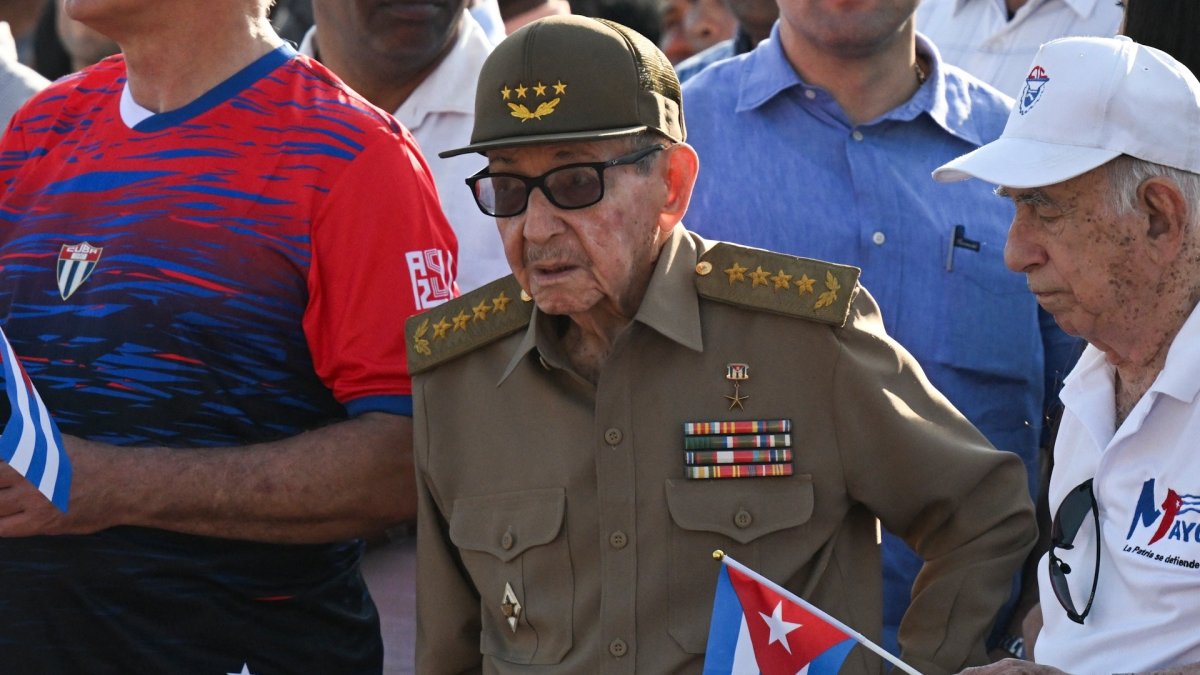
Reports that former Cuban leader Raúl Castro is gravely ill are fueling renewed speculation about the future of Cuba’s leadership and the stability of the country’s ruling establishment.
Castro, 95, is widely viewed by analysts and Cuba watchers as the most influential figure behind the scenes in the communist government, despite no longer serving as Cuba’s head of state.
According to Iliana Lavastida, executive director of Diario Las Américas, sources on the island told her overnight that Castro is in critical condition after suffering a stroke and is being kept alive by medical machines.
NBC 6 has not independently confirmed those reports.
The last public appearance by Castro came on Aug. 13, when he participated in events marking the 100th anniversary of the birth of his brother, Fidel Castro.
A Central Figure in Modern Cuba
Raúl Castro has been one of the most consequential figures in modern Cuban history.
A founding member of the Cuban Revolution, he spent decades serving as defense minister and head of the armed forces while his older brother Fidel Castro led the country. His control of the military gave him enormous influence within the government long before he formally assumed leadership.
Raúl Castro took over as Cuba’s leader in 2008 after Fidel stepped down because of illness and remained president for roughly a decade.
Since Fidel Castro’s death in 2016, experts have frequently described Raúl as the regime’s unifying figure, even after stepping away from formal leadership positions.
Critics Recall Controversial Legacy
For many Cuban exiles and opposition activists, however, Castro’s legacy remains deeply controversial.
“Raúl Castro was outright bloody. He’s been associated with some of the worst massacres in the history of that regime, that dictatorship,” said Orlando Gutiérrez, coordinator of the Assembly of the Cuban Resistance.
Gutiérrez described Castro as the regime’s most important remaining authority figure.
“I think that the different factions that compose the regime, he is their center,” Gutiérrez said. “Even at this age, even with all the years that have passed, Raúl Castro remains as a central figure, as the central figure of that regime.”
Power Behind the Scenes
Although Miguel Díaz-Canel is officially Cuba’s president and first secretary of the Communist Party, analysts have long argued that Raúl Castro continues to wield substantial influence behind the scenes.
Those who closely follow Cuba’s political system often point to Castro’s longstanding ties to the military and the Communist Party as key factors maintaining cohesion within the government.
His potential absence, observers say, could create uncertainty among competing factions inside the Cuban leadership.
Reforms and a Historic Opening
During his tenure as president, Castro oversaw limited economic reforms and a modest opening of Cuba’s economy.
He also welcomed two popes to the island and played a central role in one of the most significant diplomatic developments in recent Cuban history.
In 2014, Castro and President Barack Obama stunned the world by announcing the restoration of diplomatic relations between the United States and Cuba, ending decades of Cold War-era hostility.
Indictment in the United States
Earlier this year, the U.S. Department of Justice announced an indictment against Castro related to the 1996 shootdown of two Brothers to the Rescue aircraft over international waters.
Federal prosecutors allege that while serving as Cuba’s defense minister, Castro was part of the chain of command that authorized the operation. Four men were killed in the incident.
Castro has not appeared before a U.S. court, and Cuban authorities have long rejected U.S. efforts to hold Cuban officials responsible for the shootdown.
Questions About Cuba’s Future
The reports about Castro’s health have also renewed attention on Raúl Guillermo Rodríguez Castro, the former leader’s grandson, who is known in Cuba by the nickname “El Cangrejo,” or “The Crab.”
There has been speculation that he has been involved in recent discussions with the United States, though those talks have reportedly stalled.