
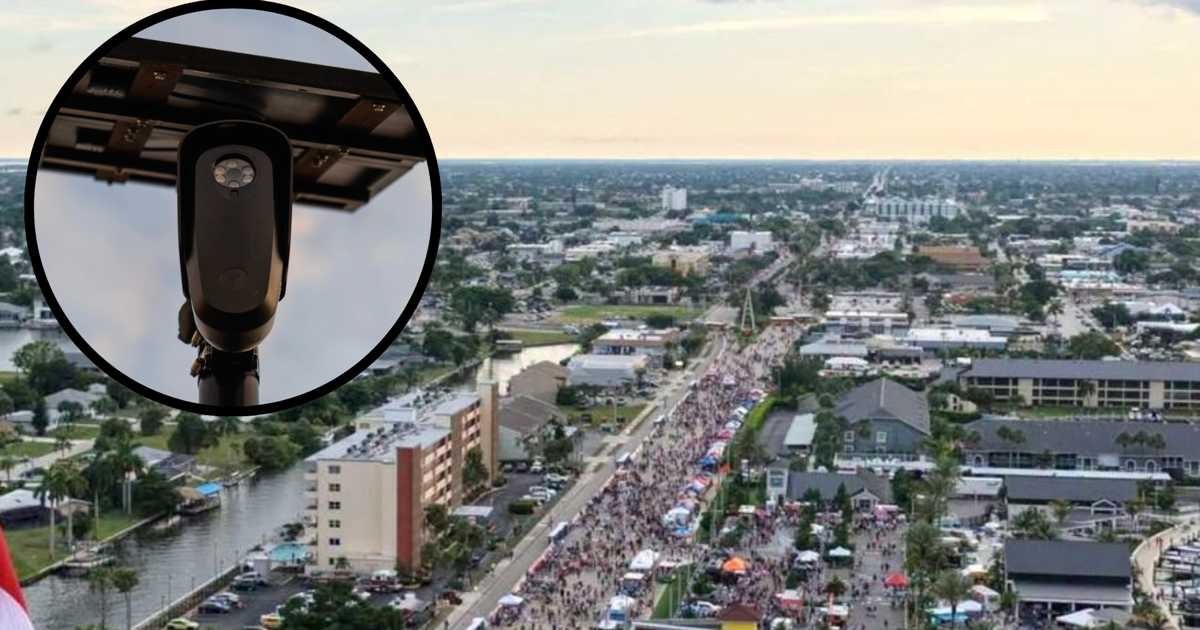
CAPE CORAL, Fla. (WINK) — The Cape Coral Police Department is discontinuing its use of automated license plate reader technology after more than 10 years, Chief Anthony Sizemore said.
The move comes as Florida officials take new action involving automated license plate readers, including FDOT’s decision to revoke permits for the technology on state roads.
RELATED: Another Flock camera torn down in Cape Coral as backlash grows
The department has used automated license plate readers, or ALPRs, for more than a decade to help solve crimes, locate stolen vehicles and find missing people, Sizemore said.
“It has played a role in multiple homicide investigations, helping us identify and apprehend violent offenders who are now serving life sentences in prison,” Sizemore explained.
Sizemore said the technology has been effective but acknowledged legitimate questions about privacy, data retention and accountability. He said the department developed policies over the years to ensure constitutional protections were maintained.
The decision comes as Florida officials take new action involving ALPR technology.
On Monday, the Florida Department of Transportation announced it was revoking permits for ALPRs on state roads and would no longer approve new requests. Existing permits are revoked immediately, with local agencies given 30 days to remove devices from state highway rights-of-way.
RELATED: FDOT revokes permits for automated license plate readers on state roads, halts future approvals
FDOT said the decision was prompted by an increase in ALPR deployments, reports of misuse, data privacy concerns and surveillance schemes.
Sizemore said Cape Coral’s decision is not based on concerns about abuse or misuse of the technology within the department.
“I don’t believe local law enforcement should be left to navigate that uncertainty on its own,” Sizemore said.
He said the legislature needs to establish clear standards for how ALPR technology is used and how constitutional rights are protected.
“Give law enforcement the guardrails. Establish the standards. Define the accountability. Protect individual constitutional rights. Then let us do our jobs,” Sizemore said.
Sizemore said the current approach leaves individual municipalities to develop their own policies without consistent statewide standards.
The department will wait for lawmakers to establish guidelines before determining whether ALPR technology can return to service, Sizemore said.
“We don’t have to choose between public safety and constitutional rights. We have an obligation to protect both,” Sizemore said.
Local agencies react to FDOT revoking ALPR permits
In a statement, Charlotte County Sheriff Bill Prummell suggested the decision to roll back the use of the license plate reader tech on the state level will hurt law enforcement efforts.
“I am very disappointed. Today the criminals are jumping up and down for joy. Again, politicians are having knee jerk reactions to something that really isn’t a problem and not looking at what the true benefit of this technology is and how it is being used. If there are people abusing this system, we need to hold them accountable just like we do for any other criminal justice system they have access to,” Prummell said in a statement. “But you just seriously crippled law enforcement by limiting the use of a great crime fighting tool. Criminals are using technology to commit crime, and we need to use it to catch them. We are seeing all-time low crime rates and all-time high clearance rates because of it,” he added.
Meanwhile, the Lee County Sheriff’s Office issued its own statement following the announcement in Cape Coral.
“There is no doubt that technology can be a double edged sword. While it has helped us in major investigations and locating missing persons, we must understand the general public’s fear of misuse,” said Sheriff Carmine Marceno. “We will comply with the orders by our State partners while the legislature straightens the rules and regulations regarding the use of certain technologies. Our hope is that they move quickly as to not jeopardize public safety,” he added.
LCSO issued a separate statement on Monday after FDOT’s memo.
WINK News is working to get statements from local governments and other entities on the changes.