
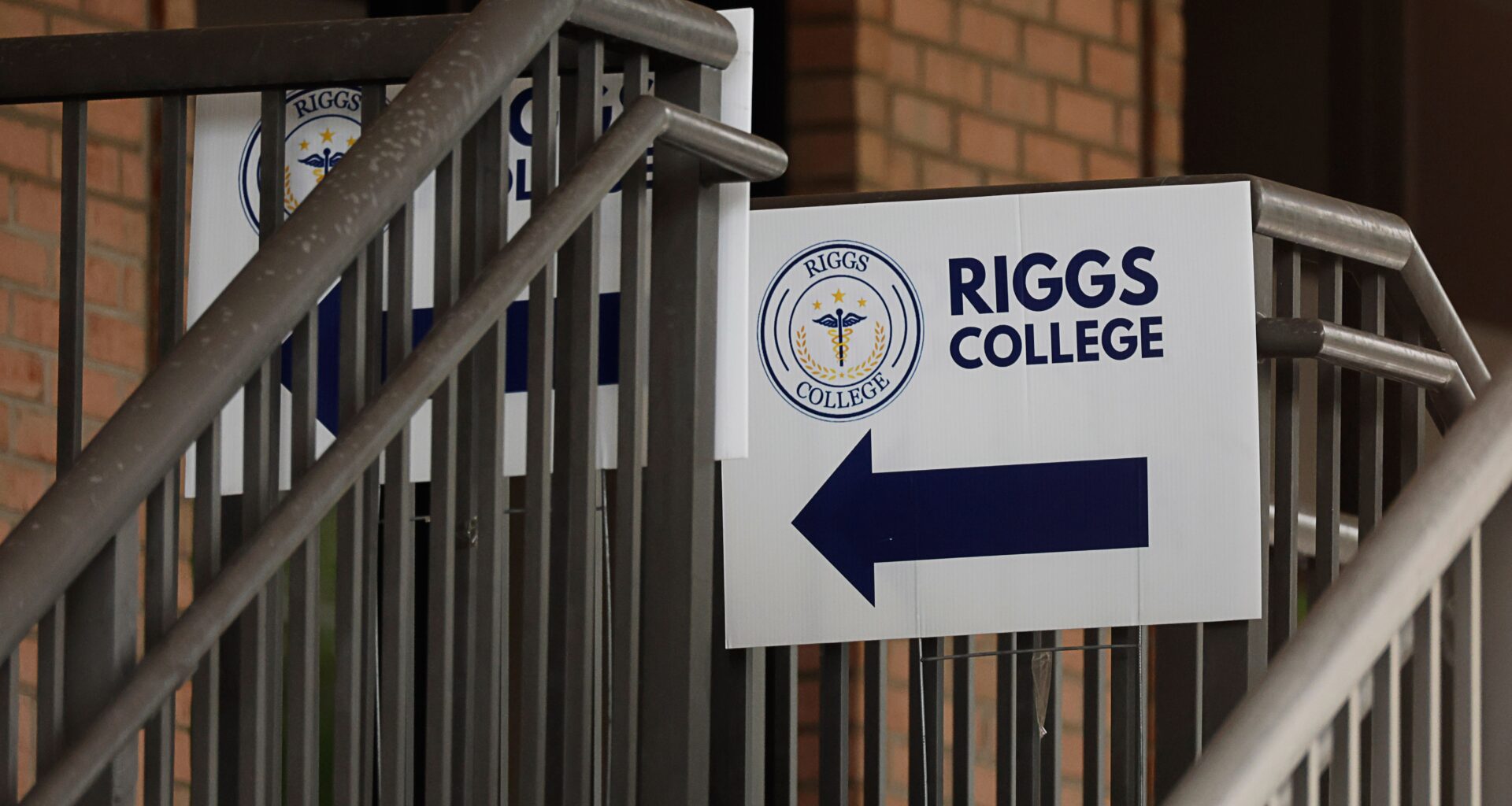
An unaccredited nursing school that operates out of a Longwood office plaza was “deceptive” and “systematically misled” students, failing to provide them proper clinical training, arbitrarily stopping some from graduating and collecting steep tuition while failing to deliver the education it promised, according to a lawsuit recently filed by four former students.
Riggs College of Allied Health Sciences, which opened in 2020, has had a troubled run, with the state placing it on probation last year and then in May limiting how many new students could enroll. Both actions were taken because few of its graduates were passing the national licensing exam required to work as a registered nurse.
Of the nine first-time test-takers who have have sat for the exam this year, just two have passed, according to data available on the Florida Board of Nursing’s website.
And the Seminole County school stopped other students — even if they had completed the required coursework — from taking the National Council Licensure Examination, often called the NCLEX, according to the students’ lawsuit filed in Seminole County Circuit Court.
It’s not clear why Riggs might have prevented the plaintiffs from sitting for the exam, but the lawsuit says the school engaged in “arbitrary and selective enforcement of academic policies,” allowing some of their classmates to graduate and test even though they failed to meet required benchmarks. The students who filed the suit, on the other hand, were not able to take the exam even though they had meet the school’s published requirements, it says.
The students are seeking compensation for tuition, fees, out-of-pocket expenses and lost wages, as well as a judge’s declaration that they are eligible to take the NCLEX.
The lawsuit also alleges Riggs misrepresented the length of its program, telling students already licensed as practical nurses that they could become registered nurses within 15 to 16 months — and then routinely extending students’ coursework to two, three or four years. It also placed students for their clinical hours in long-term care facilities that were “inconsistent with RN program requirements,” it said
The suit names Riggs, its owner and president Oladimeji Adekunle, and its owner and administrator Abiola Adekunle as defendants. Ali Kamalzadeh, an attorney representing the school, declined to comment on the details of the students’ allegations but wrote in a statement the claims “have not been tested, adjudicated, or answered.”
“My clients dispute the allegations, believe they are not supported by the facts or the applicable law, and intend to defend against them vigorously through the ordinary course of litigation, where the claims will be evaluated under the rules of evidence,” Kamalzadeh wrote.
Riggs is a local example of the poorly performing schools that have opened in Florida since 2009, when the state eased requirements for new programs to offer nursing classes. Seeking to address the state’s nursing shortage, lawmakers opened the door for more private, for-profit schools to set up shop in Florida, resulting in hundreds of new schools enrolling students over the past 15 years. Riggs College, located in a professional complex off State Road 434, was among the newcomers.
But the law also made it easier for shoddy places to open, harder for the state to close problematic schools and led to a nationwide scandal when the FBI and federal prosecutors in their 2023 Operation Nightingale probe charged dozens of Florida school operators with selling more than 7,000 phony nursing diplomas.
Three of the four Riggs students listed as plaintiffs live out-of-state; the fourth is from Orlando. All were enrolled in a program for licensed practical nurses seeking to upgrade their credentials so they could work as registered nurses, which requires more advanced knowledge and skills and typically commands a higher salary.
The students “shared a lot of the same experiences and frustrations with delays and administrative mismanagement,” said their attorney Robert Mactavish.
“Their experiences have a lot in common with each other,” Mactavish said. “It’s a reflection of Riggs College’s struggles to provide a quality nursing education for their students.”
One of the students, a woman from North Charleston, South Carolina, paid more than $18,000 for her studies at Riggs, completed her coursework with a 3.06 grade-point average and then was dismissed from the school “without cause and without any written explanation,” the lawsuit says. She was thus unable to take the NCLEX and obtain licensure needed to work as a registered nurse.
The suit was filed in July, shortly after the Commission for Independent Education, a division of the state education department that oversees unaccredited schools, told Riggs — then already on probation — that it could remain open though its students have performed poorly on the licensure exam for nurses since it opened six years ago. At their May 28 meeting, members of the commission asked pointed questions of Riggs founder Oladimeji Adekunle and sounded dismayed by the school’s performance.
But then they chose only to limit the number of new students who could enroll, setting a cap of no more than 40 new ones a year in its programs for prospective registered nurses.
Riggs was not Adekunle’s first foray into nursing education. In 2011, he and his former school, America Health Care Inc., were sued by Pennsylvania after Adekunle tried to open a nursing program without obtaining that state’s approval. He collected application and registration fees from 25 prospective students, as well as tuition deposits, and shuttered the operation without starting classes, the state said. A judge ultimately sided with Pennsylvania and determined the school had violated the law. As a result, Adekunle and the school were ordered to pay $100,000 in civil penalties and were banned from offering educational services in that state.
It’s not clear whether Florida’s nursing board knew about the Pennsylvania case when it approved Adekunle’s bid to open a school here. However, the agency’s website cautions it is “not authorized to conduct site visits, and oversight of approved nursing education program quality measures is limited by Florida law,” and directs complaints to the Commission for Independent Education.
Mactavish said Florida’s public nursing programs seem better regulated than its private ones, and if he were a prospective student, he would start his school search there.
“I would pick out a, maybe look at the state nursing schools first in light of all of the problems that Florida private nursing schools have seen with the Operation Nightingale criminal indictments and schools like Riggs struggling to meet the needs of their students,” he said.
Riggs is more expensive than local public universities and colleges. The for-profit school charges tuition of $439 per credit hour, according to its website, which also notes it does not offer financial aid. And because Riggs is not accredited, students can’t use federal grants or subsidized loans to help pay for classes.
Seminole State College, by comparison, charges $104 per credit hour for in-state students, who are also eligible for state and federal financial aid. And Seminole State graduates who took the NCLEX exam during the first two quarters of this year were much more likely to pass it the first time, with a 92% passage rate compared to Riggs’ 22%. But like other public colleges, Seminole State doe not have enough seats in its programs for all of its applicants and has had to turn away prospective students.
anmartin@orlandosentinel.com