
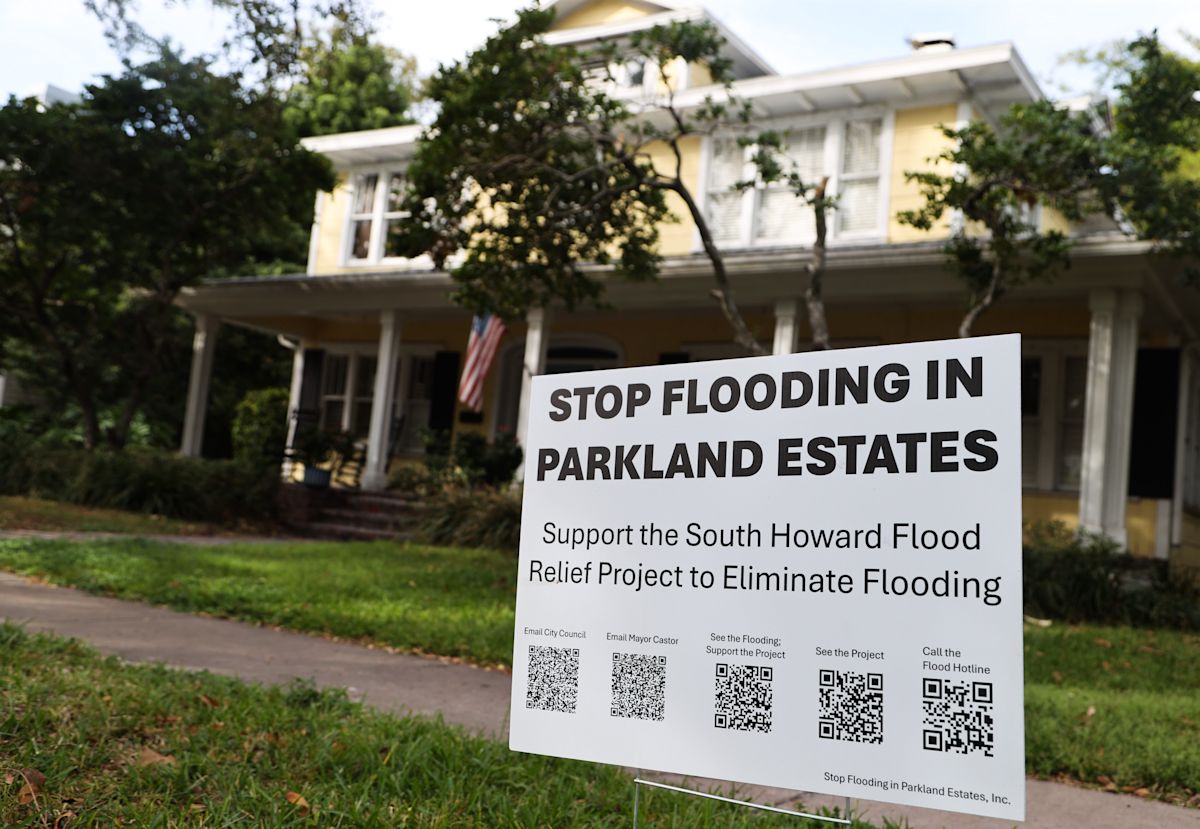
No one wants their streets to flood.
But in South Tampa, a city project intended to alleviate persistent flooding has for years divided neighbors and businesses, city staff and city council members. This month, the Tampa City Council will decide its fate.
“It is the dark cloud looming over the 2027 budget for stormwater,” council chairperson Alan Clendenin said of the South Howard Flood Relief Project, which council members will discuss Thursday and vote on later this month.
An affirmative vote would propel the $100.4 million effort toward construction. Denial would kill it.
City engineers say adding a box culvert system along stretches of South Howard Avenue and West Swann Avenuewould suck water away from Parkland Estates, Palma Ceia Pines and surrounding neighborhoods that flood during even short bursts of rain.
Many flood-fatigued residents say they trust the city’s plan and accuse the opposition of spreading misinformation. They are exhausted, they say, and question why approval has stalled.
A group of business owners on South Howard, meanwhile, worry planned street closures could spell disruptions for their shops and restaurants. They are suing the city over public records tied to the project and have raised alarms about the cost, which ballooned from $64 million in 2022 to more than $100 million this year, with some funding sources not yet certain.
Council members are split, too. Year after year, in meeting after meeting, they have circled the same questions: Is the plan too costly? Will it work? How can the city protect some of its residentswithout hurting others?
“Where do we find that balance of cost versus benefit?” Clendenin asked at a workshop in August. “I think we’re dangerously close.”
‘I trust the engineers’
David Adams stood at his kitchen counter, stacks of printed pictures, highlighted engineering studies and personal testimonies spread before him — the archives of an advocate who has pushed for a new stormwater system for more than a decade.
Adams’ Parkland Estates property first flooded in 2015, when 2 feet of water swamped his garage. Nine years later, water rushed inside his 1930s home during Hurricane Milton, warping his wood floors and molding family photographs.
Now, every summer storm spikes his anxiety. A few inches of rain turn his street into a river so swift that, Adams often jokes, he needs a “no wake” sign in front of his porch. Bouts of rain last month stalled cars and sent garbage cans floating down nearby West Swann Avenue.

Like many of his neighbors, David Adams’ house flooded during Hurricane Milton in 2024.
“I’m stuck with this,” Adams said, gesturing to the dozens of documents. If city leaders deny the project, he said, he would consider building a concrete wall with a floodgate around his property.
“Is that good for my neighbors? Absolutely not,” he said. “But if the city won’t protect me, I have to protect myself. I don’t know what else to do.”
For many in Tampa Bay, the prospect of flooding is part of the calculus of living in a low-lying part of a low-lying state. But Adams said his home is 18 feet above sea level and falls in Zone X — a federal designation that means it should have alow chance of flooding. Flood insurance is not required.
City engineers say Parkland Estates and Palma Ceia Pines are vulnerable because of their topography: Shaped like agiant bowl, the neighborhoods collect waterthat can’t escape through small, aging pipes.
A box culvert system running up South Howard Avenue would act as an underground river flowing into the bay, they say. Led by Kimmins Contracting Corp., the work would begin at Bayshore Boulevard and inch north toward the affected neighborhoods. It is designed to handle up to 5 inches of rain over eight hours — not a major storm like Milton. Still, city staff say it could help minimize hurricane damage.
“I trust the engineers,” Adams, a lawyer, said. “They’ve done their homework and they’ve gotten the data they need.”

Parkland Estates flooded during two summer storms last month.
For years, Adams and his neighbors have pleaded for support at City Council meetings and in emails to Mayor Jane Castor’s office. In January, a group showed up to a council meeting wearing T-shirts that read, “Stop flooding in Parkland Estates and Palma Ceia Pines.”
There was a homeowner who said she chose to live in the area because she thought it was unlikely to flood. A father who spoke of the financial and emotional toll of the damage. A teenager who cried as she told council members that she worries every time it rains.
In an email to city leaders last month, resident Prianka Gerrish made another urgent plea.
“We had a hard rain today … and the amount of flooding, idiot people weaving in and out of our streets causing huge wakes of water coming up to our home, and THE INABILITY FOR US TO ACCESS THE HOSPITAL BC OF IMPASSABLE ROADS, has all become untenable,” Gerrish wrote.
After years of asking for a solution, she said, residents are exhausted.
Business owners push back
Opponents of the project don’t dispute the need for flood prevention.
But they worry about the chosen route, which would require closing sections of bustling, two-lane South Howard Avenue. They say the cost of helping several hundred homes could drain the entire city’s stormwater budget. They cast doubt on the science.
Natalie Rougiétold the Tampa Bay Timesshe fears the project would damage the century-old bungalow off South Howard where she runs her acupuncture practice, Palm Wellness. For a business that prioritizes relaxation, she said, noise is also a concern.
“But why this project is so concerning to me is because there is a total lack of transparency,” she said.

A sign on the curb in front of Bern’s Steak House on South Howard Avenue.
In June, a business group filed a lawsuit accusing the city of withholding public records tied to the project, which, it said, would “impose years of major construction activity, traffic disruption, and business interruption.” In sworn depositions this summer, lawyers for the SoHo Business Alliance questioned project leaders on the proposed funding, construction plans and economic impacts.
Leaders of the business group on Tuesday presented more than a dozen reasons why the city should abandon the project in its current form. They gathered at the Epicurean Hotel on South Howard for an hourlong news conference.
City officials have touted funding that is not guaranteed, said Ed de la Parte, general counsel for the alliance. Stephen Michelini, the group’s general manager, said city leaders have misled residents and neglected to study alternative routes. Another point of contention is Palma Ceia Pines, which dissenters say won’t feel relief from the first phase of the project.
“One of the things that really is disturbing is that you’ve taken people’s hopes and dreams of a solution and you’ve sold them, basically, a project that doesn’t work,” Michelini said.
Engineer David DeLoach proposed an alternative on behalf of the business group that he said would be faster, cheaper, include Palma Ceia Pines and avoid South Howard altogether. His plan would involve underground storage vaults in the affected neighborhoods and upgrades to an existing drainage system.
“Unfortunately, it does have some major red flags,” said Brandon Campbell, Tampa’s mobility director. Speaking with reporters outside the Epicurean Hotel after the business group’s news conference, Campbell disputed the critiques and said DeLoach’s proposal would not meet the city’s flood relief goals.
“We’ve studied about two dozen alternatives over the last 18 months, and we have selected the best way forward,” he said.
Michelini, who stood on the fringes, scoffed and shook his head.

Ed de la Parte, counsel to the SoHo Business Alliance, listed more than a dozen reasons city leaders should reject the flood project at a news conference on Tuesday.
Council members remain undecided
Skepticism has taken root among some council members, too.
The seven-member group is set to discuss a $92.7 million guaranteed maximum construction price for the project Thursday and take a final vote on Sept. 17. That number does not include $7.7 million already approved for design.
If the vote fails, city leaders say, the project will be killed.
Previous council votes have been tight. In a crucial January decision, the group voted 4-3 to approve a slice of project funding with council members Bill Carlson, Guido Maniscalco and Naya Young voting no.
Carlson, whose district covers the area, has called the project a “boondoggle that’s not going to work.”
In the months since, several council members who previously voted in favor of the plan have raised questions about funding, which would come from a patchwork of city, state and federal buckets. When presented with the $100.4 million total price at a budget workshop last month, Clendenin said, “Ouch.”

Tampa City Council chairperson Alan Clendenin has questioned the project’s $100 million price.
Tampa’s chief financial officer, Dennis Rogero, said the plan includes $33 million from a stormwater fee assessed on taxpayers, $31.6 million in bonds, $3.1 million in existing stormwater bond proceeds, $11.9 million redirected from other stormwater projects, $11 million from the Tampa Hillsborough Expressway Authority and a $10 million Florida Department of Environmental Protection grant.
But several of those sources have yet to be approved, including the expressway authority money. Council members also asked if approving the project would mean cutting stormwater funding across the city. They questioned the state grant because it is reimbursable, meaning the city won’t get money until it spends dollars of its own.
“When do we get to a point that it’s not financially prudent to invest this much money into culverts?” Clendenin asked. “I understand that the project is a good project, but there’s lots of good projects. Sometimes we can’t afford them.”
Council member Charlie Miranda, who has previously supported the plan, told the Times he remains uncertain. He compared the decision to the Tampa Bay Rays’ $2.3 billion baseball stadium, approved last week by the City Council and Hillsborough County Commission.
“I never expected the Rays to get what they got, and they got everything they wanted,” said Miranda, a staunch stadium opponent. “It’s the same basic thing. You can’t ask for everything at one time. The people can’t afford it.”
Still, Miranda said, the flooding needs to be fixed.
“How would I feel,” he said, “if I lived where it flooded?”