
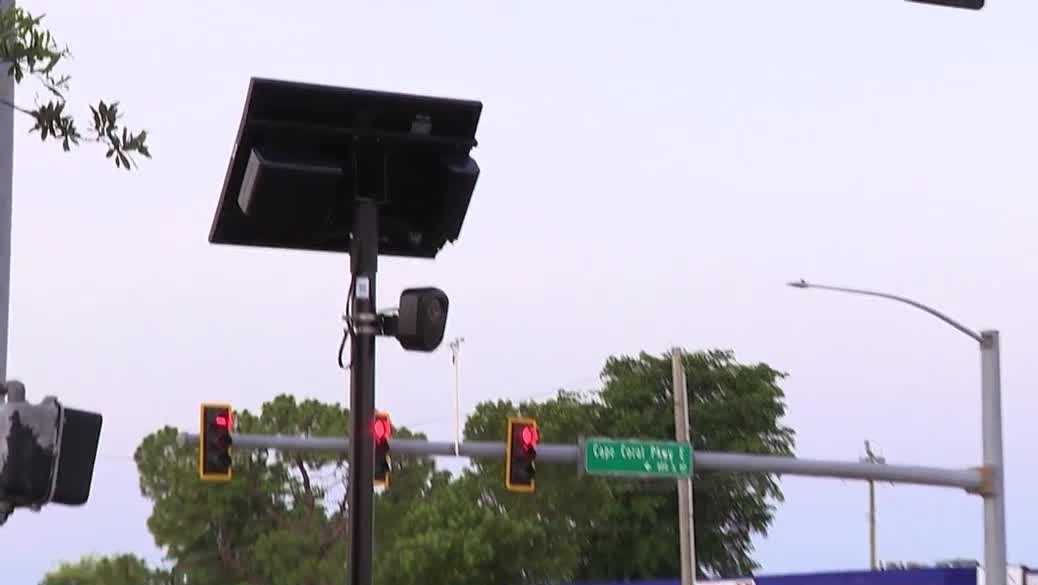
Cape Coral police chief sits down to answer questions regarding removal of license plate readers
 CAPE CORAL, Fla. —
Chief of police for the Cape Coral Police Department Anthony Sizemore held a Q and A session on the removal of automated license plate reader cameras in the city on Wednesday.
During the session Sizemore spoke about what the department has been using LPRs for in the past, and what the removal of them means for how the department conducts it’s investigations.
“To say that there would be no impact would be naive,” Sizemore said.
As of Tuesday’s announcement, all LPRs in the city have been shut down, according to Sizemore.
He also emphasized that the department has been using LPR technology for a decade, and that there have been no reported instances of abuse of that technology on behalf of any CCPD officers.
“We’ve been good stewards of that information for a decade,” Sizemore said.
Sizemore said that he is confident that lawmakers can come to a quick decision regarding guidelines and policies regarding how law enforcement agencies can use LPR technology before reinstating their use across the city.
Sizemore sent out a statement on the department’s decision to remove LPRs from the city on Tuesday. The statement reads:
For more than a decade, the Cape Coral Police Department has responsibly utilized Automated License Plate Reader (ALPR) technology as one of many tools available to our officers and investigators.
During that time, ALPR technology has helped us solve countless crimes and develop investigative leads that otherwise may not have existed. It has played a role in multiple homicide investigations, helping us identify and apprehend violent offenders who are now serving life sentences in prison.
It has helped us locate stolen vehicles, identify suspects, find missing people, and ultimately hold criminals accountable.
It is a tool. Nothing more—and nothing less.
It doesn’t replace good police work. It makes good police work more effective.
I also recognize that there are legitimate questions surrounding ALPR technology, including privacy, data retention, access, sharing, and accountability. Those questions deserve thoughtful answers and appropriate safeguards.
At the Cape Coral Police Department, we have spent more than a decade developing policies and practices designed to ensure this technology is used responsibly, and in a manner consistent with the constitutional rights of the people we serve.
But the environment in Florida has changed.
Our Governor has made his position on ALPR technology clear: He supports law enforcement and its mission, but wants the Legislature to establish safeguards and guardrails by drafting state law governing the use of this technology.
The Florida Department of Transportation has taken actions affecting the use of this technology on state roadways. At the same time, there remains a lack of clear and consistent statewide statutory guidance establishing the rules under which law enforcement agencies should operate.
I don’t believe local law enforcement should be left to navigate that uncertainty on its own.
For that reason, I have made the decision to discontinue the use of ALPR technology by the Cape Coral Police Department.
This is not because I believe the technology is inherently bad.
It is not because I believe it has been abused here.
And it certainly isn’t because I believe we should abandon a tool that has proven itself over and over again in solving crime and protecting our community.
I’m doing it because I believe the time has come for our elected officials in Tallahassee to establish a clear legal framework for the responsible use of this technology.
Give law enforcement the guardrails.
Establish the standards.
Define the accountability.
Protect individual constitutional rights.
Then let us do our jobs.
At some point, we have to stop asking local law enforcement agencies to navigate this issue in a vacuum. If the state believes this technology requires additional safeguards—and I believe reasonable safeguards are appropriate—then it is time for the Legislature to establish them.
That is what legislatures do. They establish the law. Law enforcement leaders then operate within that framework.
I don’t believe it serves Floridians to have a patchwork of policies and prohibitions developed independently by individual municipalities, often without the benefit of the operational experience necessary to understand how this technology is actually used.
Decisions about the operational use of law enforcement technology are best made by the law enforcement professionals responsible for public safety, within a clear legal framework established by the State Legislature.
I took an oath to support and defend the Constitution of the United States, and I take that oath seriously. I would never implement a program, policy, or technology that runs afoul of that oath or the constitutional rights it protects.
Every sworn member of the Cape Coral Police Department takes that same oath.
And every officer who takes that oath in our department is administered that oath personally by me.
That matters.
Technology doesn’t change our obligation to the Constitution. It also doesn’t change our responsibility to protect the people we serve. And it doesn’t give us permission to compromise either.
So for now, we will step back.
We will wait for our lawmakers to establish the framework.
And when that framework is in place, we will evaluate it carefully and determine how—and whether—ALPR technology can be responsibly returned to service.
I remain hopeful that it will be.
Because I believe we can protect individual rights and give law enforcement the tools necessary to protect our communities.
We don’t have to choose between public safety and constitutional rights.
We have an obligation to protect both.
For more than ten years, we have demonstrated that ALPR technology can be used as a responsible law enforcement tool while respecting those principles.
I am confident that our policymakers will recognize that, establish the appropriate framework, and allow professional law enforcement leaders to do what we have been entrusted to do.
Protect our communities. Solve crime. Save lives. And uphold the Constitution.
That’s the job. And that’s what we’ll continue to do.
WATCH THE FULL CONFERENCE IN THE PLAYER ABOVE
DOWNLOAD the free Gulf Coast News app for your latest news and alerts on breaking news, weather, sports, entertainment, and more on your phone or tablet. And check out the Very Local Gulf Coast app to stream news, entertainment and original programming on your TV