
As the state’s higher education board looks to prevent too many out-of-state students from enrolling into Florida’s public universities, many of the university presidents and board chairs are on the same page against the effort.
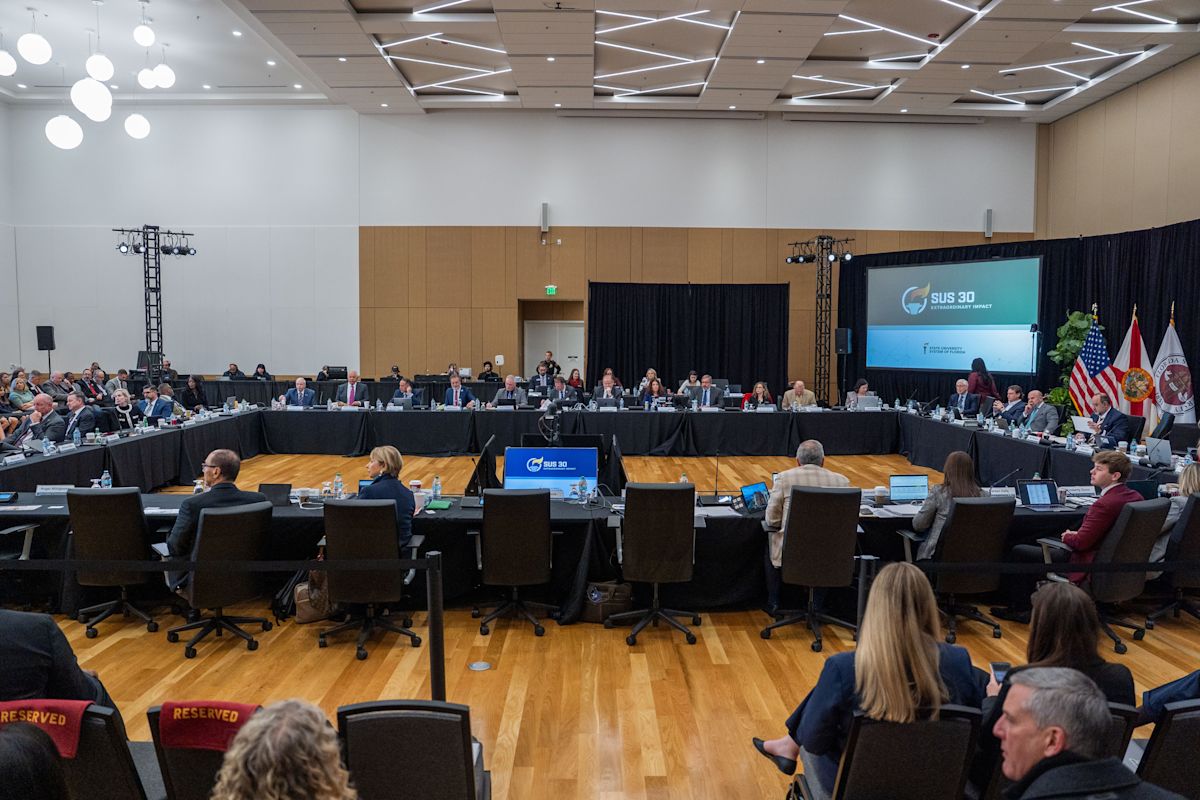
The Florida Board of Governors discussed undergraduate enrollment during a Sept. 3 meeting on Florida Gulf Coast University’s campus as they consider regulation amendments that would allow it to withhold the approval of out-of-state fee increases for nonresidential undergraduate students. The effort comes as a directive from the Florida Legislature to align with HB 5601-E, which Gov. Ron DeSantis approved in June.
Speaking up against the proposed amendment, Florida State University Board of Trustees Chair Peter Collins said it’s “awkward” and “ham-fisted.”
“It’s a solution to a problem that I’m not sure we want to solve,” Collins told the governing board Thursday. “I don’t want one or two percent of out-of-state or out-of-the-country students. What are we learning if we’re just going to school with our neighbors?”

FSU’s Board of Trustees chair Peter Collins speaks during a board meeting at the Turnbull Conference Center on campus on August 29, 2025.
SUS universities annually update their accountability plan with the percentage of nonresident undergraduate degree-seeking students enrolled during the prior year. But if the board determines a university has enrolled a greater percentage of students than what was projected, it will require corrective action − including a revised accountability plan, an enrollment reduction plan or a reduced undergraduate out-of-state fee.
“We will do what we are told to do, but I just don’t think this is the right approach to where we are in climbing in excellence,” FSU President Richard McCullough told the board. “The changes in the percentage of out-of-state students is rising and is unpredictable, so enrollment is completely the wrong parameter, in my opinion.”

Florida State University President Richard McCullough attends the Board of Governors meeting on Thursday, Jan. 29, 2026.
FSU had 12% of its student come from outside of Florida in the past two years, and the projected percentage for the next few years is 13%, according to the university’s 2026 accountability plan. At Florida A&M University, 22% were out-of-state students in the past two years while the projected percentage for the next few years is 20%.
Despite FSU and other universities recently increasing out-of-state tuition costs by 15% for this fall as a directive from the Board of Governors, Florida still has one of the lowest out-of-state tuition costs in the country.
Collins said legislators think universities want to admit more out-of-state students because they’ll get more money from them when considering how their tuition costs are higher compared to the costs for in-state students, but he said “that’s just not true.”
“If you want to pull a lever, pull that lever – but it’s not because we’re hungry for money,” Collins said. “If you want to slow (enrollment) down, make it more expensive.”
Florida Atlantic University President Adam Hasner said the wrong category in the process of admitting students is being considered by state legislators since enrollment “is not within the power of the universities.”
“We don’t control enrollment – we control admissions,” Hasner, a former House member said during the board meeting. “Once we’ve admitted students, we can’t control which students are going to accept that offer of admission. That’s what ultimately puts some of the universities one or two percent higher in our out-of-state percentage.”

Florida Atlantic University President Adam Hasner, right, speaks during a press event where Governor Ron DeSantis, left, proposed a new college and university accreditation process for the state’s university system at FAU in Boca Raton, Fla., on June 26, 2025.
During discussions, Board of Governors Chair Alan Levine admittedly referred to the proposed amendment as a “sledgehammer” that would impact what the university’s future enrollment goals are when considering projected numbers for out-of-state and in-state students.
“They don’t have total control over enrollment,” Levine told the board, referring to the universities. “But if we don’t have the policy leverage to make decisions for each of our institutions… that’s a disservice.”

Board of Governors Chair Alan Levine speaks to the members of the Board of Governors during a meeting in the student union at Florida State University on Thursday, Jan. 29, 2026.
With FAMU being a smaller sized institution compared to flagship universities like FSU and the University of Florida – where it has an enrollment count of about 8,000 students this fall compared to over 45,000 students at FSU and over 50,000 at UF – FAMU President Marva Johnson reminded the board that a solution to the out-of-state enrollment issue that may work for one university may not work for another.
“I just want to make sure we’re looking at solutions that fit each school instead of trying to do a one-size-fits-all solution,” Johnson told the board.
Levine said the governing board will work with university board chairs on the language that will be used in the amended policy, and that he hopes they will be able to “land on an agreed position” about the proposed amendment. The Board of Governors will meet on Sept. 30 on UF’s campus to take up the item.
Tarah Jean can be reached at tjean@tallahassee.com. Follow her on X: @tarahjean_.
This article originally appeared on Tallahassee Democrat: Florida university leaders voice concerns on out-of-state enrollment