
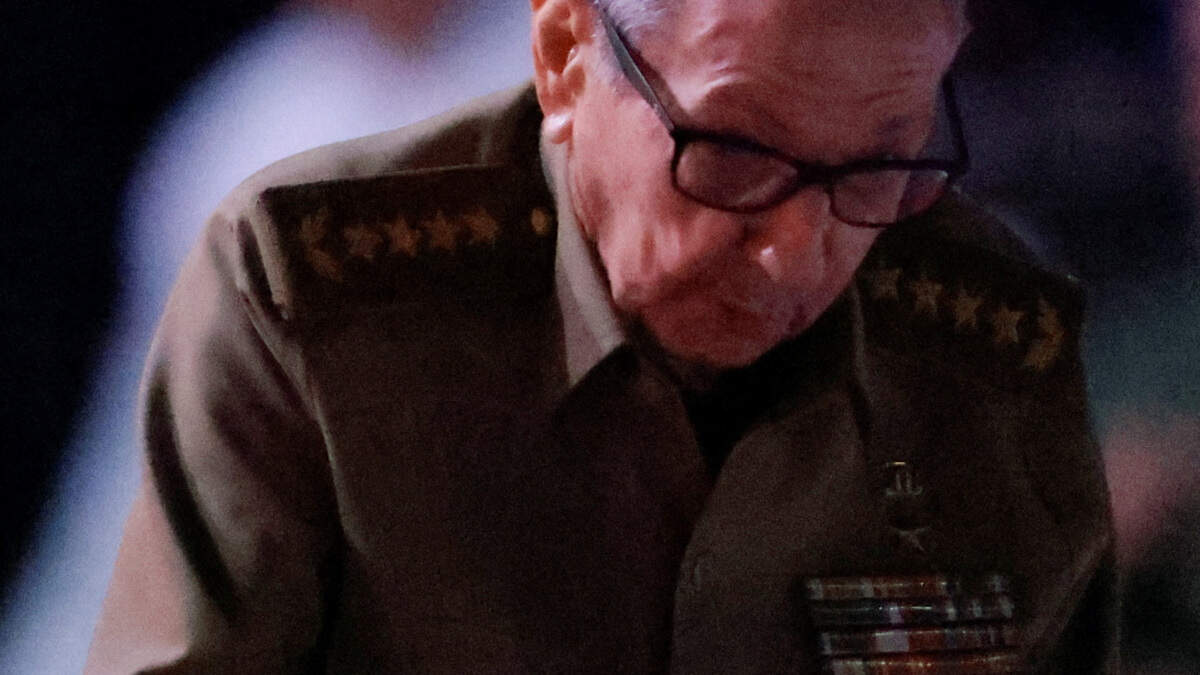
Former Cuban President Raul Castro attends a political and cultural show paying tribute to late Cuban President Fidel Castro in Havana on Aug. 13, 2026.
Norlys Perez
REUTERS
Raul Castro changed my life. Sixty-four years ago, he arranged for the execution by firing squad of my father, Luis Pedro Torroella, in the early morning of Nov. 1, 1962. The place was the maximum security prison of Boniato, seven miles from Santiago de Cuba, on Cuba’s eastern tip.
Raul Castro insisted on watching this execution. I, his daughter, in second grade in North Miami Beach, was 7 years old and unaware.
“Tell her,” my father implored a fellow prisoner who survived, “that I died like a man and that she was in my heart until my very last breath.”
Now, as I enter my seventh decade of life, I know that Raul Castro continues to have significant influence in decisions in Cuba. His time for reckoning, though, is limited at 95. He might have time to make a difference for the good. At the very least, he could inform my family where my father lies buried in anonymity.
Luis Torroella loved his country enough to fight for its freedom. Originally he supported and worked for the revolution that overthrew Fulgencia Batista. After the triumph of the revolution, in those heady days of hope, he began working for the provisional government as assistant minister of finance. He was 27, a recent graduate of Dartmouth College, eager for reforms and a true democratic system. Soon, as civil liberties were extinguished, executions proliferated and communism became entrenched, my father resigned.
Wanting to rid Cuba of communism, he went underground once more. This time, recruited by the CIA, he organized networks of resistance in preparation for the Bay of Pigs.
Writing to my mother, his wife, from hiding, he observed, “You can’t imagine how fast and how completely this country has changed in just two months. …These people are quickly changing a way of life that has existed for generations. …The most frightening and horrible part is that the foundation is hate. Every act, every law now is motivated by hate. “
Cuba is governed by hate. How else to explain the hundreds of dissidents killed or imprisoned, the lack of food, of electricity, of basic necessities? How to explain the lack of freedom or the neighborhood committees that spy on their neighbors and report back to the Committee for the Revolution?
When he was arrested, my father was accused of being an enemy of the state. Later, at his sham trial, he was charged with orchestrating an assassination attempt on the life of Fidel Castro, although he was in jail at that time. My father was interrogated by Raul Castro and given an ultimatum: supply the names of all his collaborators or die. He had 24 hours.
My father refused to reveal the information that would have meant instant arrest of his colleagues. Raul promised he would die by firing squad and that he himself would be there to watch.
While my father awaited his trial in prison he wrote a letter smuggled to my mother: “The human species is really funny, it has to lose or be deprived of things to appreciate [them]. Walking on grass is a very dear and desired thing when you can’t do it. Many nights I dream of walking with you and the Baby Girl in wide open fields or down a long sandy beach. We will do it yet, don’t worry; then all this will have been a great lesson.”
My father learned the ultimate lesson: socialism or death. It is written upon billboards throughout Cuba. They should say, “Socialism IS death” for that is what it is.
Raul Castro is near his end. Will he have learned any lesson from his long and wretched life? Will he help repair the mistakes of unrestrained tyranny? He is my enemy and the enemy of Cuba and its people, past and present.
He has ended up making a hero of my father. For 64 years, I’ve missed the man who called me “Baby Girl” and long to see him once again.
And I long, at last, to see Cuba free.
Cynthia Torroella Merrill was born in Havana to her Cuban father, Luis Pedro Torroella, and her American mother, Carole Ambrose Torroella, before the revolution. She worked as a Spanish teacher and librarian and is now retired.