
Tired of finding out about wonderous celestial phenomena after they happen? Thinking maybe you’d stay up and look up if you only knew when?
Well you’ll have no excuse for September, because we’ve rounded up some can’t-miss events in the sky, and several are in the second half of the month.
So plan ahead and seek out a Dark Sky Place to watch these planetary performances.
September Epsilon Perseids (SPE)
Date: Overnight between Sept. 9 and 10
We’re starting off the month with what the American Meteor Society considers a “minor” meteor shower.
Steve Luxenberg, president of the South Florida Amateur Astronomers Association (SFAAA), said this shower occurs at around midnight, and that at best, “only a few meteors are visible per hour.”
But if you’ve decided you want to see them, face northeast from a dark location away from city lights.
“Observing meteor showers requires no telescope, only a chair, bug spray, and patience. Always know where you are going, don’t travel alone, [and] safety is the most important rule,” Luxenberg advises.
Venus headlines with the moon, then reaches peak brilliance
Date: Sept. 14
Find the moon, a beautiful crescent, after sunset, and you’ll see Venus right there with it.
But you’ve got to be quick to catch it, since the planet is setting earlier each evening.
Date: Sept. 18
A few days later, “shortly after sunset, Venus will stand out as a brilliant point of light low above the western horizon, outshining every star around it,” NASA says in its skywatching tips for the month. “A clear view of the horizon will give you the best chance to catch it before it sets.”
Astronomy.com says the planet will be “gone within about an hour of sunset.”
Autumnal equinox
Date: Sept. 22
Despite the return of pumpkin-flavored everything, the skies say it’s not yet fall.
That’s not until the September equinox, “when the Sun is directly above Earth’s equator and day and night are close to equal in length around the world,” NASA says.
So while there won’t be a particular display to look for in the night sky, just know this marks the moment that nights start to get longer and longer in the northern hemisphere.
Meanwhile, for our friends in the southern hemisphere, the September equinox ushers in spring.
Neptune at opposition
Date: Sept. 25
Good news for observers in South Florida!
This is the moment when Neptune is going to be directly opposite the sun when viewed from earth, and it’ll be “the best time to see our farthest planet,” according to the University of Arizona’s Flandrau Science Center and Planetarium.
However, it’s too faint to see without binoculars or a telescope… which the Fox Observatory in Sunrise is happy to provide! Yes, it just so happens that Neptune will be at opposition on a Saturday night, when the observatory hosts free public viewings.
Harvest Moon (plus Saturn!)
Date: Sept. 26
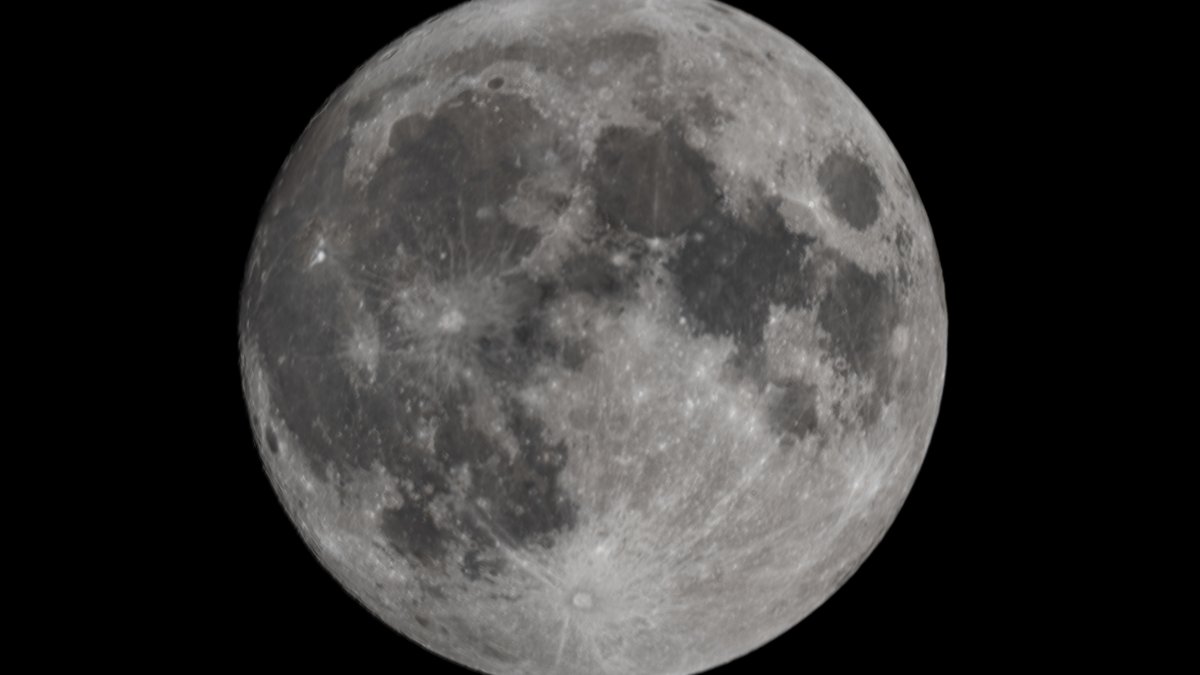
And toward the end of the month, it’s the moon’s time to shine—literally.
The name dates back to a time before electricity, when farmers depended on the moon’s light to harvest their crops late into the evening, according to NASA.
It rises in the east shortly after sunset, and bonus: it won’t be alone.
“Saturn appears nearby, with faint Neptune completing a wide triangle in the sky,” NASA says. “Saturn is the easy one-you can see it with just your eyes. Neptune is a bit more challenging.”
Lorenzo Di Cola/NurPhoto via Getty ImagesLorenzo Di Cola/NurPhoto via Getty Images
(EDITOR’S NOTE: The photo was taken with a reflex camera connected to a telescope) Full harvest moon is seen from L’Aquila, Abruzzo, Italy, on September 28, 2023. Harvest Moon is the full moon that occurs closest to the autumnal equinox. It is a supermoon, which means that it will appear larger and brighter than usual and is last 2023 super moon. (Photo by Lorenzo Di Cola/NurPhoto via Getty Images)
Where to get the best view in the darkest places
Some of these celestial displays you can see from populated areas, but others are best appreciated away from light pollution.
Enter, International Dark Sky Places, a program that “certifies communities, parks, and protected areas around the world that preserve and protect dark sites through responsible lighting policies and public education.”
Florida has several parks with this designation, but only one that’s close to South Florida, Big Cypress National Preserve in Ochopee.
Luckily, while not officially certified, Everglades National Park borders Big Cypress. So if you’ve resolved to see the awe-inspiring celestial events in store for the rest of the year, you don’t have to go too far.