
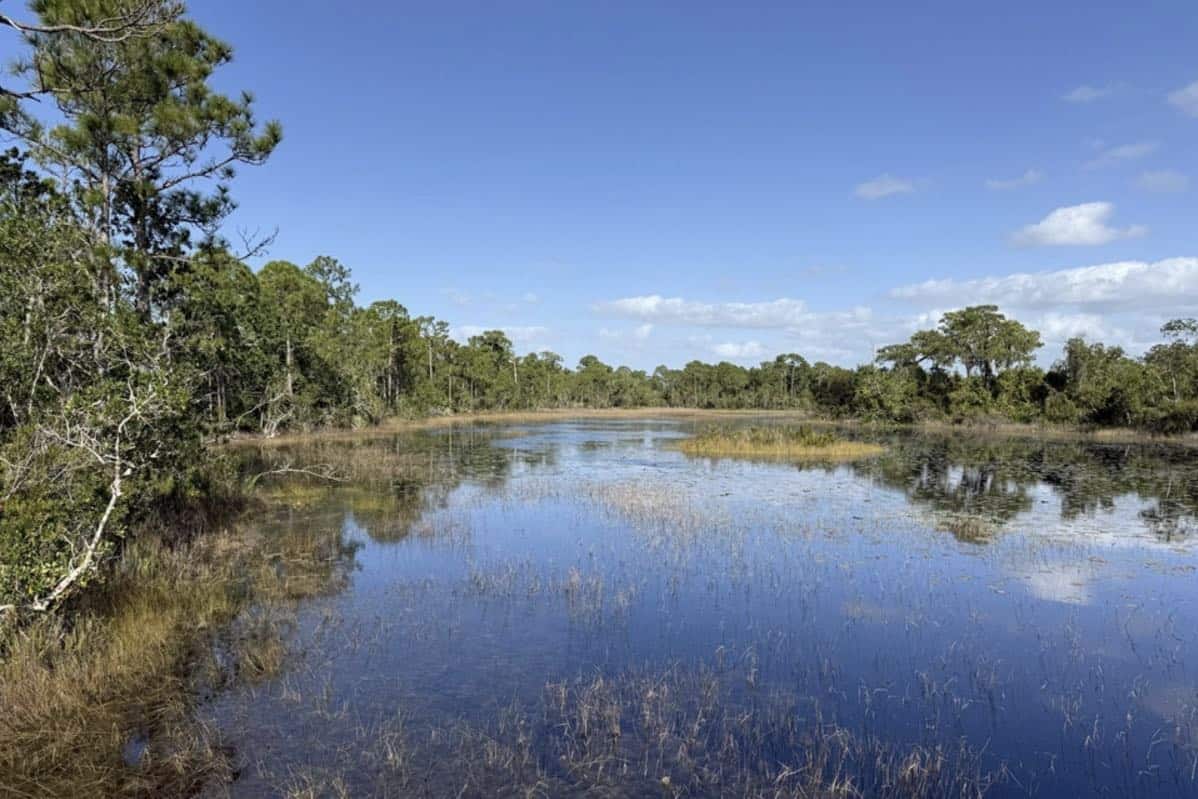
Researchers from Florida Atlantic University have demonstrated that freshwater wetlands trap and move microplastics, highlighting a major pollution challenge for coastal watersheds.
The findings highlight the importance of managing wetlands and the sources of microplastic pollution.
Microplastics Found in Protected Florida Ecosystems
The research was published in the journal Evolving Earth, and the study focused on the Spruce Bluff Preserve, a 97-acre protected wetland along the St. Lucie River in Port St. Lucie, Florida.
The research team analyzed sediment samples from diverse habitats and found microplastics at 95 percent of the sites surveyed. Roughly 88 percent of the detected particles measured under 2.5 millimeters/.098 inches, with synthetic fibers accounting for nearly half of the total.
This clearly points to runoff from urban environments.
Crucially, contamination was not evenly distributed.
The highest densities occurred adjacent to the river’s edge and an engineered flood-control canal. This shows that water flow plays a critical role in determining where synthetic debris travels and settles.
The Importance of the Discovery
Commenting on the findings, senior author Erik Johanson, an associate professor of geosciences at FAU’s Charles E. Schmidt College of Science, stated:
“Perhaps the most striking finding is that the microplastics weren’t simply scattered randomly across the preserve – they appeared to follow the pathways of water. The river edge and flood-control canal had some of the highest concentrations, suggesting that these areas can act as conduits and collection points for plastic moving through the landscape. It shows that even in a protected wetland, what happens upstream can ultimately show up in the sediment.”
Johanson added, highlighting the wider implications of the findings:
“Wetlands are often viewed as places that protect us by filtering what moves through the landscape, but they can also capture and redistribute pollutants. If we want to protect these ecosystems for the long term, we need to understand not only what is entering them, but how water moves that pollution through the system. A protected wetland is not an isolated wetland – it is connected to everything upstream and downstream through the movement of water.”
You can read the original research in Evolving Earth for more information.