
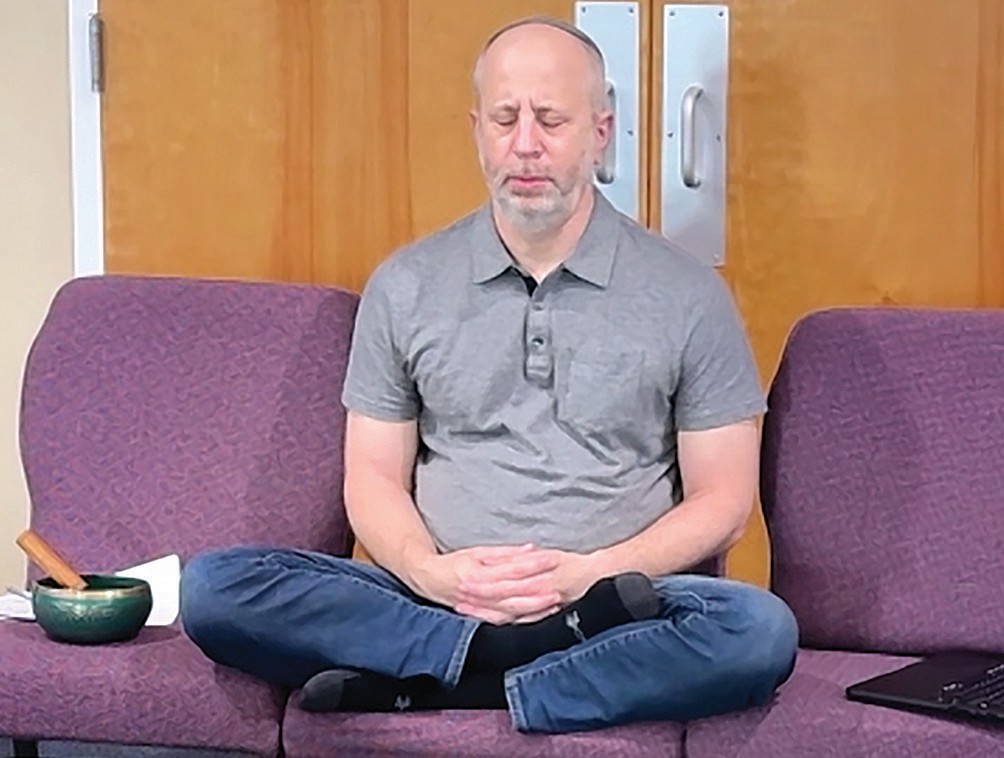

Rabbi Jason Rosenberg leads the meditation.
I need meditation. It’s when I stray from the practice and return that I remember why it means so much. When it’s busy and I don’t have time, that’s the time I need it most.
For me, it provides a subtle, maybe subconscious, reminder – during the session and throughout the day or week – of the importance of gratitude, kindness and self-care. In the case of Jewish mindfulness, I feel more connected to God. It’s as if there is a door in my mind, temporarily forgotten. Once I open it, I remember how to bring spirituality, calm, clarity and positivity into my daily activities.
According to the American Psychological Association, mindfulness meditation can change our brain and biology by offering benefits that include lower stress levels, sustained focus, emotional health, better sleep and self-awareness. It can also help lower blood pressure by turning off the body’s stress response. As a result, our nervous system relaxes, blood vessels widen, stress hormones decrease and the heart rate slows.
Since December, Rabbi Jason Rosenberg has been offering morning and evening meditation sessions in two locations every Tuesday through his Tampa Jewish Mindfulness Center (TJMC). Two things recently changed: The morning practice beginning at 8:10 a.m. is now at Congregation Beth Am in north Tampa, where Rosenberg is the spiritual leader. The evening practice, still at the Shanna & Bryan Glazer JCC in south Tampa, is now beginning at 6:30 p.m. Those unable to attend can sit in via Zoom.
“Jewish mindfulness is different from other mindfulness practice in several ways,” says Rosenberg, who was trained as a teacher at the New York City-based Institute for Jewish Spirituality. “It’s most definitely different from secular practices, such as mindfulness-based stress reduction, in that it does try to get us to focus on our souls, and on our sense of God’s presence.”
A meditation class begins with Rosenberg softly striking a metal bowl three times with a mallet to signify the session’s start. The sound from the bowl signals a transition. For instance, one bump tells participants to close their eyes and another one when it is time to open them. If you are deep in meditation, the three strikes let you know that the session is ending.
In his weekly sessions, Rosenberg guides participants to attention and acceptance. My interpretation in simple terms is to see what’s there, know what I can or can’t control, notice it without responding, and accept what it is. Members of the class sit in a quiet, safe space with closed eyes and relaxed muscles.
At my last meditation, we listened to our breath while silently repeating a word or phrase. Rosenberg said he likes to say “I am aware of my breath” on the breath in, and “I am grateful for my breath” on the breath out. When distracting thoughts come in, let them come and go, returning to you word or phrase.
When the rabbi read a poem about a rock skipping along the water, my eyes closed, imagining each ripple as the rock descended.
The water imagery is a popular metaphor with torah sages, says Rosenberg, who has been practicing mindfulness for two decades. “Throw a stone into still water and the water reacts exactly in proportion to the size of the stone, then the water takes the stone in and settles back to what it was. We don’t need to become anything, we don’t need to force anything. For this moment, at least, all we need to do is just settle. Let ourselves flow into the shape or form of whatever feels natural.”
He uses examples and teachings from the Torah. “By often tying the teachings into the parashat haShavuah, and/or any upcoming holy days, we’re also creating a practice which follows the rhythm of Jewish life.”
Rosenberg guided us through an exercise to increase awareness and acceptance: Open your eyes and notice five things, then close your eyes and notice four things that you can hear, followed by three things you can touch, two things you can smell, and finally, one that you can taste – all experienced at a slow pace.
“Believe it or not, that’s the practice. That’s meditation,” Rosenberg says. “So, I invite you to keep noticing things. This is a little taste of open awareness practice instead of focusing, just notice what’s around what’s arising. Our thoughts aren’t distractions they are just one more thing that’s out there. A car passing, a memory, my feet on the floor, a worry. Plenty of things will pull our attention, another passing car or another passing thought. Each time we can just notice it, with the same complete lack of effort, then we can bring our attention back to our breath. No struggle, no striving, no failure.”
Since starting the practice, Sarah Phillips can put space between her thoughts and its reaction. “I notice that I am able to redirect the process before I get angry or have an outburst.”
Jewish mindfulness practice acknowledges the challenges of the outside world, Rosenberg says, “and we need to be wary of them. But, we also believe that this world is a world of wonder, and that deep, meaningful spirituality can be found in this world, and sometimes even because of this world. We don’t need to transcend or leave our reality, we just need to better understand our relationship with it.”
Although he has been leading spiritual relaxation sessions for his congregation for years, Rosenberg founded the TJMC to extend the opportunity to the rest of the Tampa Bay area. Both at the synagogue and the JCC, classes are free and open to members and non-members. Donations are welcome. “The goal is to reach as many people as possible. We will never charge for meditation. We don’t want cost to be a barrier.”
If you think you don’t have time, start slowly by meditating for five minutes a day and attending TJMC’s weekly practice. “One of the great things about meditation is that there is a very strong dosage-response effect. You get more benefit from meditating more, but you absolutely get some benefit from meditating a little…. Something is better than nothing.”
For more information, visit tampajmc.org.