
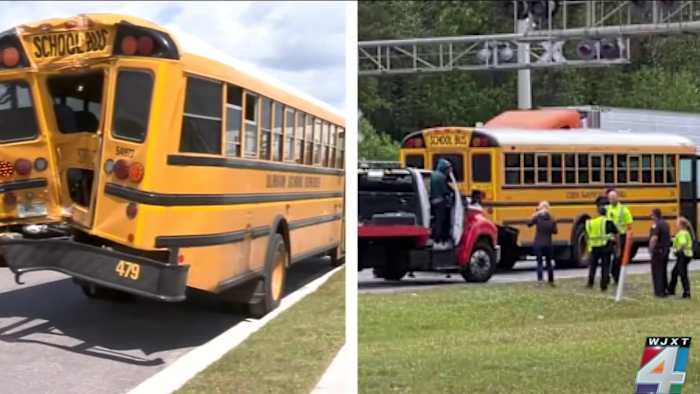
Recent school bus crashes and a near miss involving a child are renewing questions about what Florida law requires of drivers sharing the road with school buses.
A school bus was involved in a crash on Yellow Bluff Road, where no students were injured but the bus had to be towed.
In a separate incident in the College Gardens neighborhood, a stop-arm camera captured a driver going around a stopped bus as children were getting off. The car stopped just before hitting a child crossing the street.
The incidents come after two school buses were hit from behind near the Jacksonville Zoo after stopping at a railroad crossing, with students in one of the buses taken to a hospital.
Attorney Millicent Daniels of the Daniels Law Firm explained the rules and potential consequences during an appearance on The Morning Show as part of our “Justice 4 All” series.
When drivers must stop
Florida law requires motorists to stop when a school bus is displaying flashing red lights and has its stop arm extended, Daniels said.
Drivers traveling in both directions must stop unless the roadway is divided by a physical barrier, a raised median or at least 5 feet of unpaved space.
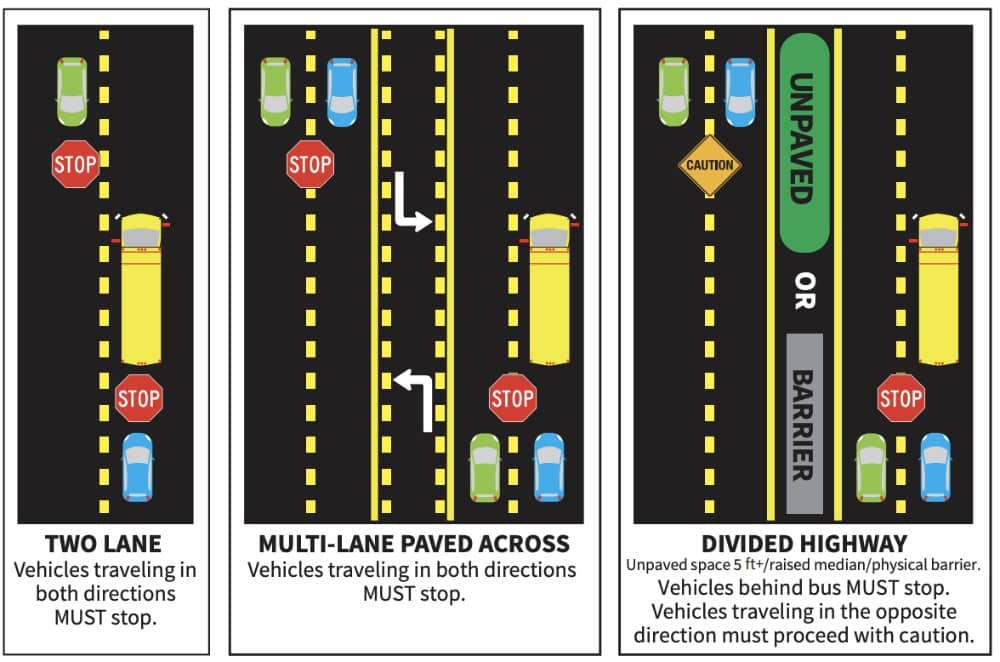 When to stop for a school bus, depending on the type of road. Image courtesy of Ann Arbor Police Department. (WDIV)
On roads without one of those dividers, drivers approaching from either direction must remain stopped while the bus is loading or unloading students.
Duval County’s school buses are equipped with stop-arm cameras.
Drivers who illegally pass a stopped school bus can receive a $225 citation, according to previous warnings from Duval County Public Schools and local school police.
Penalties can increase if a child is injured
Florida strengthened penalties through the Cameron Mayhew Act, named for a 16-year-old who was hit by a driver who failed to stop for a school bus, Daniels said.
If a driver passes a stopped school bus and causes an injury or death, the driver can face 120 hours of community service at a trauma center or local hospital, a $1,500 fine, six points on a driver’s license, a victim-awareness panel or approved driving course, and a driver’s license suspension of at least one year.
Even when no one is injured, passing a stopped school bus can result in four points on a driver’s license, a basic driver improvement course and a statutory fine, Daniels said.
Repeat offenders can face enhanced penalties. A driver who commits a similar offense within a five-year period may have a driver’s license suspended for 90 to 180 days, in addition to the fine, she said.
School buses must stop at railroad crossings
Drivers also should expect school buses to stop at railroad crossings, even when no train is visible and no crossing gate is present.
Under Florida law, school bus drivers must stop between 15 and 50 feet from a railroad crossing, Daniels said.
Motorists following a bus should leave enough room to stop safely and avoid rear-ending it.
“Anticipate that they will stop so that you can be prepared,” Daniels said. “We don’t want you to hurt anyone.”
Drivers who fail to stop for a bus or cause a crash could face additional charges, including reckless driving, careless driving or failure to stop. If someone is injured, the driver also could face a negligence claim, Daniels said.
The safest approach is to slow down when a bus displays its yellow warning lights, remain alert for unexpected stops and never go around a bus with its red lights flashing and stop arm extended.
Copyright 2026 by WJXT News4JAX – All rights reserved.