
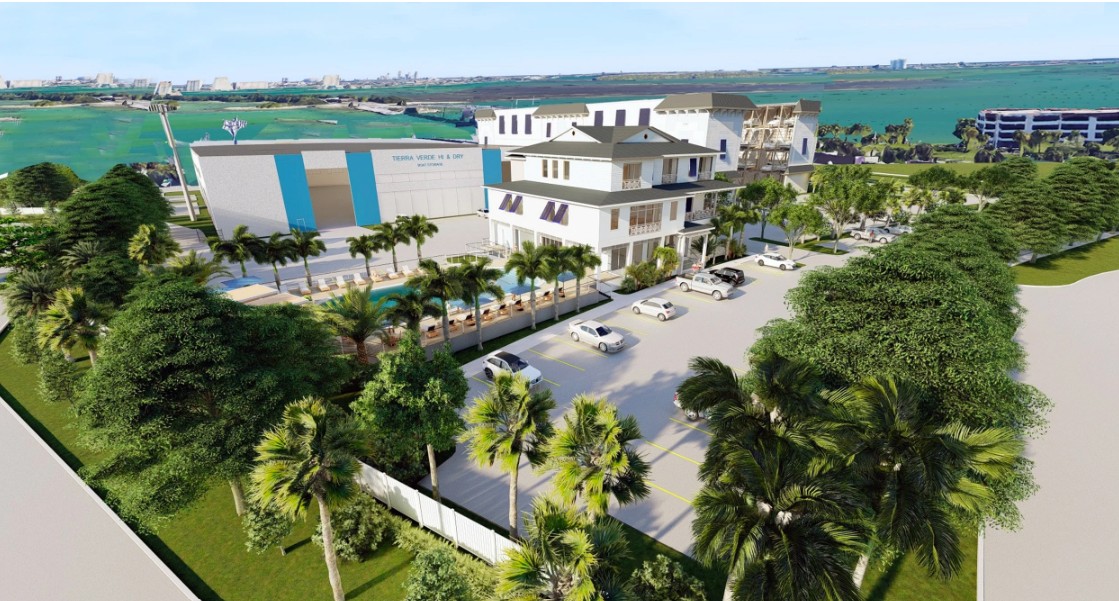
Tierra Verde NEXT, a local advocacy group, is mounting another challenge to Greenleaf Capital’s marina redevelopment, months after St. Petersburg approved a scaled-back version of the project.
The May 6 approval allows Greenleaf to expand boat storage and redevelop Tierra Verde Marina with buildings reaching 72 feet in height. Opponents have challenged the project over its size, traffic and parking, and more recently Greenleaf’s compliance with the state lease governing its wet slips.
Now, Tierra Verde NEXT wants the city’s Development Review Commission to reopen and rescind its approval. The group argues Greenleaf used 29 wet slips to reduce its required parking even though its state submerged lands lease requires at least 90% of those slips to remain available to the public.
Greenleaf was initially required to provide 226 parking spaces. It received a 40-space reduction because of the property’s proximity to the Pinellas Trail, then another 29 credits for patrons arriving by boat, bringing the requirement to 197 spaces.
Tierra Verde NEXT contends Greenleaf could not legally commit those 29 slips to the development. The lease requires at least 90% of the marina’s wet slips to remain available to the general public on a first-come, first-served basis.
Greenleaf has said the marina contains 89 wet slips, meaning about 80, must remain publicly available. Tierra Verde NEXT argues that leaves only nine for other uses, not the 29 used for parking credits.
Greenleaf attorney Nicole MacInnes addressed those slips during the May 6 DRC hearing, according to the group.
“So, there are 89 wet slips that are allowed per the sovereign submerged land lease,” MacInnes allegedly said. “Twenty-nine of those we allotted for the parking reduction.”
The Catalyst has not independently reviewed a transcript of the exchange. Tierra Verde NEXT said DRC Chair Kevin Reali then asked whether the 29 slips would be excluded from leasing, and MacInnes confirmed they would.
The argument builds on a complaint Tierra Verde NEXT filed with the Florida Department of Environmental Protection (DEP) this summer, alleging that most of Greenleaf’s existing wet slips were being used by boat clubs, a rental business and the Tampa Bay Pilots Association rather than remaining available to the general public.
The Catalyst previously reported that a subsequent state inspection resulted in a warning letter to Greenleaf. Tierra Verde NEXT said DEP directed the marina to make 80 of its 89 slips available for public rental and determined membership boat clubs did not satisfy the public-access requirement.
The Catalyst was unable to obtain the warning letter and could not independently verify all of the group’s characterization of its contents. Greenleaf said it had responded to DEP and was cooperating with the agency while its review remained underway.
Tierra Verde NEXT is now connecting that requirement to what happened before the DRC, claiming it reviewed more than 1,000 pages of the development record and found numerous references to Greenleaf’s submerged lands lease, but not the lease itself.
“That is not a minor administrative oversight,” said Geoff Comrie, a member of Tierra Verde NEXT’s steering committee. “It goes directly to the factual and legal foundation of the approval.”
According to Tierra Verde NEXT, the city has declined to reopen the case and called the terms of the state lease “immaterial.”
The group contends the city relied on the lease when Greenleaf identified 89 authorized wet slips, but failed to account for the same document’s requirement that 90% remain available to the public.
“The City’s apparent position is to let Greenleaf obtain the approval first and possibly correct the legal authority later,” Comrie said. “That turns the required approval process backwards.”
Whether the state lease prevents St. Petersburg from awarding the 29 parking credits has not been established. DEP oversees Greenleaf’s use of state-owned submerged lands, while the city granted the parking reduction through its development review process.
Residents first opposed the project over its scale, height, traffic, parking and neighborhood impacts, then later challenged the DRC approval in court and raised environmental concerns with state regulators. The submerged lands complaint followed, and Tierra Verde NEXT is now using that issue to extend its line of questioning to potential parking violations.
For the time being, the approval from May 6 remains in place.