
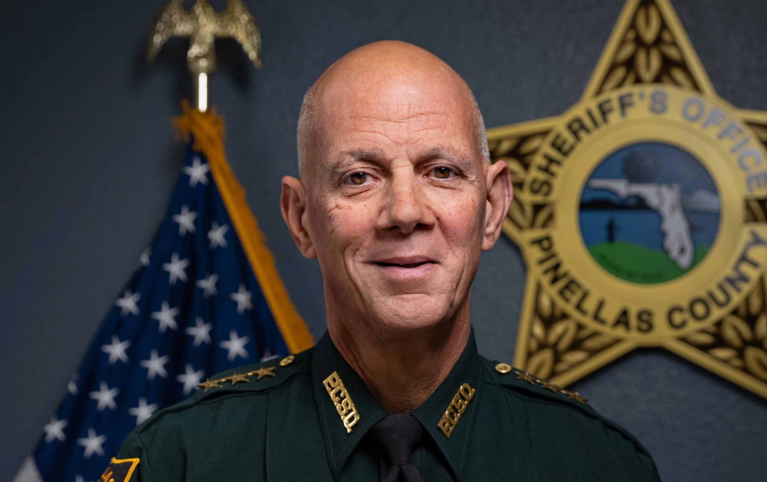
Pinellas Sheriff Bob Gualtieri
Credit: Florida Sheriffs Association.
You can’t accuse Bob Gualtieri of going with the flow. The Pinellas County sheriff has the rare combination of brains and guts to go against the current and move the needle on nationwide policy. His undertakings are enabled by his legal savvy and the respect held for him by law enforcement and legislators.
One of Gualtieri’s most consequential projects over the last decade has been transforming county jails into engines of mass deportation. While his mission has been wildly successful—with hundreds of jails enacting enforcement policies he designed—Gualtieri is often treated as an uncontroversial, common-sense sheriff. The Tampa Bay Times endorsed him in every election.
Jails as immigration hotspots might seem like common sense to some. After all, the law is the law. But critics say pushing responsibility from federal governments to local ones diverts local resources, puts legal liability on counties, and erodes trust between immigrant communities and police. Legal scholars argue that it sets up a system where, when things go wrong, local cops can blame the feds and feds can blame the locals.
Others have pointed to the brutality of recent deportation initiatives. While Gualtieri says his immigration enforcement schemes focus on “criminal illegals,” some of those swept up by his policy don’t fit in that category.
Rosa Patishtan-Gomez immigrated from Mexico on an agricultural visa and was quickly labor trafficked. Indebted to her employer, she was forced to overstay her visa and work 120 hour weeks. Last year, she was a passenger in a car that was pulled over by the Florida Highway Patrol. Separating her from her breastfeeding 11-month-old, Patishtan-Gomez was booked into the Pinellas County Jail under Gualtieri’s authority and later deported.
Even just getting swept up in low-level arrests can separate someone from their family. An analysis by Suncoast Searchlight called it “Florida’s jail-to-deportation pipeline,” and said it’s “one of the main engines of Trump’s mass-deportation push.”
Prison Policy Initiative representative Wanda Bertram told Searchlight it allows federal immigration enforcement agencies to “use jails like a dragnet to find people who are undocumented.”
“It’s kind of like shooting fish in a barrel for ICE.”
At a time when indiscriminate deportations are separating families and sending people to countries they’ve never been to, it’s worth asking why Pinellas’ sheriff has played such an outsized role in enabling the mission of U.S. Immigration and Customs Enforcement.
Gualtieri’s unique positioning
As a Florida sheriff, Gualtieri gets more freedom than most police officials.
“One of the greatest things about the job is you can get stuff done,” Gualtieri said during the “Fixty Six” podcast produced by his PR department. “You can make things happen because you get to unilaterally make all the decisions. But one of the worst parts of the job is that you’ve got to unilaterally make all the decisions.”
Gualtieri has denied every recent interview request from Creative Loafing Tampa Bay. Instead, Fifty Six and other interviews he’s granted are referenced several times throughout this article.
Gualtieri described his childhood self as a rule follower with a strong sense of justice. “I have a real sense of right and wrong,” he told Fifty Six. “I really can’t stand wrong. I really hate it when people don’t do the right thing and they do the wrong thing by others.”
Perhaps that’s in part because of the integral role cops and counsel played in Gualtieri’s upbringing. His father was a district attorney in New York. His grandfather was a judge, and he told Fifty Six that “everyone” in his family was a lawyer.
Gualtieri’s first law enforcement job was as a detention deputy in the Pinellas County Jail. Back then, he told Fifty Six, detention deputies didn’t carry weapons or cuffs. He recalled one of his first tasks at the jail: getting a guy with “mental health issues” to leave his cell. Gualtieri entered unarmed; both men left wearing each other’s blood.
He told the hosts of Fifty Six that he doesn’t do much outside of work. He goes to hockey games sometimes, and otherwise does work around the house to avoid “getting yelled at.” He goes to the gym, where he doesn’t listen to music. Even as a patrol deputy, he just listened to police radio.
Sheriffs don’t typically write new laws or draft contracts. But Gualtieri—a lawyer who once held the roles of deputy sheriff and general counsel at the same time—gets his kicks from novel legal challenges.
“You just have to take the bull by the horns and deal with it,” Gualtieri said during the same episode of Fifty Six. “With me, the buck stops here. There’s no ‘out basket’ to send it to. I just believe in getting it done, just taking care of it. … Just step out of your bounds if you have to. Step out of your lane.”
He’s regularly taken initiative since being appointed to office in 2011. He created a mental health diversion facility, shaped school safety police following the Parkland shooting, and has weighed in on national gun laws.
Gualtieri told the podcast that in 2020, he successfully lobbied against the campaign to end qualified immunity.
Perhaps his most consequential lane-hopping started when he first decided to tackle immigrant detention.
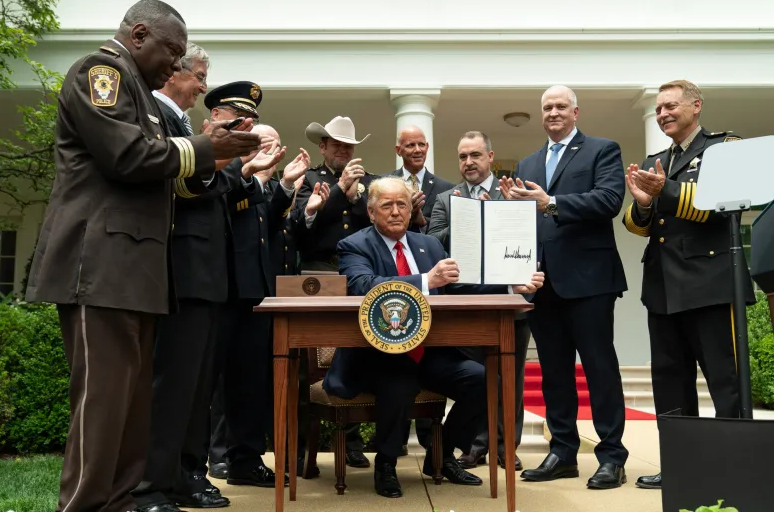 President Donald J. Trump, with Pinellas Sheriff Bob Gualtieri (center, rear) signs an executive order on safe policing for safe communities on June 16, 2020, in the Rose Garden of the White House in Washington, D.C.Credit: Shealah Craighead / Official White House Photo
Gualtieri’s first run at immigration law
Nearly a decade ago, Gualtieri proposed a legal way to do what the Constitution previously made impossible: keeping someone in jail with no criminal charges.
The distinction between being unlawfully present (an “illegal immigrant”) and breaking state law might seem trivial, but it’s important. Immigration is generally a civil matter, like divorces and traffic tickets. It’s typically not punishable with jail time like state crimes are. The Constitution bars imprisonment without a crime.
Since ICE detention is civil and not criminal, detainees lack constitutional protections. They can be held indefinitely and aren’t guaranteed an attorney. That’s why local jails were found legally liable for holding immigrants when ICE requested they do so.
In 2016, Gualtieri voted to install Donald Trump as the head of the federal government, where he attempted to turn ICE into a deportation machine.
But ICE only had 2,000 beds for detainees in Florida. They continued pushing local sheriffs to open up their jails to ICE detainees, but fearing legal liability, many declined—prompting ICE to create a public list of denied detainer requests.
The practice of detaining immigrants in local jails may have died after a few more lawsuits if Gualtieri hadn’t stepped in to find a workaround. In June of 2017, he surprised the National Sheriffs Association with a presentation outlining his plan to allow jails to work for ICE.
Physically, the same thing would happen: ICE would ask the jail to detain someone, the jail would say yes, and that detainee would become a part of the jail’s regular population. But on paper, the detainee was in ICE’s custody, not the jail’s. If their detention was deemed illegal, it was ICE who was liable, not the sheriff.
Gualtieri presented the unsolicited idea to ICE, and worked closely with the agency to develop specific implementation plans.
Solutions emerge from ‘The Gualtieri Memo’
A few workarounds eventually resulted from Gualtieri’s initial proposal, dubbed “The Gualtieri Memo” by a coalition of immigrant advocacy groups questioning the legality of the practices.
One answer was the Basic Ordering Agreement. Usually, a BOA is a standing contract for a government agency to order products at a fixed price. Instead, it was used to order prison stays for immigrants.
Another was piggybacking on existing agreements with agencies like the US Marshals Service that allowed federal prisoners to be detained in county jails. Intergovernmental Service Agreements, or IGSAs, are still used in some Florida counties, including Pinellas.
Gualtieri also proposed each jail could enter a formal agreement with ICE that deputized individual deputies to enforce immigration law. That program, called a 287(g) agreement, required a weeklong training course.
In 2018, he officially launched the plan alongside ICE officials in Pinellas, backed by 16 other sheriffs joining the initiative. Months later, he reassured a crowd at a contentious immigration forum that “if you don’t get arrested and don’t commit a crime, you’ve got nothing to worry about, because it only applies to people that are in the jail.”
In 2019, working closely with federal officials, Gualtieri helped create a new form of 287(g) agreement. The only requirement was an eight-hour online training, and it enabled officers to serve civil immigration warrants. The Warrant Service Officer model is now mandated in every jail in Florida, and is used in over 500 agencies across the country.
The anti-sanctuary law
Gualtieri is the legislative committee chair and former president of the Florida Sheriffs Association, one of the state’s largest pro-police lobbying groups.
FSA gets a significant portion of its budget from police gear markups; it purchases items like police cruisers through negotiated contracts and sells them to police departments with a small markup. While they argue that the scheme saves police time and money, critics say it amounts to taxpayers funding their lobbying efforts.
Gualtieri helped draft and advocated for an anti-sanctuary city law in 2019 (alongside a far-right anti-immigrant group). Speaking to the legislature, he said the bill would prevent a situation like in Portland, where an immigrant released from custody “got out and raped a 65-year-old woman,” in Gualtieri’s words.
Gualtieri said the law had nothing to do with people who had been in the country for decades and assimilated, becoming productive members of their communities. Instead, he said, it only affects immigrants who have been booked into jail for breaking a law. He didn’t mention that the majority of people detained in jail are still awaiting trial and therefore presumed innocent.
After the law was passed, ICE loaded immigration warrants into a database that Florida police check even during simple traffic stops. Instead of the law just affecting so-called “criminal illegals,” even a broken taillight could land someone in ICE custody.
Even in light of this, the since-expanded anti-sanctuary law prevents sheriffs and police departments from scaling back their involvement with ICE. Tampa’s mayor was threatened with removal last year for a policy that prevented victims and witnesses of crimes from being reported to ICE.
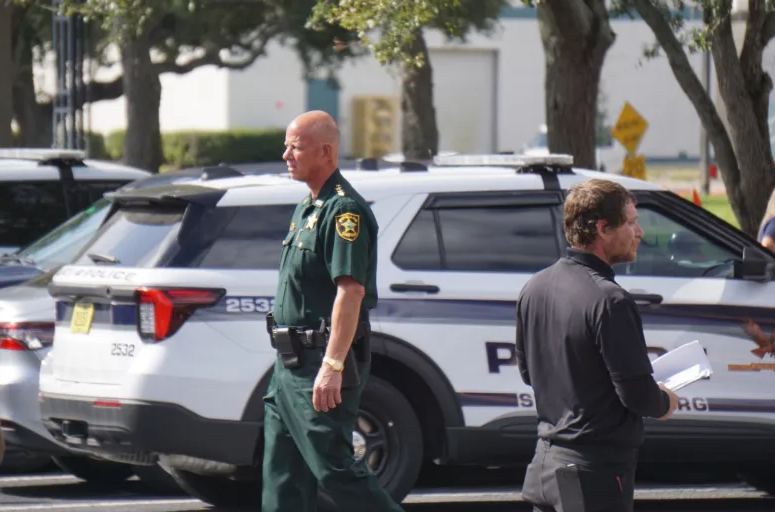 Pinellas Sheriff Bob Gualtieri outside the Carillon Hilton in St. Petersburg, Florida on Jan. 13, 2026.Credit: Valerie Smith / Creative Loafing Tampa Bay.
Trump’s second term and Gualtieri
Gualtieri was reelected without opposition in 2024, the same year Trump was elected to a second term. Gualtieri quickly seized on the renewed drive for mass deportation.
“When President Trump took office a month ago and ICE ramped up the detainer process, 26 of Florida’s 67 county jails were unable to honor the immigration detainers that would keep people like this in custody because there were no 287(g) personnel trained and deputized who could make these immigration arrests because Biden gutted it,” Gualtieri said at a February, 2025, press conference.
He said that on day one of the Trump administration, Florida “immediately began” moving forward to get 287(g) agreements signed with the remaining 26 county jails.
Since then, his lobbying efforts and position on the newly-created State Immigration Enforcement Council have led to a massive increase in state collaboration with ICE.
Gualtieri tried creating a new form of agreement where sheriffs would transport detainees to ICE field offices before their 48-hour holds expired. ICE denied the plan, citing legal concerns.
Other law enforcement leaders often take Gualtieri at his word. In a 2025 email obtained by CL, Gualtieri told Pinellas police chiefs they were required to “do certain things” regarding immigration enforcement or face removal from office by the governor.
Within days, all of them signed 287(g) agreements, even though they were not required to do so. This has earned the police chiefs significant pushback from their communities.
Pinellas County Jail rebooking
An investigation by ProPublica found that the Pinellas County Jail was repeatedly booking immigrants, briefly releasing them into ICE custody, then rebooking them. This reset a 72-hour detention time limit.
Gualtieri—known for his hands-on management style, per Fifty Six—said he didn’t know ICE was rebooking immigrants until around October. In a press conference last week, he said he put a stop to it when he found out, but ProPublica found that rebookings continued until the following July.
Gualtieri—who told the Fifty Six podcast that lack of transparency in policing breeds “suspicion and contempt”—did not inform the public about a waiver ICE sent that allows the jail to hold immigrants for longer than 72 hours. He also didn’t tell ProPublica about the waiver until five days after their investigation was published.
Social media commenters have asked how much Gualtieri was getting paid for the rebooking practice. But housing immigrants is a net loss for the sheriff’s office. While Pinellas gets paid $140 per night for people jailed on behalf of ICE, it costs about $150 to house them, according to the sheriff’s FY2026 budget presentation.
The ProPublica report came days before Gualtieri hosted a press conference to defend unpopular Flock cameras. Afterwards, he fielded questions about the rebookings.
Outside of the press conference, Conni Berns held a sign decrying ICE as a murderous agency. She lives two minutes from the office where Gualtieri conducts his affairs.
“I was born in Germany during the bombing of Berlin,” Berns told CL. “I was very small. I remember bombs, I remember sirens. … I always knew what the Germans had done to millions of Jews, and it left me with an intense pain.”
Berns fears that future generations will feel similar guilt over ICE’s treatment of immigrants today.
Thomas Kennedy, an analyst with the Florida Immigrant Coalition, told CL that Gualtieri helps sanitize deranged-sounding rhetoric that often comes from those supporting the same policies he boosts.
“When there’s a committee hearing, they need to cover themselves with a rational voice,” Kennedy said. “So they’ll pull out Sheriff Gualtieri in the committee. And he’ll come in with his uniform steamed, looking very professional with his gun, and he’ll go on talking in very technocratic terminology about the application of these contracts.”
Kennedy also said that Florida policy influenced by Gualtieri often goes national. “So Florida serves as this laboratory,” he told CL, “and he’s one of the evil scientists within it.”
The reasoning behind Gualtieri’s immigration stance
Gualtieri didn’t respond when CL asked for his comment on this article. But he’s spoken publicly about the reasoning behind his tough-on-immigrants policies.
Gualtieri said that 287(g) agreements make the community safer. Crime and its causes are connected in complex ways, so that’s a difficult statement to prove or disprove. But evidence suggests civil immigration enforcement does very little to impact local crime rates.
Gualtieri has pointed to individual incidents where immigrants with deportation orders have committed crimes. But a National Institute of Justice-funded study found that immigrants lacking legal resident status commit less than half as much crime as natural-born citizens.
A study by a left-leaning think tank found that cities with sanctuary policies had lower crime rates and greater economic strength. They attributed the decreased crime rates to witnesses and victims who are immigrants feeling more comfortable working with police.
And one study by the libertarian CATO Institute found that regions with 287(g) agreements didn’t have lower crime rates, but that they did have higher numbers of assaults on police officers.
The left-leaning Center for American Progress says that immigrants, even ones who are not lawfully present, contribute to the economy more than they burden it. They also highlight that many arrive in the US because conditions in their home countries were hostile, and they simply needed a better place to live faster than the legal system could offer.
Even the Center for Immigration Studies—an anti-immigration think tank founded by self-proclaimed eugenicist John Tanton, a man the Southern Poverty Law Center called “the racist architect of the modern anti-immigrant movement”—warns against arresting victims of crimes.
Gualtieri’s refrain to critics of ICE policy is often passing the buck, telling them to “talk to congress.” While it’s a strategy he’s found useful, he also believes trying to get congress to budge is useless. Guns and immigration, he told Fifty Six, are the two issues congress will never move forward on because of their divisive natures and the filibuster.
Now that Gualtieri is facing backlash, immigrant advocates like Berns hope he’ll have a change of heart.
“It is actually a physical pain to me,” she told CL. “I feel for the many people that are being mistreated cruelly, inhumanely. And I almost feel that if habeas corpus doesn’t represent them, then it can’t represent me. We’re all in the same boat.”