
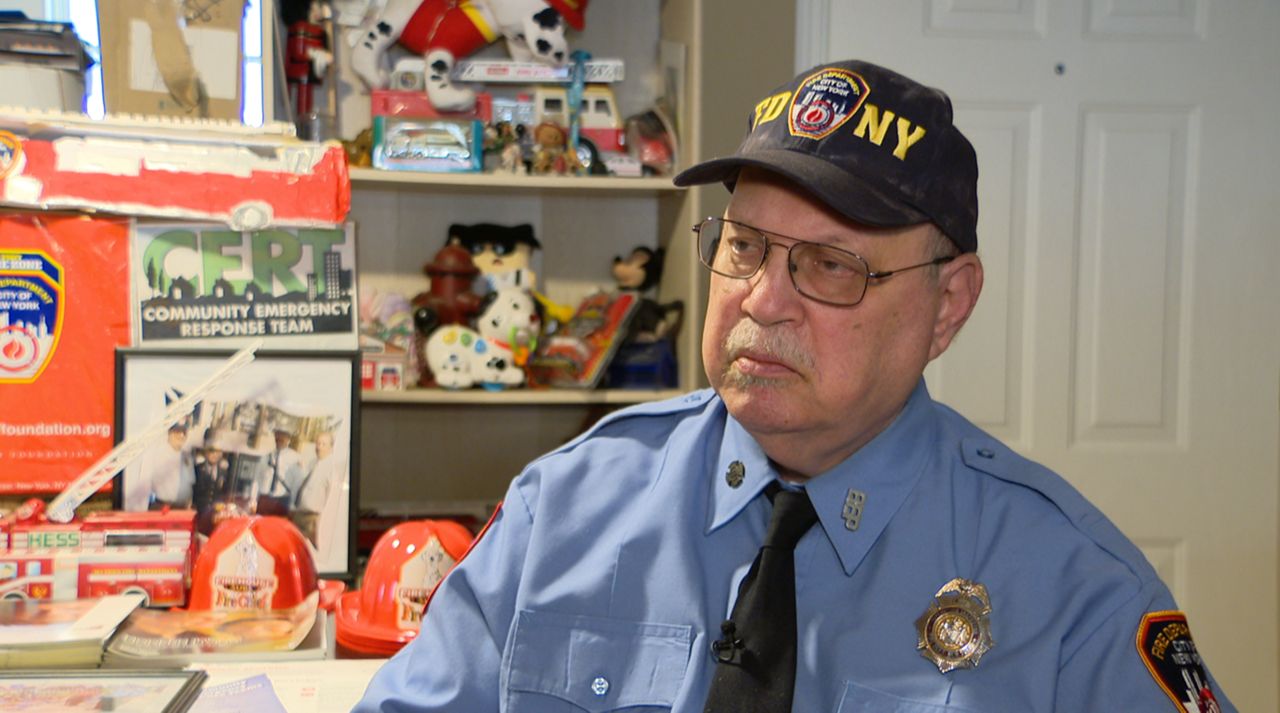
ORLANDO, Fla. — Alan Hirschkorn, a retired New York City Fire Department inspector who responded to the 9/11 terrorist attacks in 2001, is continuing public safety work in Central Florida despite long-term health problems from the response.
Hirschkorn said he was working in Midtown Manhattan on Sept. 11, 2001, when he got a radio call to go to the World Trade Center.
Like many first responders, Hirschkorn said he rushed toward Ground Zero before knowing exactly what had happened.
Once he arrived, the conditions were difficult to see through, he said.
“We got over there, and I said, ‘Holy moly, people are running; the plane hit the building’,” Hirschkorn said. “You couldn’t see if it was day or night with all that soot flying around.”
Hirschkorn spent five months working at Ground Zero, sifting through debris that was piled several stories high.
“That debris was glass, building material — everything that fell out of that building — so you had to watch out when you were climbing on that so that you didn’t fall into that,” Hirschkorn said.
He said the soot covered his uniform and affected his breathing.
“You see this uniform — you couldn’t tell it — the soot on there — coughing and breathing in all that stuff,” Hirschkorn said.
He said he lost fellow first responders on 9/11 and has seen more people die in the years since from health problems connected to the dust and debris.
“Not just the first responders, but people who lived and worked in the area were affected from breathing all that stuff in — and it’s a slow death,” Hirschkorn said.
He said he has lung damage, chronic obstructive pulmonary disease and post-traumatic stress disorder after his work at the site. He said he checks in with a psychiatrist each week.
“When I sleep at night, I dream, and sometimes I think about 9/11 and I wake up screaming,” Hirschkorn said. “I still have those flashbacks.”
After moving to Central Florida, Hirschkorn became a volunteer with the American Red Cross, local fire departments and other agencies.
“We go out and give information on fire prevention and safety — let them know to have a working smoke alarm,” Hirschkorn said.
Staying focused on safety work helps him keep going, he said.
“If I focus on something and I’m not thinking about it (9/11), I’m OK,” Hirschkorn said.
“It’s all about helping people, saving lives.”
The American Red Cross honored Hirschkorn with a Good Samaritan Award, and the organization will continue to give the award to others in the future in his name.