
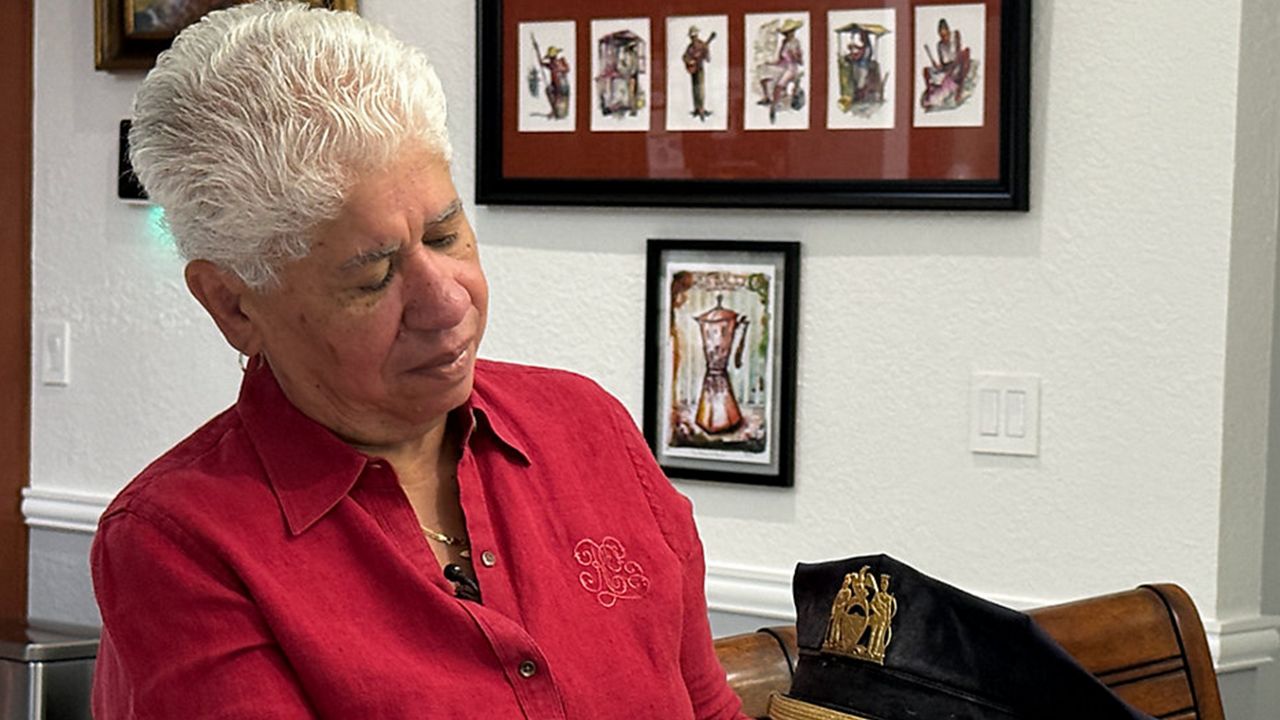
ORLANDO, Fla. — Nancy Rosado has an old package stored away in her Orlando home, but she can bring it out within minutes.
Inside it is her old police cap from her time with the New York Police Department. It was shipped to her after she lost it on Sept. 11, 2001. The hat still has debris on it.
“I have no words for it,” Rosado said. “It’s just a little heartbreaking.”
Rosado worked in the NYPD’s Early Intervention Unit. On Sept. 11, she was with a support group not far from the World Trade Center when she saw people looking up and pointing.
“I passed someone who said, ‘It was a small plane or helicopter hit the World Trade Center’,” Rosado said. “I get to the corner, look up, and the building had a gash in it that looked almost like a smile. And there were flames, but the flames weren’t going up; they were going down.”
Rosado remembers the sights and sounds of the New York City streets at that moment.
“You can see all this debris coming out of the building and paper,” Rosado said. “As you got closer, you realize it wasn’t just debris; it was people.”
Rosado said she pushed people to get away from the area. She also remembers seeing a police radio on the ground and hearing officers calling for help.
“Cops who were maybe inside the building or in the surrounding or maybe already pinned, ‘I’m on such and such floor,’ and you knew that floor didn’t exist anymore,” Rosado said. “And then you would lose that voice.”
For Rosado, the experience has remained close.
“For me, it feels like yesterday,” she said.
She said the attacks had a lasting impact on the city and on first responders.
Her work at the time focused on the mental health of others, leaving little time to address her own needs.
Rosado said she developed a bad temper and wound up with skin cancer. She also saw a psychiatrist for the next seven years and did not begin prioritizing her own mental health until months after the attacks.
“I was not realizing what was happening to me ‘cause I was taking on everyone else’s story and figuring out what to do about everyone else,” Rosado said.
She said it remains important to keep talking about Sept. 11 and to preserve firsthand accounts as part of history.
“I don’t think any of us have left it behind,” Rosado said. “We must never forget what happened. We must never forget the people who were willing to put their lives out there to possibly save other people.”
Rosado is now an activist and outreach consultant for UCF Restores, an initiative that helps first responders with trauma-related treatment. She also was selected to be part of the Pulse Memorial Advisory Committee.