
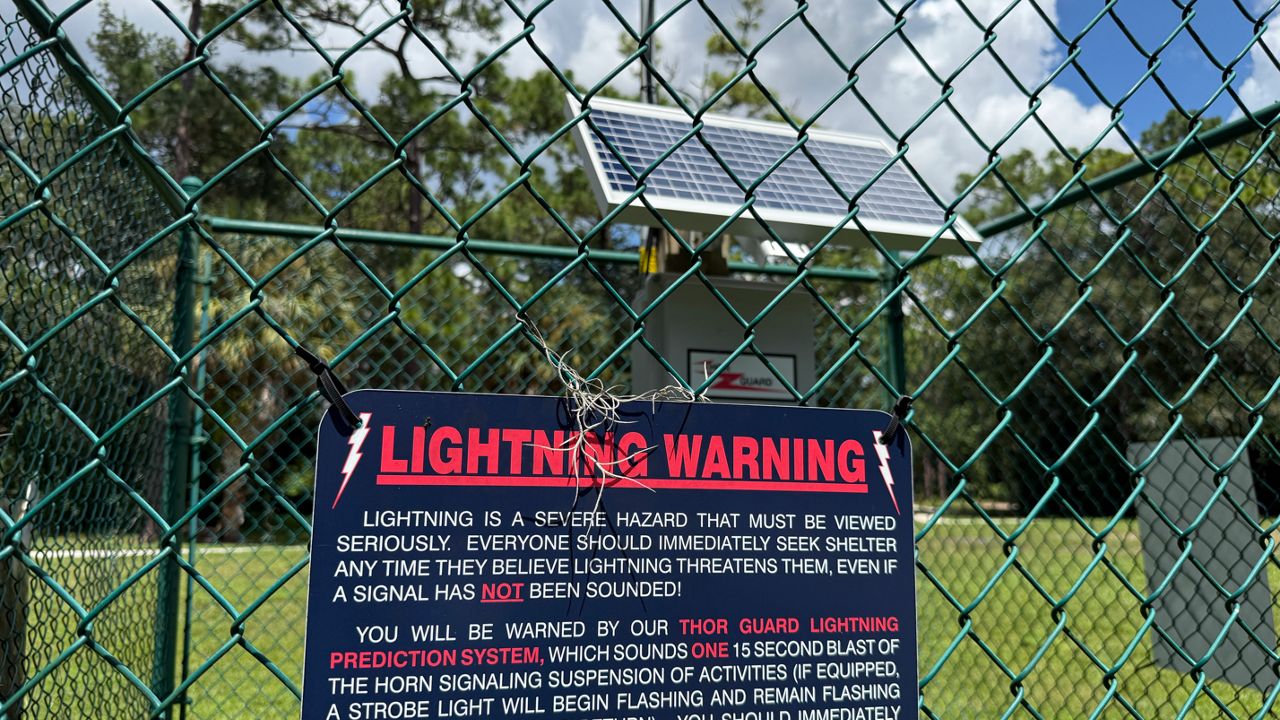
ALTAMONTE SPRINGS, Fla. — Several people have been struck by lightning in Central Florida over the last few weeks, raising concerns among residents who work and play outside.
Places like Sanlando Park in Altamonte Springs have a lightning warning system to help keep people safe.
When the sirens sound, it’s time to get inside quickly, something landscaper Daniel Sharkey will always heed after a near-death experience.
Home surveillance video shows Sharkey on the ground two years ago after he says he was struck by lightning while mowing a lawn in Altamonte. Sharkey adds that he doesn’t remember getting hit, just waking up dazed.
“I couldn’t feel very much,” Sharkey said. “I was just kind of numb and tingly, just trying to figure out, you know, it’s like I was hit by a freight train.”
Sharkey sustained burns on his body and spent four days in the hospital as he recovered.
Central Florida paramedics receive a lot of training to respond when someone is struck by lightning. Paramedic James Tagliani at Seminole County Fire Station 21 in Casselberry says paramedics often focus on neurological damage and keeping someone’s heart pumping after they are struck.
“We have our Lifepak 15s here. It has an AED built into it, so we’ll use that to be able to monitor their cardiac rhythm, as well as being able to treat any cardiac dysrhythmias,” Tagliani said.
Spectrum News 13 Chief Meteorologist Bryan Karrick says lightning strikes in Florida 1.2 million times a year on average. He adds a storm can still pose a risk from miles away.
“It can strike anywhere from 10 to as much as 20 miles away from the parent storm,” Karrick said.
Karrick also says residents should move indoors even if a thunderstorm is not right overhead. He adds that over the past year across the U.S., only Oklahoma witnessed more lightning strikes than here in Florida, and he says residents and visitors in Central Florida need to be extra careful.
“On average, we see the most lightning in a stretch from Tampa up to Titusville, and actually it’s known as Lightning Alley,” Karrick said.
Sharkey does not dwell on the strike that changed his life. He’s fully recovered, works as a part-time firefighter and EMT, teaches CPR classes and educates people about the risk of lightning while spending time outdoors. He recalls that the neighbors who tried to help him were not medical experts.
“They were afraid to even touch me,” Sharkey said. “They didn’t know if I might still be electrified or things like that. So it’s really important to get that information out there to the general public.”
Karrick often reminds viewers during his forecasts, “When thunder roars, go indoors,” to play it safe.
He adds that the temperature in a lightning bolt itself can reach up to 54,000 degrees, five times hotter than the sun’s surface.