
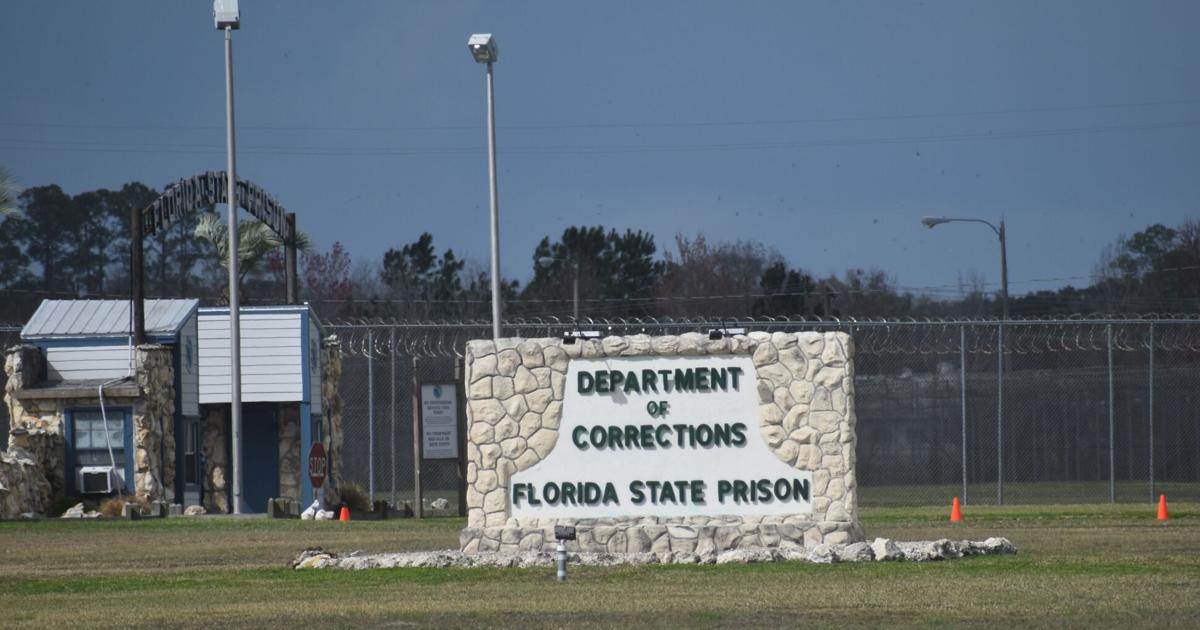
RAIFORD — With Thursday’s execution of Daniel Owen Conahan Jr. for the 1996 kidnapping and killing of Richard Allen Montgomery, there are six men from Charlotte and Sarasota counties remaining on Florida’s Death Row.
Among them are James David Robertson, Emanuel Johnson, Ernest Whitfield, Robert Trease, Dwight Eaglin and Jack Sliney.
Before Tuesday, the latest region resident put to death was North Port’s Michael King, who was executed on March 17 for the 2008 killing of Denise Amber Lee
On Feb. 13, 2025, James Ford was put to death. He was a DeSoto County resident when he murdered a couple that eventually led him to the Union County facility.
Death Row is at Union Correctional Institution with miles of prison facility overlapping Bradford and Union counties along State Road 16. Within some of the prison acres, cows and bulls roam on state-owned lands near white guard towers.
The others on Death Row include:
Dwight Eaglin
Dwight Eaglin is on Death Row for killing an officer at Charlotte Correctional Institution near Punta Gorda.

Dwight T. Eaglin,
PHOTO PROVIDED
Eaglin, 49, is the last surviving of three inmates convicted of killing Darla Lathrem, a corrections officer, and fellow inmate Charlie Fuston.
The 2003 killings took place during an attempted escape by Eaglin and two other inmates, Michael Jones and Stephen Smith.
All three were convicted and sentenced to death in 2006. Jones and Smith have both since died in prison, leaving Eaglin.
Eaglin was convicted 20 years ago and sentenced to death, and spent most of that time on Florida’s death row at the Florida State Prison in Starke.
He sought a retrial but was denied.
He did have a resentencing hearing in January, where a second Charlotte County jury agreed with the first and sent him back to Death Row.
Emanuel Johnson
On Oct. 4, 1988, a Sarasota woman was found dead, suffering 24 stab wounds and blunt trauma to the head.
Emanuel Johnson
PHOTO PROVIDED
Iris White was 73 at the time of her death.
“At the crime scene, police discovered an open living room window and a screen that had been cut open,” the court documents state. “Emanuel Johnson’s fingerprints were found on that windowsill.”
Previously, he had worked for her. Other biological evidence was also found at the scene and he later confessed.
James David Robertson
James Robertson was an inmate at the Charlotte Correctional Institution south of Punta Gorda when he killed his cellmate, Frank Hart, by strangling him with a pair of socks in 2008, prosecutors say.
James Robertson, also known as James David Robertson.
PHOTO PROVIDED
Robertson was featured in an episode of a Netflix documentary, “I Am a Killer.”
Robertson said the killing was the means to an end. He entered the Department of Corrections as a teenager, sentenced to just four years for a burglary and assault, according to previous reporting.
“I finished my original time way back in the late ’80s,” Robertson said in one interview. “I got a bunch more time. I don’t really even know how much time — about 100 years, I guess. It got to the point where I just said f— this s—, I’m going on Death Row. So I said well, I’ll just go ahead and kill my cellmate. I felt pretty confident I could overpower him.”
Jack Sliney
On June 18, 1992, George Blumberg was found slain by his wife. The two owned and operated a pawn shop on the Charlotte County side of Englewood.
Jack Sliney on Florida’s Death Row
PHOTO PROVIDED
Blumberg had been stabbed with a knife and bludgeoned with a hammer.
A witness said he saw two men enter the store and go to Blumberg about jewelry.
A composite sketch made the rounds.
A young man, Thomas Capeles, was shown the sketch but did not recognize either. It was believed Capeles may have known them due to their ages.
Capeles later contacted police officer after Sliney asked if he wanted to buy a gun.
Capeles said Sliney “looked similar” to a man in the sketch.
“Capeles agreed to assist in the investigation, and a controlled gun buy was arranged. The serial number of the gun that was bought from Sliney matched the gun registry from the Blumberg’s pawnshop,” court documents stated. “Another controlled gun buy was arranged, and these guns also matched the pawnshop registry. Sliney was arrested shortly after the second gun sale.”
A fingerprint at the scene was linked to Keith Witteman, according to court documents.
Sliney would confess to the killing of Blumberg.
“Sliney told officers that he and Witteman went into the store and argued with Blumberg over the price of a necklace,” it states. “He reported that Witteman told him to hit Blumberg and then said that he would have to kill Blumberg because the victim could identity them.”
During his trial, Sliney said it was Witteman who killed Blumberg, contradicting his original statements.
Robert Trease
Robert Trease and an accomplice robbed Paul Edeson in Sarasota. But in doing so, Trease stabbed Edeson to death
Trease and his accomplice, Hope Siegel, planned a date for her and Edeson so she could learn where Edeson kept a safe, court documents state.
Robert J. Trease
PHOTO PROVIDED
“Siegel arrived at the victim’s home and after spending time with the victim, determined that he did not have a safe. She left the victim’s residence and met with Trease, to inform him that the victim did not own a safe,” it states.
Trease followed her back to Edeson’s home, where he attacked Edeson hoping to learn the safe’s location.
“The victim continued to insist that he did not have a safe in his house,” it states. “Trease told Siegel to get a gun, which he put to the victim’s head as he continued the questioning.”
Trease fired a bullet into Edeson’s head, although he survived that. He then asked Siegel to get a knife.
“He then cut the victim’s throat resulting in his death. Subsequent to his arrest, Trease denied any knowledge or involvement in the crime. Siegel, however, gave a detailed statement implicating them both.”
Siegel received 20 years in prison.
Ernest Whitfield:
Ernest Whitfield was sentenced to death for the June 19, 1995 murder of Claretha Reynolds.
He was visiting Reynolds’s Sarasota home where he asked her and two other women for money; all three, including a former girlfriend, denied him, according to court records.
Ernest Whitfield
PHOTO PROVIDED
“When all three women refused, Whitfield attempted to grab (Estella) Pierre’s purse,” it states. “Reynolds put Whitfield into a headlock and proceeded to throw him out of her house. Before leaving, Whitfield exclaimed, ‘I am going to kill all three of you bitches.’”
He returned early in the morning, but was denied entrance.
“Whitfield then broke into Reynolds’ home armed with a large knife. Whitfield proceeded into the bedroom where (a woman) and her child lay sleeping. He raped (the victim) and motioned that he would stab her if she made any noise … Whitfield left (the victim) and went into the bedroom where Reynolds and her five children were sleeping.”
He returned to the room of the sexual assault victim and told her he’d stabbed Reynolds “numerous” times.
“Whitfield fled the scene and Reynolds died soon after the police arrived,” it states. “After his arrest, Whitfield confessed to stabbing Reynolds and showed authorities to the murder weapon.”
He was high on drugs at the time.