
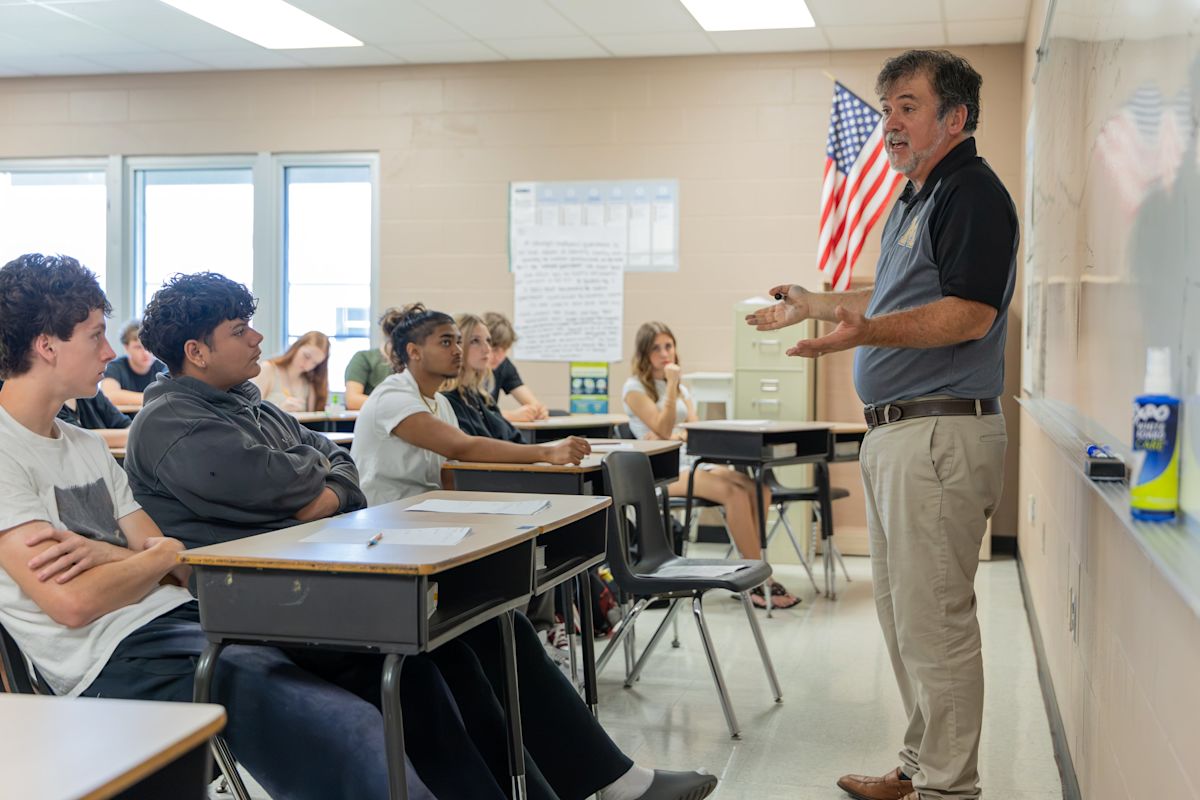
Pasco County Schools Superintendent John Legg began his lesson on 9/11 with George Washington’s 1796 farewell address.
Fifty-three minutes remained in the U.S Government Honors class period at J.W. Mitchell High School in New Port Richey. He’d need to connect the dots between our first president’s warning about foreign entanglements and the Sept. 11, 2001 terrorist attacks 200 years later, plus the 25 years since.
A quarter-century after hijacked airplanes struck the World Trade Center and Pentagon and another crashed in Pennsylvania, Florida students are required by law to learn about the attacks for at least 45 minutes on eachanniversary.
So Legg, standing before 30 seniors he’d come to guest teach this Fridaygot moving.
Washington, he said, had warned the young nation about becoming entangled in the affairs of other countries. That had proved complicated.
Legg moved to the USS Maine. World War I. World War II. The Cold War. The fall of the Berlin Wall. The first bombing of the World Trade Center.
On the whiteboard behind him, the timeline grew.
The students, Legg said, needed to grapple with questions of how America should intervene overseas and how it balances security with individual liberty.
All of it led toward 2001.
“Did we know that 9/11 was coming?” Legg asked the class. Some shook their heads no.
“We didn’t know it would be the World Trade Center, we didn’t know it would be that day, but we knew something was coming,” he said, before discussing previous attacks.
He asked how many students knew about the 1993 World Trade Center bombing. No hands went up.
In 2001, Legg said, he’d been in the classroom teaching sixth graders when the first plane struck. Chris Holke, the students’ regular teacher, chimed in from his desk. He’d been in a classroom too that day — as a fifth grader.
The students weren’t born yet. On their desks sat stapled handouts to guide them in taking notes on interventionism, the USS Cole and the Patriot Act.
“You did not experience Sept. 11,” it read. “You inherited the world it helped create.”
It also posed a question: “How should the United States balance isolationism and interventionism in an increasingly interconnected world?”
Legg explained that for many years the United States found security in isolationism, helped by two great security systems, “the Pacific and the Atlantic oceans.” The terrorist attacks, he said, came asa response to US. interventionsin the Middle East. He asked whetherthey thought the U.S. should continue to step into international conflicts, to protect its allies.
A boy wearing an earring said sometimes yes, but sometimes no. Legg pushed for more.
“Israel and Palestine,” the boy answered. “I just don’t think it’s necessary.”
Should the U.S. not help its allies? Legg asked.
“They’re your allies for a reason,” a girl named Alyssa said. “Would you want them to abandon us?”
Another boy, with a ponytail, spoke up: “It’s a matter of choosing the right allies, aligned with the same morality as America.”
Legg nodded, then asked, “So, would you say that our ally Saudi Arabia is aligned with American values?” The students shook their heads no. “So why ally with them?”
“They have our resources,” the boy with the ponytail answered.
Legg reiterated that he could not answer any of these questions for them.
“You vote, you decide how we do this,” Legg told them, but it would take take time. They couldn’t get the information from 15-second social media reels.
“You need to think deeply and wrestle with this. You have to figure out how to navigate this world. You have to figure out how to avoid the next 9/11.”
Legg moved on to talking about the days after the attack, the images of President George W. Bush standing on the rubble. Toby Keith singing about putting a boot up someone’s backside, “Courtesy of the Red, White and Blue.”
“We were united. It was the only time I can remember where it didn’t matter who you were: Were were all unified,” he said. “It was a season. Maybe two years.”
There were minutes left. A student asked about the meaning of “populism,” a word on the worksheet.
“Is it journalists writing about what’s popular?” he asked.
Legg, perhaps sensing there was nowherenear enough time to explain the myriad ways the attacks may have fueled our cultural anxieties, eroded trust, created an us-versus-them world that is very much still with us, answered in brief.
“In this context,” he said, “it means doing what the people want.”
There was so much more to discuss about the post 9/11 world the handout said they’d inherited, but the classroom was beginning to fill with the sound of backpack zippers. There was another class to get to.
Holke asked if Legg had any main things the students should take away.
“No. 1, you’re in charge now,” he said. “No. 2, it’s complicated.”
Legg asked one more question. How many people knew someone who’d been in 9/11? Who was personallyaffected?
No one raised a hand.
“Oh, huh,” Legg said, surprised.
The bell rang. Holke told the students to turn in their handouts. He would be grading them.
“But then I’ll give them back,” he said. “I want you to keep them forever.”