
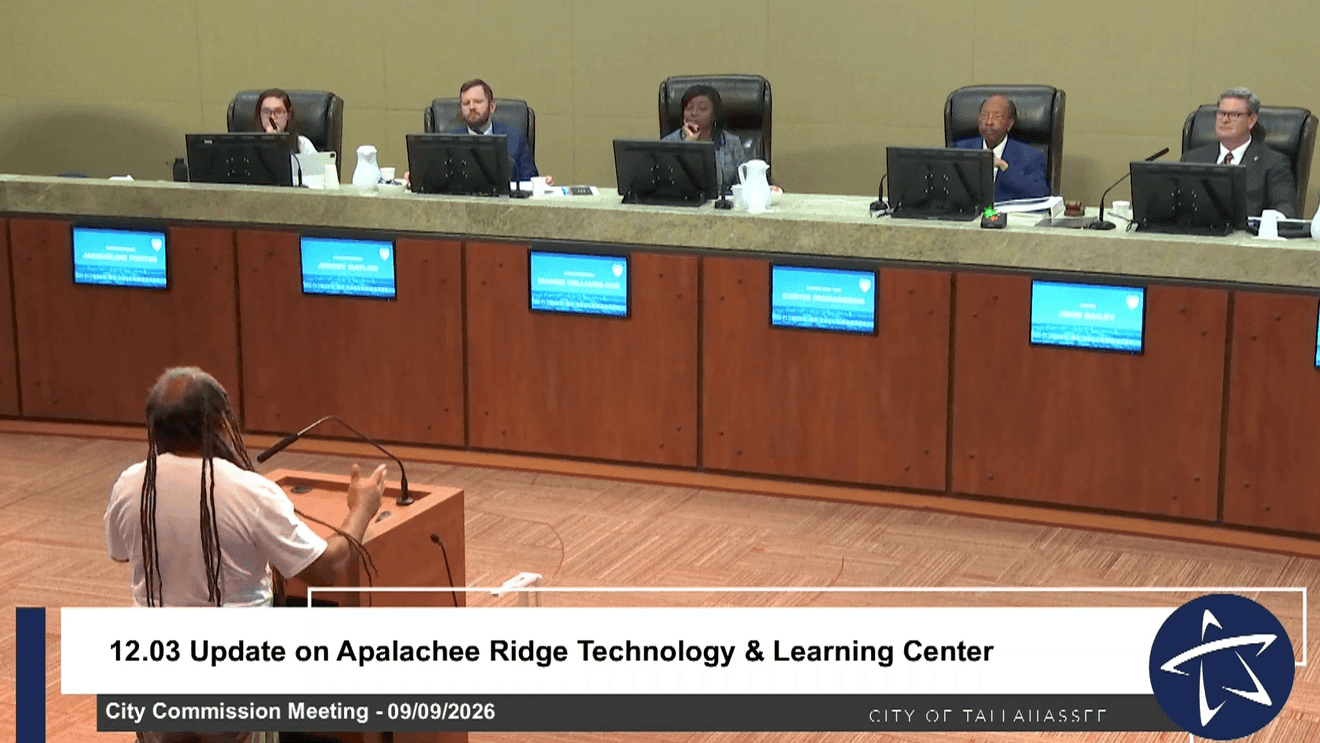
City commissioners voted unanimously to begin transferring the Apalachee Ridge Technology and Learning Center to the neighborhood association, potentially ending years of uncertainty that supporters say has limited grants, insurance and programs for children and families.
TALLAHASSEE, Fla. — After more than two decades of neighborhood advocacy, Tallahassee commissioners are moving to put a longtime community resource directly into the hands of the residents who have fought to keep it alive.
The City Commission voted 5-0 Wednesday to direct staff to develop an agreement transferring ownership of the Apalachee Ridge Technology and Learning Center to the Greater Apalachee Ridge Estates Neighborhood Association, a nonprofit organization that has helped operate and support the facility.
The agreement will include a reverter clause, designed to return the property to the city if the association ceases to exist or the facility no longer serves its intended public purpose.
For neighborhood leaders, the decision could resolve a problem that has persisted for years: They have been trying to raise money, secure insurance and expand programming at a building they use — but don’t control.
‘We weren’t going to close it down’
Neighborhood leader Christic Henry traced the center’s history back more than 20 years, describing it as the product of a broader neighborhood improvement effort driven by residents.
The center was initially supported through partnerships involving the city, Leon County, the state, Florida State University and other organizations.
When the recession undermined that funding model, Henry said residents faced a choice.
“We were faced with one option, not two, because we weren’t going to close it down,” she told commissioners.
The neighborhood association eventually became a nonprofit and continued operating the center with grants, partnerships and a continuing $10,000 annual city contribution.
The city also helped with major capital needs, including replacing the roof and HVAC system, while the neighborhood secured outside support for technology and other improvements. Henry said more than $53,000 in site improvements have been made.
No lease became a barrier
The problem intensified when the association’s lease expired.
The organization continued operating as an at-will tenant, but Henry said the lack of long-term site control eventually became a major obstacle.
When the association sought to renew liability insurance in 2024, she said it was asked a basic question: Where is your lease?
It didn’t have one.
That uncertainty came even as the organization was attracting significant outside investment.
Henry said Comcast provided more than $75,000, followed by $50,000 to support the federal Affordable Connectivity Program and 50 computers for residents in need.
The center has also hosted technology assistance programs where residents could bring computers for repairs or potentially receive replacement laptops.
But without control of the property, supporters argued the neighborhood cannot fully capitalize on grants and partnerships.
Neighborhood asks city: Give us the building
Henry asked commissioners to transfer the property to the neighborhood association with deed restrictions requiring it to continue serving the community.
“The major thing is obtaining the site control necessary to execute fully our programmatic delivery,” she said.
She also stressed who the center serves.
Henry told commissioners the neighborhood has a 45% poverty rate and a per-capita income of approximately $35,000.
At the same time, she said homeownership in the area has climbed back to approximately 53% after falling during the recession.
For supporters, giving the neighborhood control of the building is not simply a real estate transaction. They see it as an investment in a community that has already demonstrated it can attract resources and deliver services.
City says transfer is possible
City staff told commissioners Tallahassee has used a similar approach before.
Staff pointed to property purchased by the city and later leased to the NAACP before commissioners ultimately transferred it to the organization with restrictions.
A similar agreement could be structured for Apalachee Ridge.
Staff said the city has not conducted a formal appraisal of the technology center property. Based on nearby residential listings, staff estimated it would likely fall toward the lower end of the roughly $150,000-to-$230,000 range because converting the building back into a residence would require additional investment.
The city could have offered a long-term lease instead.
But commissioners ultimately directed staff to pursue transfer of title, not merely another lease.
Supporters: Neighborhood has already done the work
Council of Neighborhood Associations President Leroy Peck backed the transfer, telling commissioners the neighborhood has generated substantial resources of its own.
Peck said the association has marshaled more than $100,000 in volunteer labor and more than $186,000 in grants and other funding.
“This is the kind of thing we encourage all of our neighborhoods to do,” Peck said. “Put in the work, seek resources outside of the city, outside of government.”
“They put in the work,” he added.
Longtime residents also described the center as something much larger than a computer lab.
Elton Thomas recalled children coming to the center after school and university volunteers working with them. Adults also used the facility to develop employment skills.
Thomas said the neighborhood appeared poised for a resurgence in programming in 2024, but the lack of control over the building has made that difficult.
“We spent a lot of money to upgrade the building,” Thomas said, asking commissioners to provide the site control needed to attract additional outside investment.
Williams-Cox sees opportunity in technology and AI
Commissioner Dianne Williams-Cox strongly supported the transfer, saying she has personally seen the work happening at the center.
She pointed to the rapidly changing technology economy, including artificial intelligence, as an opportunity for the facility to help residents develop skills that could transform their economic futures.
Williams-Cox also asked the city’s grant staff to help the neighborhood identify and pursue funding for future programs.
Her support came with one safeguard: a reverter clause ensuring the property continues serving the public purpose for which it is being transferred.
Mayor Pro Tem Curtis Richardson, who made the motion, accepted that condition.
Porter: Public assets shouldn’t routinely be transferred
Commissioner Jack Porter supported moving forward but raised a broader caution about giving away city-owned property.
Porter said her preference generally would be to begin with a long-term lease when that provides an organization enough site control to operate successfully.
“I don’t think the default should be to transfer or sell public assets,” Porter said.
However, she said the Apalachee Ridge situation was sufficiently unique that she supported seeing what staff brings back.
Matlow also supported the transfer, noting that city responsibilities for the roof, HVAC, plumbing and other expenses would move with the property. He said maintaining the building’s public purpose was important and supported the reverter provision.
From city property to neighborhood control
The unanimous vote does not immediately hand over the keys.
It directs city staff to negotiate and prepare the transfer agreement, including restrictions designed to ensure the property remains a community resource.
But commissioners were explicit about their intent: the neighborhood association would receive title to the building rather than simply another lease.