
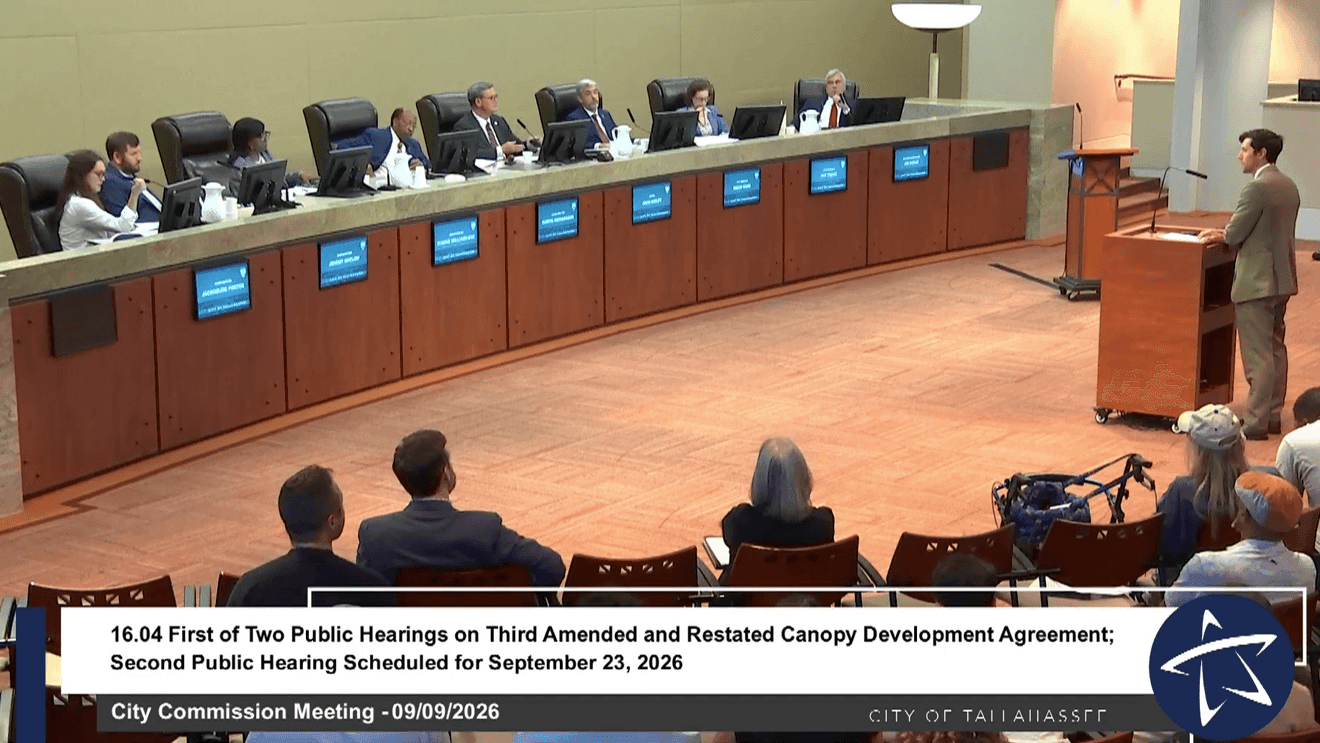
Tallahassee commissioners voted 3-2 to advance a proposed Canopy development agreement despite questions over a possible Dempsey Mayo-Miccosukee Road connection, traffic impacts, concurrency costs and whether taxpayers could inherit infrastructure expenses.
TALLAHASSEE, Fla. — A decades-old plan for a road connection across protected green space is again at the center of a Tallahassee development fight — this time raising questions about who pays for future roads, how more development will affect traffic and what happens to the Miccosukee Canopy Road.
Tallahassee commissioners voted 3-2 Wednesday to advance the third amended and restated Canopy development agreement to a second public hearing Sept. 23.
Commissioners Jeremy Matlow and Jack Porter opposed moving forward.
The most contentious issue involves the potential extension of Dempsey Mayo Road across the Miccosukee Greenway to Miccosukee Road.
City Growth Management Director John Reddick said the proposed agreement would clarify the developer’s position on that connection while also updating several older provisions of the Canopy agreement.
Would the developer have to build the road?
That question dominated the debate.
Attorney Erin Tilton, representing the developer, said the idea of extending Dempsey Mayo across the greenway dates to 1998, when an easement was reserved for possible future road access.
In 2002, the city and county adopted a policy allowing the connection if local government determined it would have a desirable impact on Miccosukee Canopy Road. A prior City Commission made that finding in 2006, Tilton said.
But Tilton disputed what she described as a public perception that the developer is obligated to construct the road.
“That was never the case,” Tilton said, adding that the obligation has never been contained in the development agreement, planned unit development or Welaunee Critical Area Plan.
Under the proposed amendment, the road could still eventually be built, including potentially by the developer. But Tilton said the agreement would clarify that constructing it is not a development obligation.
City planning has assumed the connection would exist
That clarification raised a more complicated issue.
Reddick told commissioners Tallahassee’s traffic modeling has operated under the assumption that the Dempsey Mayo connection would eventually be constructed.
When the city evaluates traffic generated by phases of Canopy development, its modeling assumes drivers will have that additional route to Miccosukee Road.
If that connection does not happen, Reddick acknowledged the city must consider what that means for traffic and concurrency calculations.
Porter questioned why those financial and traffic consequences were not resolved in the agreement before commissioners were asked to advance it.
Resident: Don’t shift road costs to taxpayers
Resident Lynn Adams-Tackus delivered some of the strongest criticism.
She argued the proposed changes could shift road construction responsibilities away from developers and toward taxpayers while allowing development to continue.
She also raised concerns about reserved roadway capacity, provisions she said could remain locked in for 15 years and the potential effect of continued development on Tallahassee’s tree canopy.
“Trees matter,” Adams-Tackus told commissioners.
She urged commissioners to scrutinize the agreement rather than approve changes that could ultimately leave the public paying for infrastructure associated with private development.
The developer disputed the premise that it is currently obligated to construct the Dempsey Mayo connection.
Porter: ‘The implications of this are pretty significant’
Porter said the uncertainty over traffic and concurrency costs was enough reason to stop the agreement and get answers first.
She also questioned why the agenda material indicated there was no financial impact when commissioners had just discussed potentially significant unresolved concurrency costs.
“This is a lot of money,” Porter said. “The implications of this are pretty significant.”
Porter moved to stop the process and have staff return with additional information, including the concurrency figure, rather than leave that issue for a separate agreement later.
Matlow supported her motion.
He said his reading of the proposal suggested financial responsibility could be moving away from the developer and toward city government.
“Frankly, on first reading to me it looks like it’s transferring financial responsibility away from the developer to the city government,” Matlow said.
City manager: Road may never be built
City Manager Reese Goad offered a different perspective.
Goad said development agreements naturally change as large projects evolve over decades and obligations are completed.
He also questioned whether the controversial connection will ever actually happen.
“I’m not sure that road connection’s ever made,” Goad said, pointing to substantial public opposition, particularly around Westminster Oaks.
Goad said the proposed agreement nevertheless provides useful clarity over easements, utilities and how a connection could work if it is eventually pursued.
Development agreement also changes other requirements
The roadway is not the agreement’s only change.
Staff said the amendment also addresses transit shelter requirements, recognizes the 2024 termination of an inclusionary housing agreement and removes or updates obligations that have already been satisfied.
The developer described the changes largely as a cleanup of an agreement originally approved in 2011 and amended in 2016 and 2020.
Tilton said there are no proposed changes to the underlying development program.
Final decision Sept. 23
Porter’s attempt to pause the process did not prevail.
Commissioner Dianne Williams-Cox instead pushed to continue to the second hearing, arguing commissioners have two weeks to get answers to the questions raised.
Mayor John Dailey agreed the issues were serious but said he was not ready to stop the process.
The commission voted 3-2 to move forward, with Matlow and Porter opposed.
The second and final public hearing is scheduled for Sept. 23 at 6 p.m.