
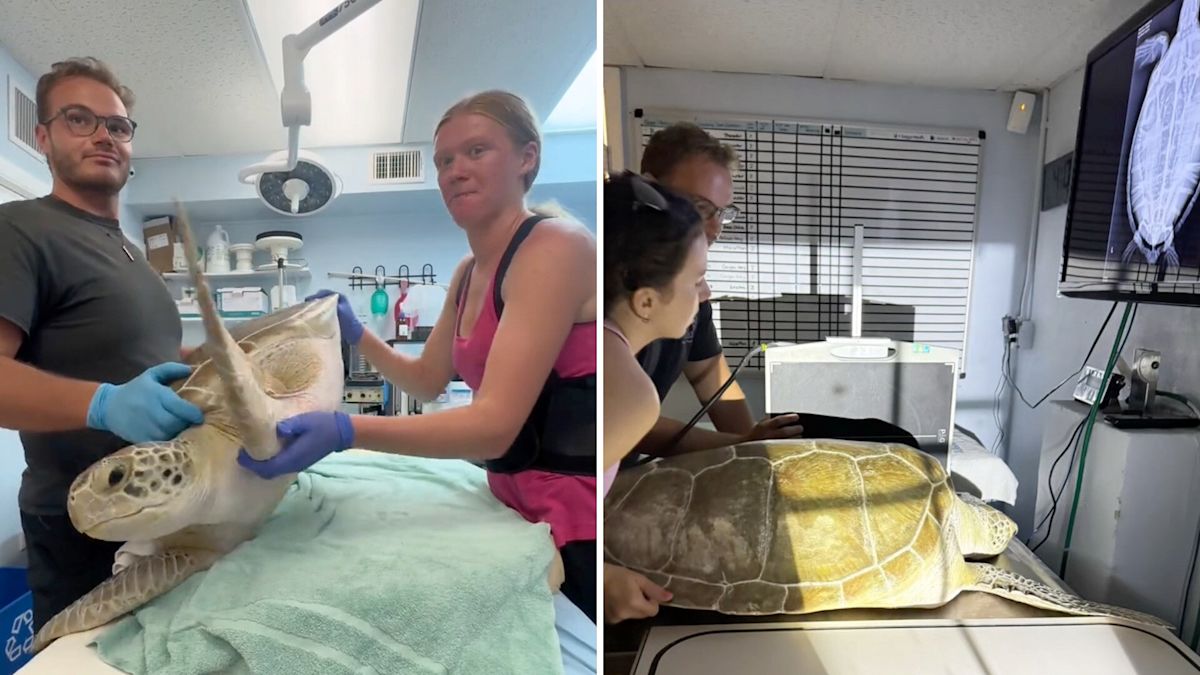
A rescued green sea turtle in Florida is getting a second chance after undergoing an unusual medical procedure designed to help her breathe — and dive — normally again.
Off Key West, rescuers found Baby Myrtle, a 100-plus-pound green sea turtle, floating at the surface because air trapped inside her body kept her from submerging on her own.
Here’s what to know
In a TikTok update shared by The Turtle Hospital (@turtlehospital), Myrtle’s caretakers said the U.S. Coast Guard helped bring her in after the rescue. They diagnosed her with a pneumothorax, explaining that air had collected in her coelomic cavity and was interfering with her ability to dive normally.
Her first round of treatment included a lung tap to draw out the trapped air, along with broad-spectrum antibiotics, fluids, and vitamins. Staff then placed her in a hospital tank so they could continue watching her recovery.
Veterinarians later moved on to a blood patch, a procedure that uses donor blood in hopes of sealing a suspected tear in the lung. The hospital said blood from resident turtle Sam was matched for Myrtle to help that suspected lung injury heal.
One commenter wrote, “What a big beautiful girl! I hope the patch works so she can get back to diving.”
More background
Sea turtles play a key role in ocean ecosystems, and healthier marine ecosystems can help support the coastal environments that communities rely on for recreation, local economies, and biodiversity.
By releasing trapped air, a lung tap can ease dangerous pressure. The blood patch, by contrast, targets the leak itself rather than simply treating the symptom.
“She is beautiful!” one commenter wrote.
Another added, “I love how each turtle has their own specific coloring combo making each one so unique.”
What’s being done?
After the blood patch, Myrtle had post-procedure X-rays and was placed back in the water so staff could watch for signs the leak is closing and her buoyancy is returning to normal.
The lung tap removes air that has already built up, while the blood patch helps the lung heal so more air doesn’t keep escaping.
Wildlife hospitals, rescue partnerships, and animal donors such as Sam can be critical in complicated medical emergencies. When facilities have trained staff, equipment, and blood donors available, they can respond quickly to emergencies that might otherwise prove fatal.
Her caretakers said, “Myrtle received post-procedure X-rays and is now back in the water.”
Where can I learn more?
Myrtle’s recovery shows how much sea turtle survival can hinge on a quick rescue, careful rehab, and follow-up care. Similar efforts have helped turtles that were stranded, disoriented, or too badly injured to make it back to the water on their own.
• In North Carolina, scientists saved a green sea turtle and returned it to the ocean.
• At Florida’s Navarre Beach Pier, responders explained a sea turtle rescue step by step.
Cases like these show the kind of coordination and patience it takes to give vulnerable turtles another chance.
Get TCD’s free newsletters for easy tips, smart advice, and a chance to earn $5,000 toward home upgrades. To see more stories like this one, change your Google preferences here.