
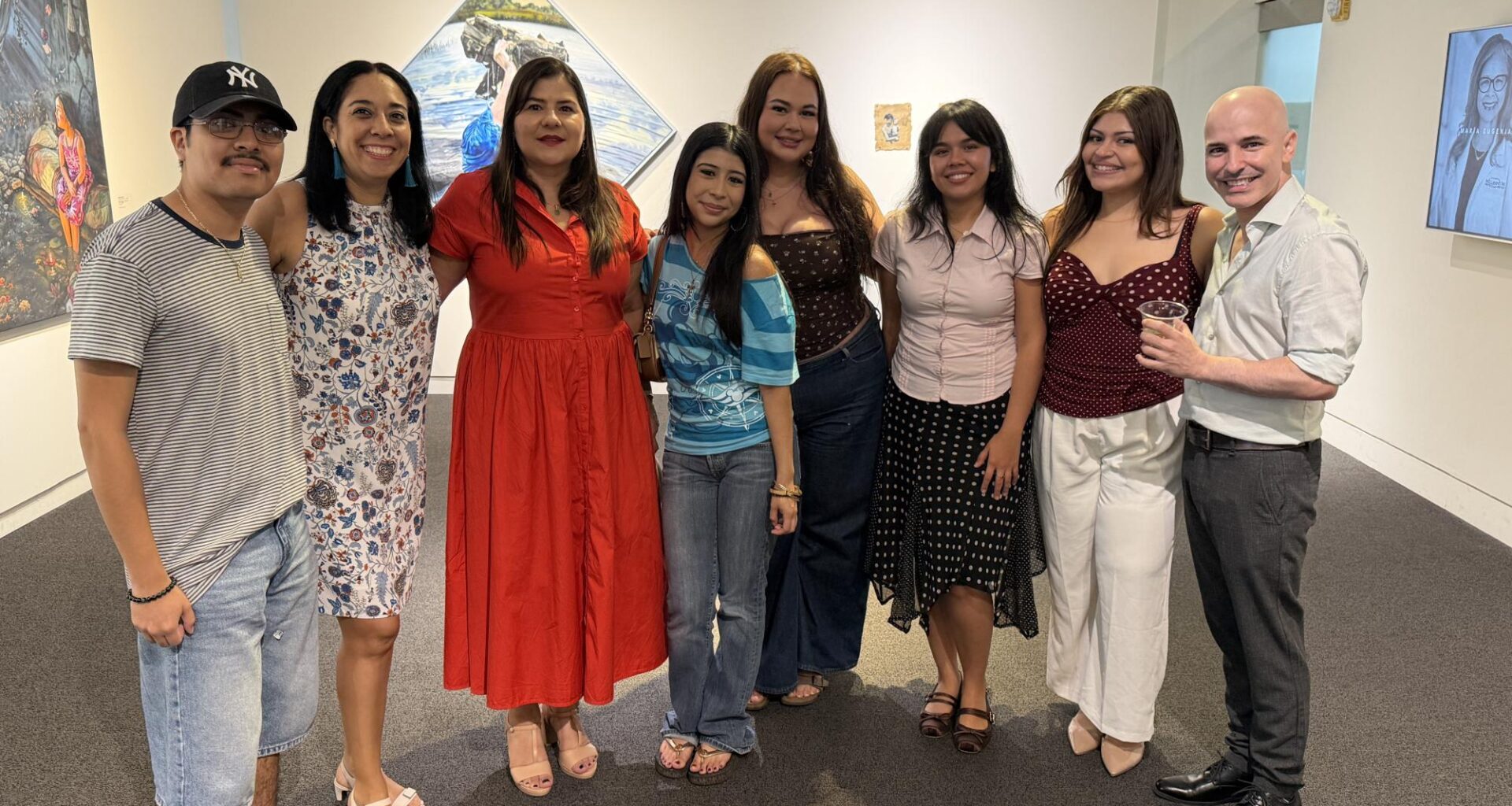
For 14 years, the Voces y Caras project has collected hundreds of interviews with members of the Latinx community, aiming to tell stories about communities left out of the limelight, according to University of North Florida professor Constanza López Baquero.
López Baquero, a Latin American Literature and Spanish professor, began Voces y Caras in 2012 after moving to Jacksonville from New York. Doctors, business owners, civic leaders, and newly arrived immigrants have filled an archive of more than 200 recordings, each conducted by a UNF student searching for a piece of their own history in someone else’s, López Baquero says.
Now, the project has reached a major milestone by moving off campus to the downtown Museum of Contemporary Art Jacksonville, where it will remain on display until Sept. 21, according to the MOCA website.
In past years, Voces y Caras held a physical exhibit during Hispanic Heritage Month at UNF’s Thomas G. Carpenter Library for 11 years, then moved to the UNF Gallery of Art in 2023. This year’s exhibit opened during Downtown Jacksonville’s First Wednesday Art Walk, drawing community members, students, and alumni alike.
For this year’s featured artist, MOCA and Voces y Caras partnered with Cuban American painter Ricder Ricardo. Two of his oil-and-laser-engraving pieces, “The Lake” and “The Beach,” hang alongside the project’s interview archive, displaying the faces of interviewees who have taken part over the past 14 years.
Voces y Caras
Voces y Caras, Spanish for “Voices and Faces,” is a passion project of López Baquero. The project is a digital oral history initiative at UNF that engages students of Latinx heritage in developing questions, recording interviews with members of the growing Latinx community and documenting their experiences as immigrants.
According to the site, the project serves four purposes:
Recognizing immigrants as essential to the community
Connecting heritage Spanish speakers to their cultural backgrounds
Letting those students see themselves in the stories of others
Building community both in and outside the classroom
López Baquero used the podcast format in a previous job before bringing it to UNF, at a time, she said, when podcasts were becoming a more prominent medium.
“We wanted to highlight the people, the voices and faces of the community,” said López Baquero.
López Baquero calls her teaching style “horizontal” and “very collaborative.”
“The students had the freedom to learn, and I would be there for support,” she said. Students picked their own podcast topics, and she guided them rather than directed them.
That freedom sent her students in varied directions: Yadhira González researched LGBTQ+ history in Latin America, Alma Cruz looked at Dominican culture and clothing, and Oscar Andrade traced K-pop’s influence on Latin American dance.
To learn how to communicate their research naturally through a podcast, López Baquero used performances and theater exercises to help students become more comfortable speaking and projecting their voices before recording.
While the in-class monologues and plays helped students learn to project, “it also helped them feel more comfortable with one another,” López Baquero said. This interactive environment directly laid the groundwork for the students’ foray into formal academic research and public presentations.
The Students
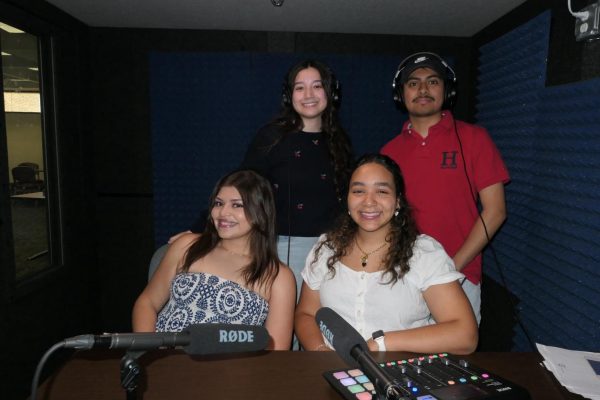 Left to Right: Jacqueline Gonzalez, Alma Cruz, Oscar Andrade and Yadhira González in the podcast lab (Courtesy of Alma Cruz).
Yadhira González, a public health major and heritage Spanish speaker, said that comfort came with a language lesson, too.
“She empowered us so much that we kind of uplifted each other,” González said.
Practicing in the Spanish language lab with her classmates helped her sharpen both skills. “I had to learn how to better communicate, since I am a heritage speaker, so I only learned how to speak from other people. I didn’t read or write,” González said.
“I mean you can see us talk in Spanglish now,” González said, nodding at fellow student Cruz. “It’s a skill that I have gained that I can put into use later on.”
Cruz, a Spanish and psychology major, said the curriculum built in proper research and podcast production, with students learning how to interview, write, record and present their work to a professional standard.
“We had to learn how to speak up, how to ask the right questions, how to write and talk at the same time,” Cruz said.
The project’s community focus also shaped how Cruz approached her research. Her work included interviews with people in the Dominican Republic, while the larger Voces y Caras project focuses on sharing stories from members of the Hispanic community.
“Having a space where you can connect and notice, ‘I’m not the only person going through this,’” Cruz said.
Undergraduate Research: UNF Latinx
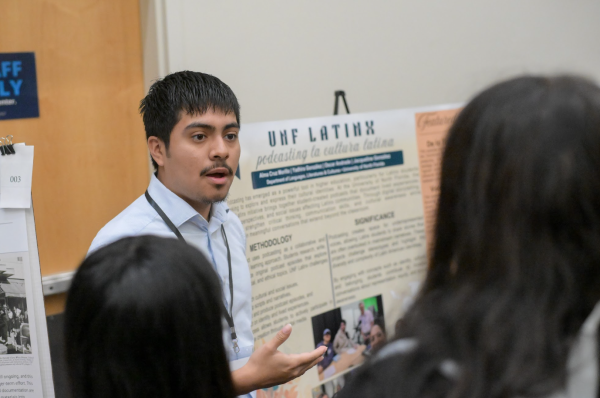 The student researchers presented their work at the UNF Student Research Symposium in April and were named the Office of Undergraduate Research’s Researchers of the Month in September (Courtesy of the UNF Office of Undergraduate Research).
For González, working on the UNF Latinx project presented them with the opportunity to get involved in research.
“I was trying to get into undergrad research, but it was kind of difficult trying to connect with other professors,” González said. “But then once I got into a class, and I realized like research was embedded into the class, I was like, oh, this is so cool.”
For Andrade, an international studies major at the university, the experience also changed how he approached communicating with others. Presenting his research required him to become more comfortable talking about his work and answering questions.
“I don’t think I can be as shy as I was, because you have to talk to people and connect with them,” Andrade said.
The student researchers presented their work at the UNF Student Research Symposium in April and were named the Office of Undergraduate Research’s Researchers of the Month in September.
Building on momentum from local presentations like the UNF Student Research Symposium, the team took their research to San Antonio this month, where they presented alongside López Baquero and Dr. Andrea Gaytán Cuesta at the Latin American and Caribbean Digital Humanities Symposium.
Their presentation, “UNF LatinX: Podcasting Latinx Studies as a Pedagogical Tool,” was supported by UNF’s Digital Humanities Institute and a conference travel grant from the Office of Undergraduate Research.
With an audience of “mostly graduate students, Ph.D. students and other professors,” Cruz said many audience members seemed engaged with the UNF Latinx presentation, adding that “the professors liked to see this initiative that we have here.”
According to Cruz, toward the end of the podcast panel, “everybody was very emotional.”
“They really liked the fact that it’s a space for Latinos to use their voice, and it’s a space for students to create community in the classroom,” Cruz said. “In this era where everything is very AI, having a space where students have to talk and collaborate and create this whole podcast is very meaningful. Seeing other graduate students really inspired all of us to continue our education. It was a very good experience for growth.”
For González, the future of the project and podcast comes back to its ability to connect people and the surrounding community.
“As AI is growing, this is one of a few things that are still made by humans, and we’re actually connecting with each other, and we’re connected with the community,” González said.
Exhibit at MOCA
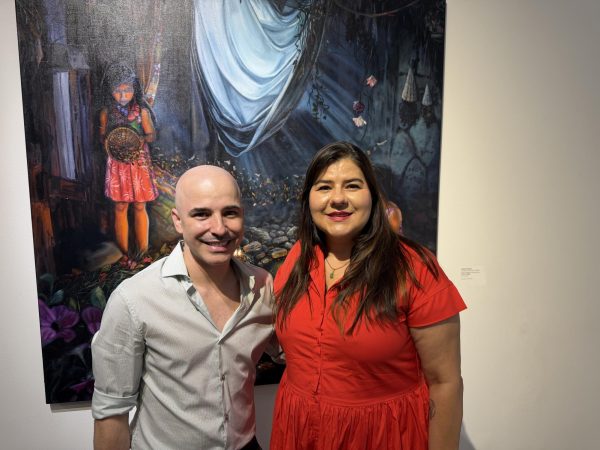 Constanza Lopez and featured Cuban-American artist Ricder Ricardo pose in the MOCA exhibit (Courtesy of Clayton McCarl).
López Baquero said she wanted the opening to make the project visible to the wider public, not just the university.
A recording studio was set up inside the MOCA theater, open to anyone who wanted to sit down and record an interview with a loved one, adding directly to the project’s growing archive.
Daisy Miranda, an international business and Spanish sophomore at the university and a member of the campus LASO chapter who attended the opening, said it was her first time at the Art Walk.
“When I arrived, it was very packed already, and seeing all the people who showed up for our presentation, and just as a whole, I think it was really meaningful,” Miranda said.
She said the interviews collected for Voces y Caras stretched beyond the usual voices.
“It wasn’t just adults or professors that you could interview,” Miranda said. “It was people who come from different backgrounds, people in the LGBTQ+ community, people who have different careers.”
Miranda said she had the opportunity to interview Yadira Cardona, Jacksonville’s first Hispanic outreach coordinator.
“She made a really big impact on Jacksonville, and especially the Hispanic community, especially for students too. Family members were interviewed, and people got to share stories about their parents and siblings,” Miranda said. “I think that was also really beautiful.”
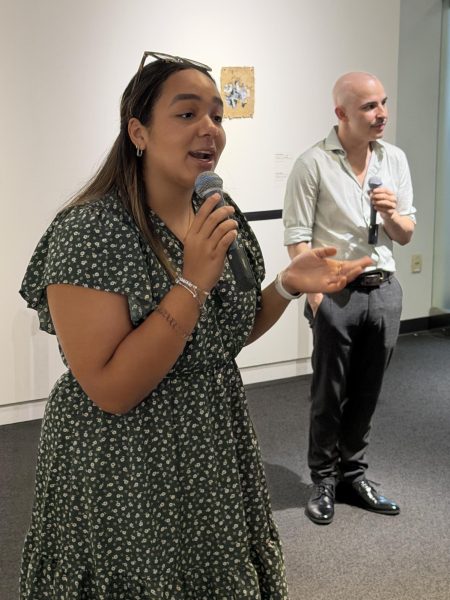 Spanish and Psychology student Alma Cruz speaking at the “Voces Y Caras” MOCA exhibit opening (Courtesy of Clayton McCarl).
“It kind of represents what the Latin American Student Organization is,” Miranda said of the project. “We definitely try to create a space to learn about these different experiences within our community, and for other people who are outside of our culture to learn more about it. We push through.”
She spent close to two hours at the Art Walk, taking in handmade jewelry, clothing and Ricardo’s portraits.
“One of his portraits is kind of about how immigrants crossed the border, and how they had to literally go through trenches and all this stuff just to get over here,” Miranda said. “That was emotional.”
López Baquero said finally seeing the constructed exhibit didn’t land the way she expected.
“As we were finishing up the project, I was more worried about getting everything done; when seeing the exhibit, it was more like a breath of fresh air than awe,” López Baquero said.
Watching people move through the space, López Baquero said, made the true impact hit. Past interviewees, their families, and former students attended, with several interviewees tearing up at the sight of the exhibit.
Another attendee brought “their grandmother, and she brought me bread as a gift,” López Baquero said.
The moment stood out to López Baquero, who said the act showed how the local Latinx community had truly “come together” around the project.
Voces y Caras will be on display at MOCA Jacksonville through Sept. 21.
For more information or news tips, or if you see an error in this story or have any compliments or concerns, contact [email protected].