
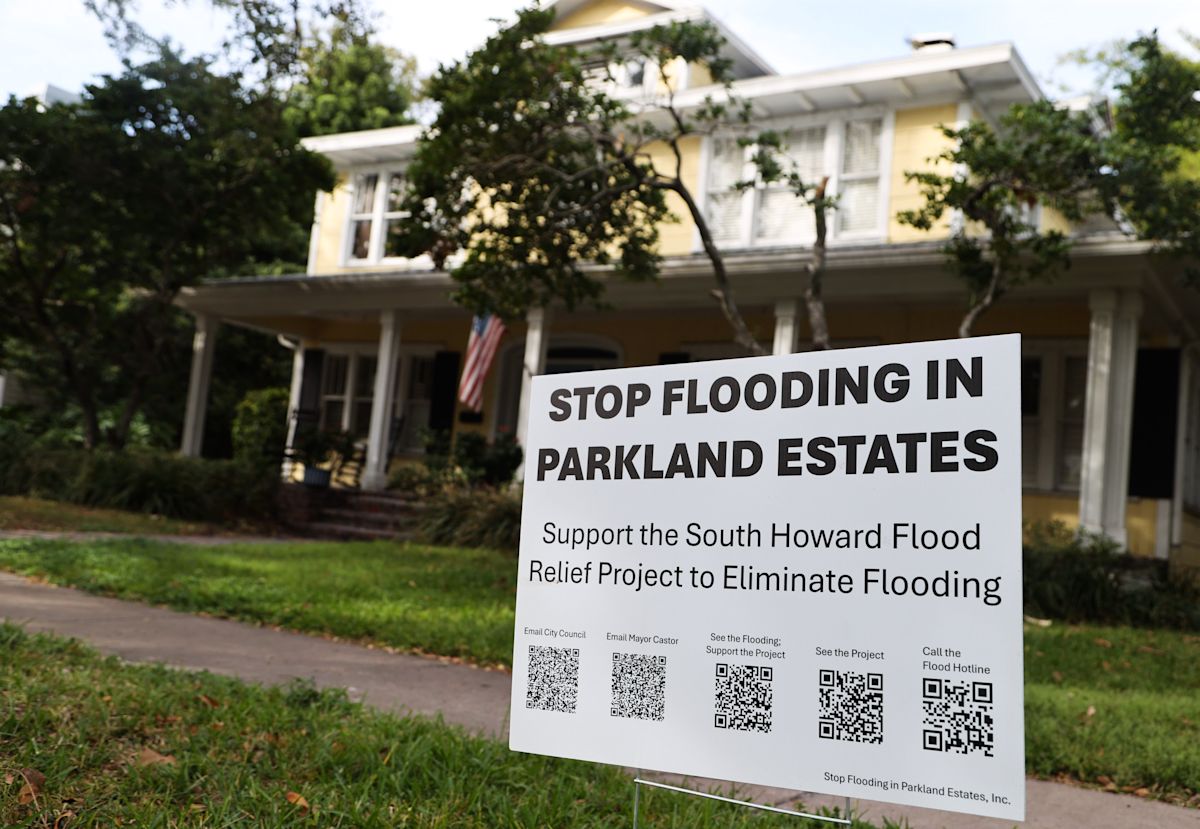
The Tampa City Council on Thursday narrowly approved the contentious $100 million South Howard flood relief project, intended to alleviate persistent flooding in a slice of South Tampa.
The council voted 4-3with board members Bill Carlson, Naya Young and Guido Maniscalco voting no. Council chairperson Alan Clendenin, the swing vote, said it was among the most difficult decisions he has made on the board.
The vote, which propels the project toward construction, marked the climax of a yearslong debate that pit neighbors, business owners, city leaders and city staff in opposition.
Across the divide, all agreed on one thing: “We’re fighting against our neighbors,” said Shawn Routten, general manager of the Epicurean Hotel. “It should not be this way.”
The city’s plan involves adding a box culvert system along stretches of South Howard Avenue and West Swann Avenue to suck water away from Parkland Estates, Palma Ceia Pines and surrounding neighborhoods.
Led by Kimmins Contracting Corp., the work will begin at Bayshore Boulevard and inch north toward the affected neighborhoods. It is designed to handle up to 5 inches of rain over eight hours — not a major storm like Hurricane Milton.
Many of the homes in the area are more than a dozen feet above sea level and fall in Zone X — a federal designation that means they should have a low chance of flooding. Flood insurance is not required.
Still, engineers say, the neighborhoods are vulnerable because of their topography: Shaped like a giant bowl, the area collects water that can’t escape through small, aging pipes.
At meeting after meeting, residents have shared tearful accounts of streets turned to rivers during short bursts of rain; of homes, cars, furniture and family artifacts destroyed when the water rushes in.
Opponents do not dispute the need for flood prevention. But they worry the project will drain the city’s stormwater funds, and that it could disrupt their shops, offices and restaurants. The SoHo Business Alliance is suing the city over public records tied to the project and have proposed alternative routes that would skirt the busy street.
Both sides have accused the other of fueling a blaze of false information.
“We want to focus on the facts,” said Brandon Campbell, Tampa’s mobility director, at a final pro-project news conference Wednesday. “Unfortunately, there’s also a lot of misinformation about the project that’s been circulating.”
Skepticism trickled to several council members, who for months have probed city staff on funding, permits and engineering plans. Thursday’s vote concerned a $92.7 million guaranteed maximum price, which did not include $7.7 million already approved for design.
“I keep asking one question: Is there another way?” Clendenin said. “Is there a less expensive or less disruptive alternative that provides the protection this community needs?”
The answer, he decided, was no.
“Doing nothing is also a decision,” he said.
“Who’s right and who’s wrong?” asked council member Charlie Miranda. “There’s flooding in a lot of areas, and we’ve got to start somewhere. We have an opportunity to start here.”
Attendees packed the council’s chamber hours before Thursday’s vote, lining the walls and spilling intoan overflow room downstairs.
Ahead of a marathon of public comment, Clendenin floated shortening the usual three minutes of time allotted for each speaker to two. Several people exclaimed in protest, and the suggestion fizzled.
Wearing a T-shirt that read, “Stop Flooding in Parkland Estates and Palma Ceia Pines,” resident Steve Gerrish said there are “always going to be problems” with proposed flood prevention efforts.
“But we need a solution,” he said. “It’s been 10 years and we need something to happen now.”
David Adams, a Parkland Estates resident, said residents would support the affected businesses.
If council members denied the project, Adams told the Tampa Bay Times last month, he would consider building a concrete wall with a floodgate around his property.
“Is that good for my neighbors? Absolutely not,” he said. “But if the city won’t protect me, I have to protect myself. I don’t know what else to do.”
Linda Misner, who owns a personal training studio steps from South Howard, listed a range of questions: What is the city’s plan for parking? What happens if homes and businesses along the route are damaged by construction? Could the residual effects cause more flooding in other pockets of South Tampa?
Routten, the general manager of the Epicurean, said the hotel has already lost potential customers due to uncertainty around construction. David Laxer, the owner of Bern’s Steak House, said there could be aftershocks for the restaurant’s 300 employees and their families.
John Lister, the executive chef at Ava, said, “We won’t survive this. We will fail.”