
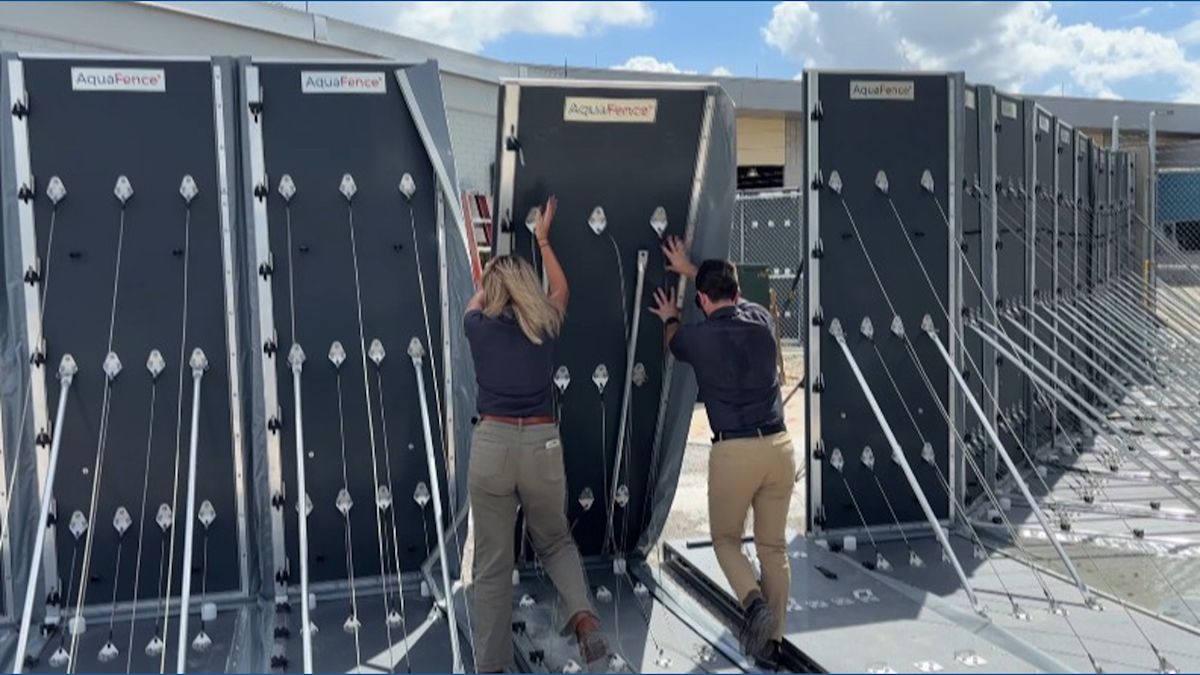
Tampa International Airport is displaying its newest layer of protection against storm surge, designed to help keep critical electrical equipment operating during and after a major hurricane.
The airport recently installed a custom-fit, 9-foot AquaFence around an airfield electrical vault.
The barrier is part of a $1.9 million project that also includes foundations, drainage, fencing and pumps.
The goal is not simply to keep floodwater away from the airport during a storm. Officials say protecting the electrical equipment could help TPA resume normal operations more quickly after a hurricane.
“The airport functions as an emergency response airport for the community and so we need to make sure that our airport operations remain open and operational pre-hurricane as well as post hurricane,” said Dan Seeley, TPA’s director of construction.
That includes keeping flights moving and allowing personnel and government resources to reach the region.
“Absolutely. Flights, personnel. Any local or governmental assistance that we can get. It has to remain operational,” Seeley said.
The need became more apparent during the 2024 hurricane season. TPA did not experience power outages or runway impacts during the storms, but water approached the west runway at levels officials said they had never seen before.
“So that sort of opened our eyes to say we need to take a hard look at all of our infrastructure to make sure that we’re ready for the next storm,” Seeley said.
The airport subsequently reviewed its flood maps and identified several critical areas where additional resilience was needed.
“This airfield electrical vault behind me is one of those locations,” Seeley said.
The vaults contain electrical equipment that powers airfield lighting, signs and other systems needed for flight operations.
“We need to make sure that these are operating 24/7 and they can never go down to sustain our flight operations,” Seeley said.
A flood at the facility could have a significant effect on airport operations because some of the electrical equipment has long replacement lead times.
“If this facility flooded, it would be a major impact to our airport operations. There is electrical gear in here that has long lead time, and it would be quite impactful to what we do on a daily basis,” Seeley said.
TPA chose the 9-foot AquaFence after seeing a similar system deployed at Tampa General Hospital during Hurricane Helene in 2024. It is the tallest AquaFence model and is designed to withstand Category 4 hurricane conditions.
The system has also been tested for winds of up to 140 mph, according to AquaFence President Patrik Hansson.
The barrier is not intended to stand permanently around the electrical vault. Instead, the panels are stored in specially marked crates until a storm threatens.
The system has about 250 components for each panel, and each installation is engineered and customized for its specific location, Hansson said.
“So, it’s not an off-the-shelf product. It’s a specific product for each site that we do,” Hansson said.
The airport’s specialized response team can deploy the barrier around the vaults in about eight to 12 hours.
During the installation demonstration, crews were performing what Hansson described as a “dry fit” to make sure each panel fits precisely before the system is taken down and stored.
“Today is more learning, putting it up, making sure everything fits. It’s according to specifications and then we put it back and hope we never have to use it,” Hansson said.
Hansson said the system has undergone testing by the U.S. Army Corps of Engineers and in Europe, including impact and wind testing.
The AquaFence is also designed to be reusable, with the company saying the system is certified for repeated deployment.
Hansson contrasted that with traditional sandbagging, saying the barrier can be taken down, cleaned and stored after a storm rather than requiring the same type of cleanup and disposal.
TPA is the first airport in Florida to install the AquaFence system. Other airports using the technology include Boston Logan International Airport, LaGuardia Airport and Teterboro Airport.
For now, TPA has no plans to install additional AquaFence systems. Seeley said the airport is instead taking a broader look at locations throughout the property and considering different ways to harden critical infrastructure against future storms.
“We’re not just building for today we’re building for the future,” Seeley said. “And so, with sea levels rising and increase and we wanna make sure that what we put out for our infrastructure is good for the next five, 10, 15, 20 years. So that’s why we went with the 9 foot Aquafence.”