
Cranes are a constant in South Florida skylines, but construction crews there are getting less real value from their wages than their counterparts in every other major U.S. metropolitan area, new research shows.
A new analysis by online industry publication and research outlet Construction Coverage found construction workers in Miami-Dade, Broward and Palm Beach counties earn a median $50,650 a year.
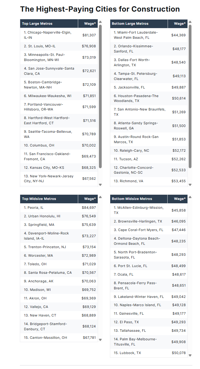
The region’s cost of living runs 14.2% above the national average, however, so those earnings are equal to $44,369 — the lowest of any U.S. metro with 1 million or more residents.

(Image via Construction Coverage)
For context, the median annual wage for all workers in the tri-county region, across every occupation, is $48,640.
That means construction jobs in the Miami area pay only about $2,000, or roughly 4%, more than the typical local job before adjustment. Nationally, the gap is far wider. Construction workers across the U.S. earn a median $59,540, nearly 17% more than the $50,980 median for all occupations.
The Miami metro area employs nearly 109,300 construction workers, according to the study.
(Image via Construction Coverage)
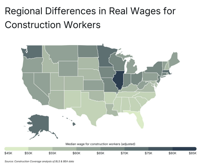
At large, Florida is just as bad. After adjusting for regional prices, the Sunshine State ranks dead last among the 50 states, with a median construction wage of $47,740.
Illinois ranks first at $80,604, meaning Florida workers take home about 40% less once living costs are factored in.
Other Florida cities also rank near the bottom. Orlando ($48,177), Tampa ($49,113) and Jacksonville ($49,887) joined Miami among the five lowest-paying large metros after the cost-of-living adjustment, with Dallas-Fort Worth rounding out that group.
And among midsize metro areas of 350,000 to 999,999 residents, 11 of the 15 lowest-ranked areas are in Florida, including Cape Coral-Fort Myers ($47,446), Port St. Lucie ($48,499), Naples-Marco Island ($49,128) and Tallahassee ($49,734).
The disparity is regional, with nine of the 10 lowest-paying states in the South, including Texas ($50,661) and Georgia ($51,707), where lower living costs offset modest base pay.
Meanwhile, eight of the 15 best-paying states are in the Midwest, and some expensive coastal metros also placed high because their base pay is steep enough to absorb higher costs, including Boston, San Jose, San Francisco and Seattle.
To produce the rankings, Construction Coverage researchers drew on the U.S. Bureau of Labor Statistics’ 2025 Occupational Employment and Wage Statistics, the U.S. Bureau of Economic Analysis’ 2024 Regional Price Parities and the U.S. Census Bureau’s 2024 American Community Survey.
Jonathan Jones, a senior researcher and data journalist at Construction Coverage, performed the analysis, which covered all wage and salary construction trades workers at nonfarm employers in every state and more than 350 metro areas.
Jones’ findings come as the construction industry regains momentum in the U.S. After holding at about 8.25 million jobs throughout 2025 amid high interest rates and rising costs, nationwide construction employment climbed to a new peak of more than 8.34 million by mid-2026, fueled by heavy infrastructure spending and new manufacturing projects.