
UNF’s Student Health Center staff knows students often go to another medical professional before arriving at the clinic: Dr. Google.
“Between social media and Dr. Google, people come in with a plan,” said Dr. Vanessa Riegert-Johnson, chief medical officer and medical director at Student Health Services.
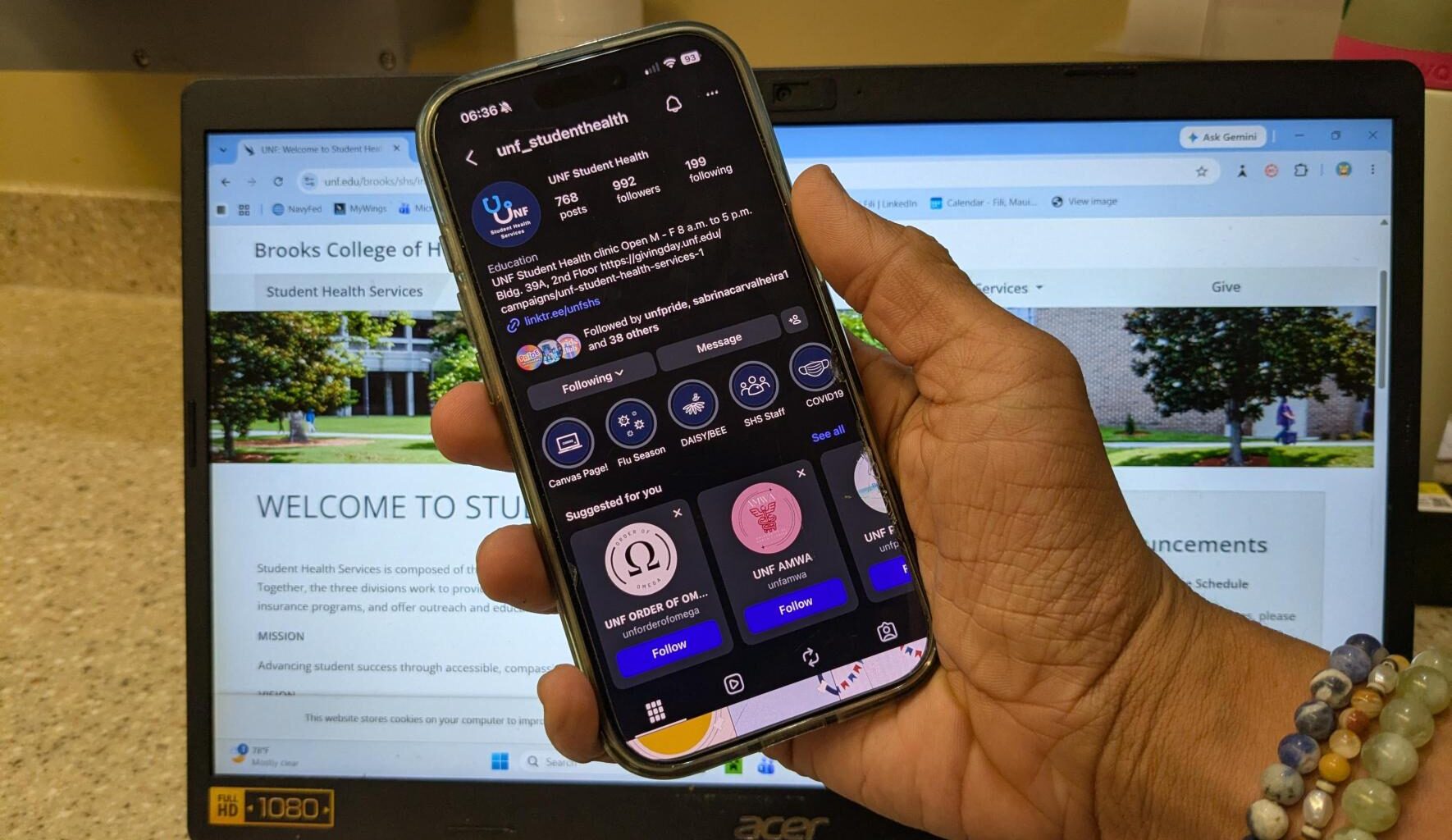
The clinic has adapted to technology, featuring online resources such as a Canvas page and recently updated Facebook and Instagram accounts, where students can find general information about the clinic and its resources.
Dr. Google is NOT board-certified
College-aged students have shifted online for advice, including medical and health information.
A 2025 study in Frontiers in Public Health found more than 90% of surveyed college students had searched online for health information, most often to research a new symptom or to prepare before an appointment.
While researching before an appointment is common, students need to make sure they get medical information from a credible source, according to Riegert-Johnson.
“I want you to be interested in your health, and I understand people want to try to figure it out on their own too. I get that. But don’t take it as gospel,” Riegert-Johnson said.
Students may struggle to sift through their timeline for credible information on social platforms like TikTok. A 2026 analysis by Tebra reviewed more than 5,000 TikTok videos offering medical advice and found 45% were false or misleading, with alternative medicine content the least accurate of any category.
“One of my biggest concerns about social media in general is just the drive that makes people compare themselves to other people and often feel inadequate,” Riegert-Johnson said.
Beyond spreading misinformation, Riegert-Johnson said some trends actively promote habits that work against a student’s health, “even when they’re marketed as self-care.
An example Riegert-Johnson used was “slugging,” a skincare trend that involves layering heavy moisturizer, like Vaseline or Aquaphor, over the entire face overnight after heavy exfoliation.
“You don’t need to do all that,” Riegert-Johnson said. “If anything, it often causes more irritation, since it can clog pores unnecessarily.
Student Health: A Credible Health Influencer
To meet students where they are, Student Health Services has leaned further into its own online outreach.
“That’s also the reality; that’s where people are going for health information,” Riegert-Johnson said.
Valarie Morrison, director of Student Health Services, said the clinic’s Instagram account is working toward 1,000 followers, while its Facebook page targets faculty and alumni more than students.
“One of the things we have pinned on there is how to use your patient portal so people can understand where to go to access their information,” said Morrison.
The Student Health Instagram features clinic updates, highlighting upcoming events and resources, such as how to read lab results or informative posts about the clinic’s gynecology services.
The page also shares timely preventive care recommendations and infographics, such as monthly awareness highlights and “Back to School Bug” recommendations.
The clinic also recently revamped its self-guided Canvas course, which is open for enrollment for any interested student. The course page acts as a hub for resources and information that students can easily access, including sleep, women’s health, men’s health, and general preventive care, according to Morrison.
Students don’t have to work through it from front to back, Riegert-Johnson said, and can jump straight to whichever modules apply to them.
Telehealth Resources
As students search online for medical information, more students have also opted to be treated via telehealth.
According to FAIR Health data, as of September 2025, adults aged 19-30 accounted for nearly 24% of all telehealth claims in the United States, the largest share of any age group.
UNF Student Health Services offers telehealth visits through Zoom, scheduled the same way as an in-person appointment through the Student Patient Portal. Students get a secure Zoom link at least an hour before their appointment and can check in as early as 15 minutes ahead, according to the clinic’s website.
UNF’s Counseling Center also offers telehealth appointments, available 8 a.m. to 5 p.m. Monday through Friday, through an online request on the Counseling Center’s website.
In-Clinic Support
Every student who pays the university’s mandatory fee can visit the clinic for free, although tests, labs, and certain procedures may cost extra, according to the UNF Student Health Services website.
“We have quick appointments; come in, have a conversation,” Riegert-Johnson said. “It’s always to make sure you’re not going down the rabbit hole of something that could cause you harm.”
Students with other health questions can reach Student Health Services on the second floor of Building 39A or call 904-620-2900 to book an appointment or speak with the clinic’s 24/7 nurse advice line.
Students can find more information on the Student Health Center webpage or on the Student Health Center’s Instagram and Facebook pages.
For more information or news tips, or if you see an error in this story or have any compliments or concerns, contact [email protected].