
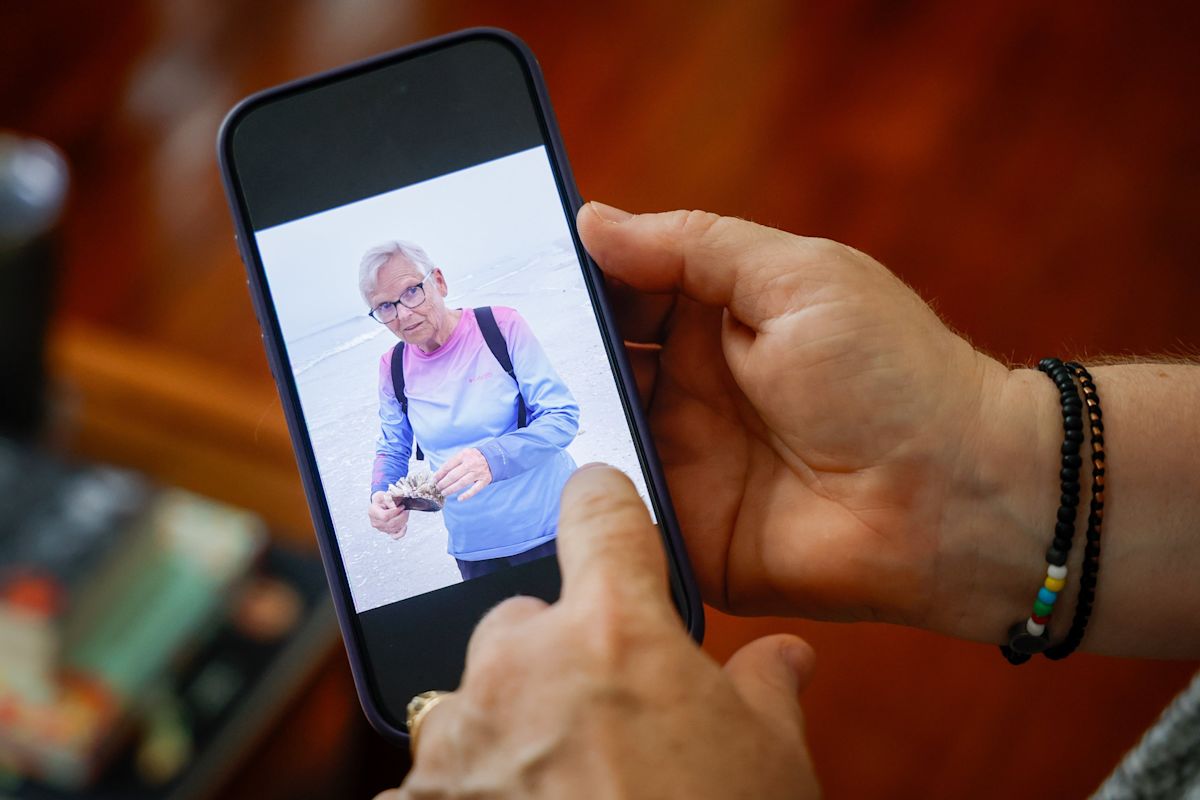
The Florida Department of Health confirmed Friday that a Hillsborough County woman is the first known person to die as a result of dengue fever in the state this year.
Gay Small died at Tampa General Hospital on Sept. 4, the result of a mosquito bite she got near her home on Bayshore Boulevard. The Tampa Bay Times reported her death about 10 days ago, before health officials confirmed dengue was the cause.
Her death certificate includes “dengue infection” along with “septic shock” and “multi-organ failure.”
“So I guess that means the state agrees she died of dengue,” said her daughter, Anna Small, 55, on Thursday.
Small’s death marks Tampa Bay’s first fatality from the tropical disease in almost a century, according to Kristi Miley, who teaches at USF’s College of Public Health.
Historically, most dengue cases were contracted overseas and brought back to Florida.
But since July, the state has been experiencing an unprecedented outbreak of locally caught cases. Hillsborough County has been at the epicenter of the epidemic.
The most recent state department of health report, which includes data through Sept. 12, shows that 152 people have contracted dengue fever in Florida this summer – 134 in Hillsborough County.
Pinellas and Miami-Dade counties each have had seven cases.
More than 330 cases have been reported in Florida in 2026, according to data from the U.S. Centers for Disease Control and Prevention. That’s the greatest prevalence of dengue fever diagnoses of any state. California is home to the second highest count, at 31 cases.
Hotter summers with more rain, and milder winters may be contributing to the spike in disease, experts say. Those conditions are ideal for mosquito breeding, heightening the risk.
Paolo Pecora, an environmental scientist with Hillsborough County, said the mosquito control team has been working overtime to try and control the population in hot spot areas. The county, he said, has never seen an outbreak of this scale.
When a community is at risk of mosquito-borne disease, it’s important for scientists to get a sense of how many insects are carrying it. To do so, they trap a sample-size — about 25 mosquitos from the area where an outbreak is occurring — and send them to labs for testing.
In August and early September, Pecora said samples were regularly returning positives for dengue — a rarity and cause for concern.
The good news, is that efforts to quell the mosquito population, through aerial dispersion of insecticide and larvicide by helicopters, and more targeted on ground spraying methods, appear to be working. Of the last 1,500 mosquitoes they’ve sent off for testing, all have returned negative for dengue.
But Pecora said responsibility now falls on the public to help keep rates down. Because the disease is in the human population, when new mosquitos are born and bite people who are carriers, there’s risk that they’ll spread it to someone new. Pecora said reducing breeding habitats is key. He’s asking residents to be diligent about emptying outdoor containers or surfaces where liquid pools. Those could be buckets or pet bowls or a flipped over frisbee that’s filled with rain water.
“It’s a team effort. It’s a community effort,” Pecora said. “That’s how this problem is really going to be resolved.”
Only one in four people who have dengue fever know it. Most don’t ever experience symptoms.
People who have contracted the disease a time prior are much more likely to suffer severe symptoms and organ failure.
Small’s family thinks she first caught dengue years ago, while travelling abroad, but didn’t know it.
She died on her 80th birthday.