
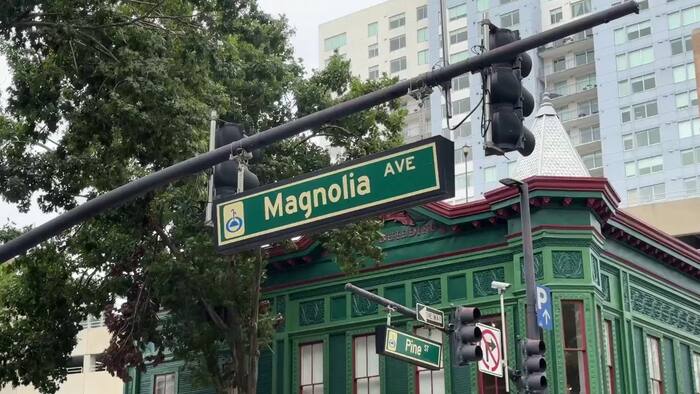
ORLANDO, Fla. – For nearly seven decades, there was one basic rule drivers, pedestrians and people working along Magnolia Avenue could count on: traffic came from one direction.
That changed Thursday.
With a ribbon cut, applause from city leaders and the final barricades pulled away, a stretch of Magnolia Avenue through downtown Orlando officially reopened to traffic in both directions — completing the first phase of a project city leaders say represents much more than changing which way cars can travel.
Now comes another challenge: getting people accustomed to roughly 70 years of one-way traffic to change their habits, too.
Eric Cordero works in downtown Orlando and told News 6 that even knowing the project was coming has not immediately changed the way he thinks about using Magnolia.
“Even for me… it’s hard to remember I can go now two ways on Magnolia,” Cordero said. “I will just treat it still as a one-way.”
[WATCH: Magnolia Avenue 2-way street project’s Phase 1 in Downtown Orlando]
Cordero said he expects it could take him “a couple weeks” to fully adjust. He recalled driving downtown just one day earlier and realizing afterward that Magnolia could have provided the route he needed.
“Even yesterday when I drove I could have taken this way,” he said. Instead, he said, he instinctively took another route.
That old habit is one of the most immediate issues accompanying a project Orlando has spent years planning.
Why did Orlando change Magnolia Avenue?
The answer begins decades before Thursday’s ribbon cutting.
According to the City of Orlando, Magnolia Avenue was converted into a one-way roadway in the 1950s, during an era when downtown streets were being designed in part to accommodate commuter traffic after the construction of Interstate 4.
The city now says many of downtown Orlando’s one-way streets were built around fast, high-volume traffic, a configuration officials say can make walking, biking, using transit and simply navigating downtown more difficult.
In other words, the city is attempting to reverse a transportation philosophy that dates back generations.
Instead of primarily moving vehicles through downtown as efficiently as possible, Orlando’s current DTO Action Plan calls for streets that city leaders say are easier to navigate and better accommodate people walking, cycling, using public transportation, visiting businesses or spending time downtown.
The city lists five broader goals behind its current downtown infrastructure work: converting some one-way roads to two-way streets, improving transit access, improving pedestrian and micromobility safety, improving public spaces and easing congestion.
Magnolia is one of the first major tests of that strategy.
“This is the first DTO Action Plan project to convert a one-way street in our downtown to a two-way street,” Downtown Development Board and Community Redevelopment Agency Executive Director David Barilla said during Thursday’s ceremony.
Barilla said the city believes allowing two-way travel will make businesses and destinations easier to reach while adding more parking and creating additional ways to move through downtown.
[WATCH: Downtown Orlando drivers concerned over proposed two-way street conversions]
Later in his remarks, Barilla put the project in broader terms.
“It’s more than about changing the direction of traffic,” he said. “It’s about really setting the foundation for the future of our downtown.”
The policy shift did not originate with this year’s construction. Orlando says community input gathered through previous planning efforts — including the 2003 Downtown Orlando Action Plan and a traffic study completed in 2022 — pointed toward a need for more walkable streets, additional transportation options and stronger connections through downtown.
When Mayor Buddy Dyer formally unveiled the current DTO Action Plan in 2024, the city described one of its central ideas as making downtown “easy to get around.” Plans specifically called for Magnolia Avenue to become a two-way street while eventually receiving wider sidewalks, additional public space and other pedestrian-focused improvements.
A new street — and an adjustment period
The physical change may now be visible in the pavement markings and traffic lanes, but city leaders acknowledge behavior may take longer to change.
Cordero said one of his biggest concerns is whether drivers who have known Magnolia as a one-way road will immediately recognize that vehicles can now approach from the opposite direction.
“I’m worried about drivers not realizing that,” he said.
Cordero said he had already seen people mistakenly travel south on the corridor even before the conversion was officially opened, when that portion was still being used differently under the former traffic configuration.
He also raised concerns about people using bicycles and electric scooters downtown, saying he has witnessed close calls in the area before.
“The only fear I have is the people that have electric scooters and bikes,” Cordero said. “I’ve seen close calls down here.”
Dyer acknowledged Thursday that drivers will need time to adapt.
“Watch signs and be careful,” Dyer told News 6. “When you’re in Downtown, you shouldn’t be driving fast anyways. But we do recognize that some people will have to get used to having two-way versus one-way streets.”
Dyer said he believes the transition will happen relatively quickly, pointing to the noticeably different street layout and parking positioned for vehicles traveling in both directions.
“I think people get used to it pretty quickly,” Dyer said. “There’s a noticeable change to the street.”
The competing realities now meet on Magnolia: city leaders see a more intuitive road network, while at least some regular downtown users say decades of familiarity with the old layout will not disappear overnight.
What exactly changed in Phase 1?
The completed first phase covers Magnolia Avenue from South Street north toward Livingston Street.
According to the city, the $2.8 million Phase 1 project began in February and was expected to take approximately six months. Gomez Construction Company is listed as the contractor.
The work included:
converting Magnolia Avenue from one-way to two-way traffic;
removing most of the dedicated LYMMO bus lane;
moving LYMMO buses into general traffic;
adding on-street parking; and
preparing the corridor for later streetscape and mobility improvements.
The city says Magnolia now serves as an alternative north-south route parallel to Orange Avenue through downtown’s historic business district. Officials say the intent is to improve connectivity while creating a street that is more inviting to residents, workers and visitors.
City redevelopment officials also see the additional access as an economic-development tool.
In an interview following Thursday’s event, a downtown official told News 6 that the city believes easier access and added parking can make businesses more visible and easier for customers to reach. The official said the city will continue watching how the redesigned road functions now that the plan has moved from paper onto the street.
Cordero sees potential benefits as well.
He said one-way traffic and road closures during major downtown events have sometimes forced drivers to travel farther simply to get around a closed street.
“You had to go long ways just to get around,” Cordero said. “This way at least it’ll help it out a little bit.”
He added that friends who live downtown have told him getting around is already somewhat easier with Magnolia open in both directions.
Phase 1 is finished. Magnolia is not.
Thursday’s opening does not mark the end of the city’s work on Magnolia Avenue.
It marks the end of Phase 1.
The City of Orlando currently lists Phase 2 for an estimated start in the second quarter of 2027. That phase is expected to involve more extensive roadway reconstruction, removal of remaining dedicated bus lanes, additional on-street parking and curbside and bus-route changes around Central Boulevard intended to support pedestrian traffic.
The city also plans additional streetscape and hardscape improvements and a new corner park at Livingston Street.
That distinction is important: Phase 1 changed how Magnolia functions. Phase 2 is intended to further change how the corridor looks and how people experience it outside their cars.
Magnolia is only the beginning
The bigger story extends beyond Magnolia Avenue.
Orlando’s DTO Action Plan calls for additional changes to the downtown street network, including converting Orange and Rosalind avenues from multi-lane, high-speed one-way streets into two-way corridors.
The city’s current project schedule estimates that work could begin in the third quarter of 2027. Plans also call for integrating bus operations into regular traffic, adding parking where space allows and creating more room for curbside uses.
The city is also planning changes farther north through the North Quarter, where portions of Orange and Magnolia avenues are expected to be reconfigured for two-way travel with improved facilities for people walking and biking. That project is also currently listed for an estimated third-quarter 2027 start.
Church Street is undergoing its own transformation, while The Canopy beneath Interstate 4 is another piece of the wider effort to reshape how people move through and spend time downtown.
Dyer told News 6 that he sees Magnolia as a preview of those future conversions.
“I do think that when people experience Magnolia, they’re gonna be more excited about the other streets that we’re gonna two-way as well,” he said.
For now, however, the first test is happening on Magnolia itself.
The barricades are gone. The double yellow lines are down. Traffic can move in both directions.
Changing a street took months.
Changing nearly 70 years of habit may take a little longer.
Copyright 2026 by WKMG ClickOrlando – All rights reserved.