
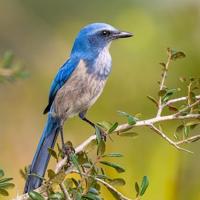
MURDOCK — A Charlotte County lawsuit over scrub jays and land development could be settled before a law firm can use it to upend the national Endangered Species Act.
The Charlotte County Commissioners are expected to vote at their Tuesday meeting on a $130,000 settlement with property owners Michael and Ryan Colosi.
The item is on the consent agenda, meaning it was not expected to be up for debate, although commissioners can choose to speak publicly.
Represented by Pacific Legal Foundation, Michael Colosi filed suit against the county in 2024 after being assessed a $120,000 fee to build a home on a small section of his 5 acres in a rural subdivision in the 18000 block of Bending Willow Court.
The rural eastern part of the county is one few areas left in the state where scrub jays survive.
According to the settlement text, the county and the Colosis have agreed to sell the land to the county for $130,000 — the price Colosi paid in 2024 — in exchange for dropping the entire law suit with prejudice.
The county would also pay Colosi’s nonprofit law firm, Pacific Legal Foundation, $10,000. The federal government is also a defendant via the U.S. Fish and Wildlife Service.
Pacific Legal Foundation formed in the 1970s in California. It takes on cases that it sees as government overreach, including in regard to property rights.
“The County’s fee scheme is arbitrary and illogical. The fees are arranged in tiers based on no apparent mathematical formula and with no consideration for actual development impact or even the presence of scrub jays on the property,” the firm said in a statement on its website. “Instead, fees seem plucked out of thin air with steep, haphazard increases tied to total acreage, rather than the actual amount of land being developed.”
The firm did not return calls for comment from The Daily Sun.
In federal court, the foundation’s legal argument was that as a species that lives only in Florida, it should not be regulated by a federal agency. Charlotte County’s regulations are in place only as a response to federal regulation.
The fees cover the cost of the county buying and rebuilding scrubjay habitat elsewhere. If the county fails to create enough habitat, the federal government, under previous administration, can bar any development in scrubjay habitat.
Environmental protection groups sounded the alarm over the Charlotte County suit. If it succeeded, it would have knocked more than half of currently protected species off the national list, an attorney for EarthJustice said in 2025.
“At Florida Wildlife Federation, we are encouraged by what could happen,” President and CEO Sarah Gledhill recently told The Daily Sun.
Her group joined in opposition to the Colosi lawsuit, she said, “to defend the integrity of the Endangered Species Act and to encourage the continued protection of the Florida scrub jay.”
The Trump administration has enacted several strategies to change the law enacted in the 1960s and again in the 1970s.
Among the changes is the definition of “harm” that took effect in July. Gledhill said it is being challenged in court by environmental groups. Specifically, harm has been redefined to include on intentional harm to a species, not accidental. Also, destruction of habitat is no longer considered a harm.
One commissioner expressed frustration in the past over being required to charge residents to develop their land in scrub jay territory.
“I’m just not kowtowing to this Endangered Species Act,” Commissioner Christopher Constance said six years ago. “I speak for the hearts of my fellow commissioners … we’re really sick and tired of the federal government dictating to us how we’re going to develop the land … If they want to impose something on us, give us the money like they did in the old days when we were a rich country.”