
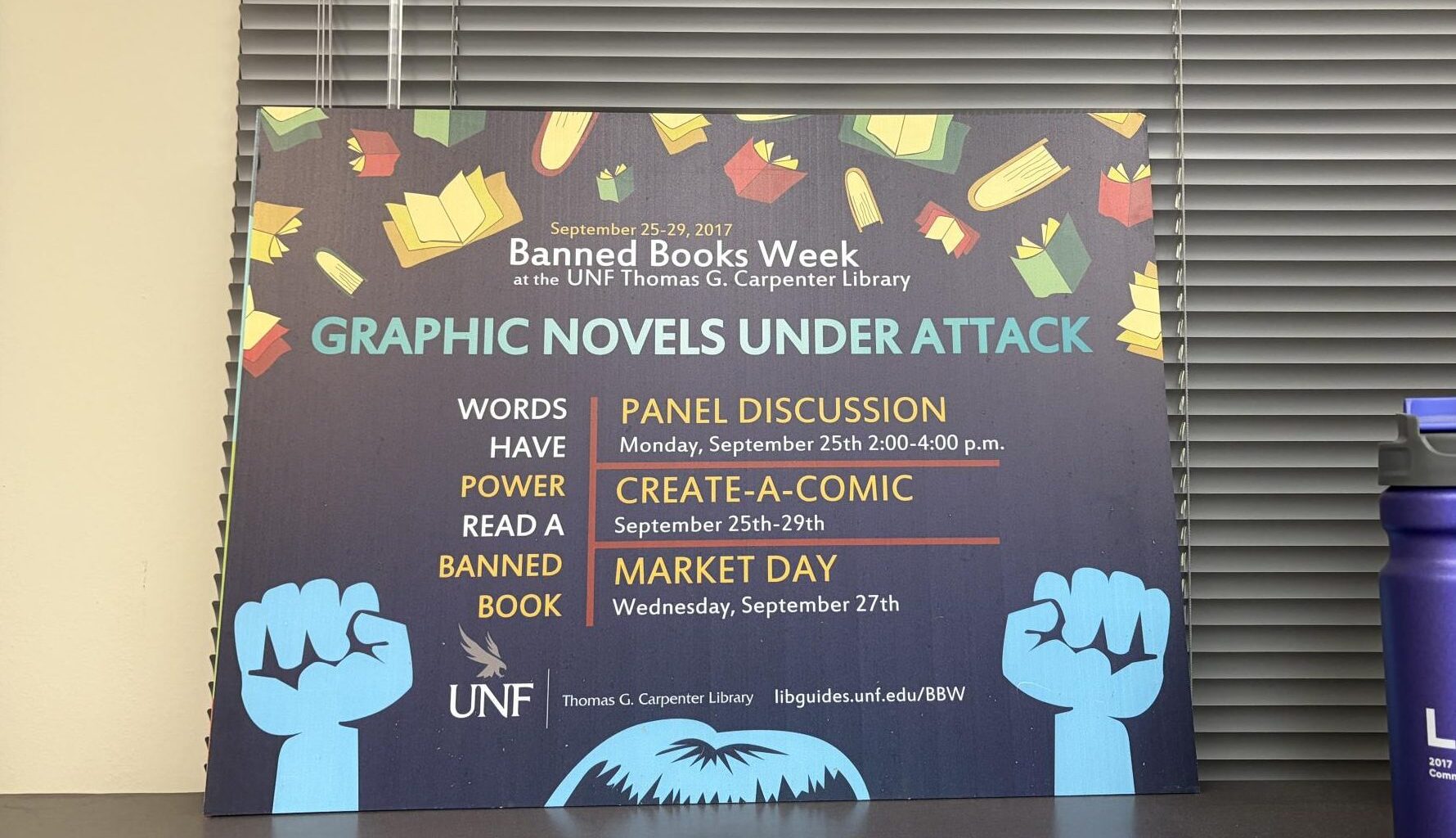
Long before “banned books” became a nationally debated topic, the librarians at the UNF Carpenter Library were already considering what was on student “to be read” lists and what they could actually locate within their shelves.
The American Library Association tracked 4,235 unique challenged book titles in 2025, the second-highest number on record, and 92% of those challenges came from organized groups and officials rather than individual parents.
Florida was the No. 1 state for school book bans for the third straight year in 2024-2025, with 2,304 instances recorded, according to PEN America.
“With interlibrary loan, we can get books from anywhere,” said Maria Atilano, UNF’s student success and engagement librarian. If the library doesn’t own a title, students can request it from another library in the country and pick it up at the front desk for free.
The graphic novel collection
Atilano has worked at the Thomas G. Carpenter Library for almost 20 years, starting straight out of her undergraduate degree in North Carolina. She moved into her current faculty role in 2013, where she now oversees programming, displays and promotions.
“I’m a big nerd and I like to read,” Atilano said. “I’ve got two English degrees, and it’s probably my number one hobby.”
Atilano has helped launch popular student programs at the library, including the UNF Campus Canines, the Blind Date with a Book program, and the graphic novel collection on the library’s third floor.
When she first arrived, the library cataloged graphic novels by subject alongside everything else, so “Maus,” Art Spiegelman’s graphic memoir about the Holocaust, sat among the history books, while Alison Bechdel’s “Fun Home” was filed with American literature.
In 2015, Atilano and her colleagues applied for a grant to fund the possible graphic novel collection. They didn’t win it, but the proposal convinced library administration to fund it anyway with a “few thousand dollars” to start, according to Atilano.
Atilano worked with a cataloger to reclassify the books the library already owned and turned to other faculty for recommendations, building a list from scratch.
“We started our collection with a couple hundred volumes and then mostly all new stuff. And now we’ve got almost 800 volumes. And it’s probably our highest circulating collection that we’ve got in the library,” Atilano said.
The collection helps support two of the library’s other signature events: Blind Date with a Book, a two-week February program where more than 200 wrapped books go out on description alone, and Eisner Week each March, named for Will Eisner, the cartoonist credited with coining the term “sequential art,” for graphic novels and comics.
Atilano keeps a running list on Goodreads and only buys a book for herself if she’s read and loved it, a habit that’s sent her digging through the back rooms of independent bookstores on vacation.
“Usually I check out a blind date and it sits there for months,” Atilano said. “This one, I was like, I’m going to get to it. And I really enjoyed it.”
Atilano still handles most of the ordering herself, and leans on students to cover her blind spots.
“Manga is a big blind spot for me. I don’t read manga,” Atilano said. “Students are like, ‘I really love manga, tell me what you want me to buy.’ So I’ll add it to our list.”
Atilano said that while many graphic novels are often only viewed as superhero comics, many carry heavy messaging.
“It’s still kind of in this little fringe area, and people will be like, ‘Oh, that’s like Marvel and DC and comic books, that’s not real,’” Atilano said. “But if you read specific titles, there’s some really heavy hitting, like even comic books.”
Among them is the novel “Maus,” Art Spiegelman’s Pulitzer Prize-winning graphic memoir about the Holocaust. A Tennessee school board voted in 2022 to remove it from an eight grade curriculum over its language and imagery of the Holocaust and internment camps.
Several graphic novels Atilano brought into the collection have landed on the ALA’s most challenged lists.
Banned books in the library?
Comics and graphic novels have shown up disproportionately on national ban lists in recent years, in part because of the social and political commentary many carry, from allegories about war and genocide to stories about race, gender and sexuality.
In 2017, three of the ALA’s top 10 most challenged books were graphic novels, the first time that had happened. “Gender Queer” by Maia Kobabe later topped the list for three straight years.
“I think it fell down to like number two or three for this year,” Atilano said.
Atilano said “Gender Queer” was challenged in schools before it was even published. Kobabe’s graphic novel has been said to be the most banned book in the last three years.
“They just read the blurb and they went, ‘Nope,’ and nobody even read it,” Atilano said. “When you read it, you’re like, it’s spicy, but for certain age groups.”
The library carries “Gender Queer,” plus a second copy purchased after the first couldn’t keep up with demand.
“Libraries really are always about the free access to information,” Atilano said. “We’re never going to judge or say you can’t check something out. There are no barriers to it unless somebody already has it checked out.”
Atilano says that students will at times see a book is unavailable and jump to the conclusion the title was pulled or banned.
“We have it; it’s checked out. If they can’t see it, they just think we don’t have it.” She recommends checking the library’s OneSearch catalog first, and asking staff rather than assuming the worst if a listed book isn’t on the shelf.
“Because we’re an academic library, we’re not taking things off the shelf because of the subject matter,” Atilano said. “We aren’t censoring our materials.”
From the shelf to the servers
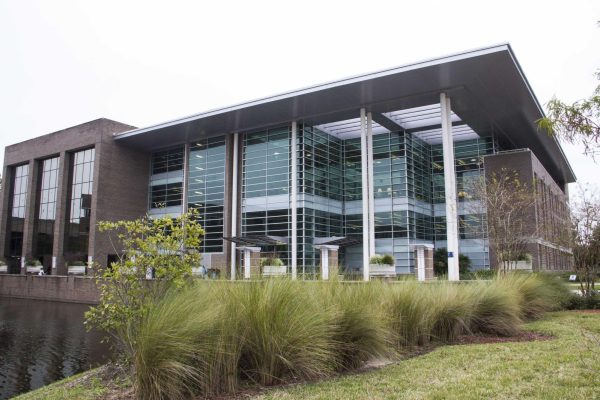 Keri Weird Weiland
The UNF Library currently carries “Gender Queer” by Maia Kobabe, a graphic novel that was one of the most challenged banned books for three straight years.
Atilano said the collection has shifted online dramatically since she started.
“We still have a lot of books, but most of what we have access to is online,” Atilano said. “We still get students who come in going, ‘Why doesn’t the library have books?’”
UNF’s library maintains close to 300 databases, including streaming services like Kanopy, Films on Demand and Swank, giving students free access to documentaries and films they’d otherwise need a subscription for.
UNF students can access these streaming perks for free by authenticating through the Thomas G. Carpenter Library website using their standard UNF login credentials.
When students aren’t able to find a copy of their desired book, they can complete an interlibrary loan, searching library catalogs, pulling almost any book, film or album from another library in the country, for free.
Atilano used it herself, once waiting on a book that arrived “all the way from California” because it existed in only a handful of libraries nationwide. It’s also how the library handles multivolume series, like manga series that are too expansive to fully stock in-house.
“We can’t have all 131 volumes,” Atilano said. “So we buy the first maybe six to eight, and if you like it, you can put in a request for the rest.”
Increased access to books, increase of diversified stories
Students can also sign up for a Jacksonville Public Library card, which they can register on Libby. This mobile, online library app gives students free e-books and audiobooks and lets them register multiple cards, with some organizations creating catalogs for underrepresented groups.
Atilano also mentioned the Queer Liberation Library, a nonprofit that offers free digital library cards with diverse LGBTQ+ representation, according to Atilano, and has more queer novels and representation available than the common library catalog.
“It’s a matter of demand,” Atilano said of gaps in the bigger systems. “The Queer Liberation Library started because of that.”
Popular titles can take months to arrive because demand for books in the collections is stretched nationwide, but Atilano said that’s a fair tradeoff for free access.
Nicole Beam, a sophomore chemistry student at the university, said access to a wide, diverse range of novels in the library matters more than people realize.
Before college, Beam grew up in a liberal county with a well-stocked public library and read widely, from Toni Morrison’s “Beloved” to queer fiction comics like Alice Oseman’s “Heartstopper.”
“I was very lucky to, before college, live in a county which was very liberal so I could get most of what I wanted to read from my library,” Beam said.
Beam now buys most of her reading material for herself, instead of relying on the library.
Beam says losing easy access to certain books can cut off more than a good read; it can also limit representation for students searching for themselves in characters.
“I find it disheartening that a lot of the places I can find the most representation of myself are likely not very accessible to students because of book bans,” Beam said.
“If I didn’t have as much internet access, I probably would’ve heard about being aro-ace for the first time through ‘Loveless’ by Alice Oseman, and there isn’t much rep of that out there.”
For Atilano, the library’s main goal is for its students to understand the countless resources and titles available to them, via the databases, interlibrary loans, or even the librarians themselves.
“The main thing is that we’re here,” Atilano said. “We’re here until 2 a.m. most nights. Come to the library, contact us if you have needs.”
“And if you have book suggestions, call me,” Atilano said with a smile.
For more information or news tips, or if you see an error in this story or have any compliments or concerns, contact [email protected].