
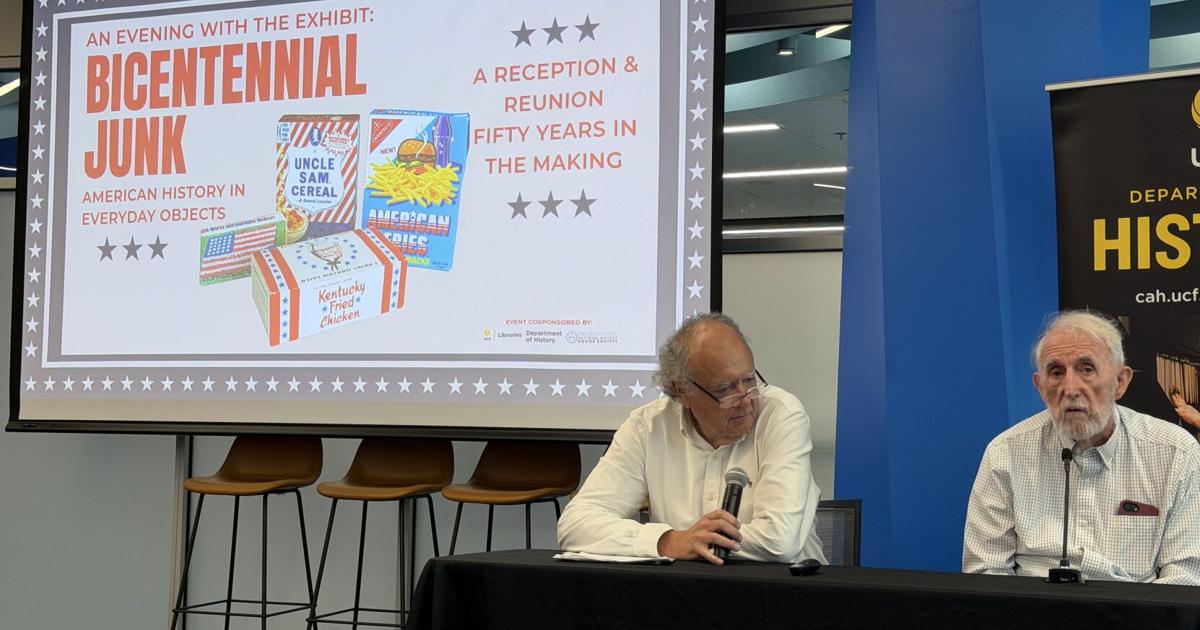

(Left to right) Randy Noles and Dr. Richard Crepeau speak at the Solarium in the John C. Hitt Library on Wednesday. The ‘Bicentennial Junk’ exhibit at the UCF library began as a class project in 1976 to acknowledge the United States’ bicentennial.
Francisco Vera-Giron
Bicentennial Junk: American History in Everyday Objects is an exhibit created by UCF History professor emeritus Dr. Richard Crepeau, currently being shown in the John C. Hitt Library in room 402 until September 30.
The exhibit began after he assigned a class project that involved collecting items that celebrated the United States’ Bicentennial in 1976.
Fifty years later, Dr. Crepeau and his former student, Winter Park magazine publisher Randy Noles, talked at an event on Wednesday at the Solarium in the John C. Hitt Library, recounting how the exhibit came to be and how much the world has changed since the project came to fruition.
Dr. Crepeau became fascinated by a kids’ menu that turned into a trifold hat, in celebration of the Bicentennial. This inspiration led to hundreds of different items being turned in by his students. Some of these items were superhero calendars, joke books and a flyer that talked about celebrating the Tricentennial in 2076.
“You never think…10 weeks into that process of collection, that it was gonna someday be a huge collection nationally,” Crepeau said.
One of the students who took part in this project was Randy Noles. He spoke at the event on Wednesday and shared his perspective on what motivated him and other students to participate in the project.
“I think everybody respected him so much as a historian and as a teacher that we just wanted to participate,” Noles said.
Crepeau and Noles said their favorite set of items collected during this project was a set of 50 7-Up cans, one for each state. These cans would depict Uncle Sam when placed like a pyramid.
Third-year history graduate student Brenden Niestzche attended the exhibit and shared his sentiment on how these items showcased a feeling of unity and honor.
“I think [the exhibit] reminds us of who we are, where we’ve been and the things that shaped us into who we are,” Niestzche said. “I think it also reminds us of the things we may lack in the present that we just have to revive and bring back from the past.”