
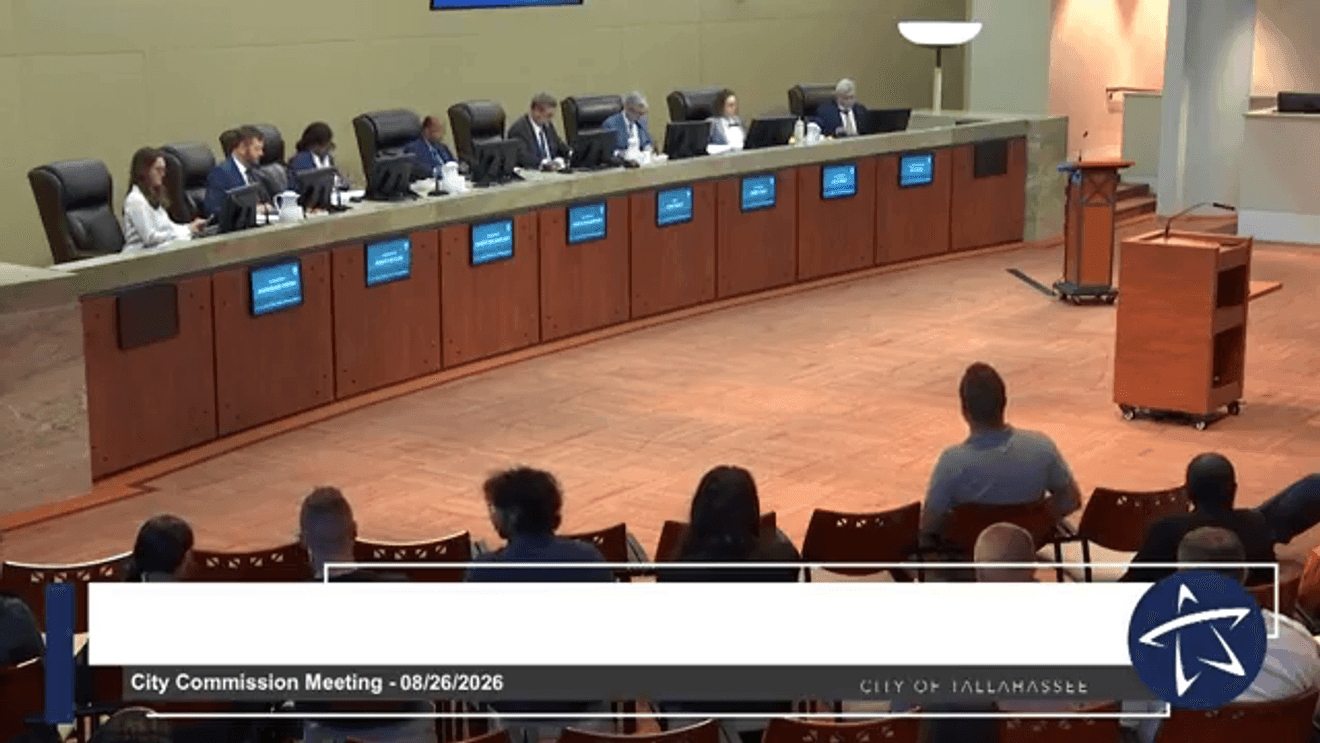
Tallahassee commissioners initially voted 3-2 to keep the city’s 4.4072-mill property tax rate, but that was no longer enough. A new Florida law requires a two-thirds vote to exceed the rollback rate, forcing commissioners back to the table and ultimately producing a unanimous vote for a lower rate — with the difference coming out of money intended for city reserves.
TALLAHASSEE, Fla. — For a few seconds Tuesday night, it appeared Tallahassee had adopted its property tax rate.
The vote was 3-2.
Then came the catch: Three votes weren’t enough anymore.
A new Florida law requiring a two-thirds vote to set a millage rate above the rollback rate transformed what ordinarily would have been a winning City Commission majority into a failed motion — forcing commissioners to lower the rate and rewrite part of the city’s nearly $1 billion operating budget on the fly.
“It passes three to two,” Mayor John Dailey initially announced, before immediately correcting course: “Yet the motion fails … requiring a supermajority under the new Florida law.”
Florida law now generally makes the rollback rate the maximum property tax rate local governments can adopt without a supermajority. A rate up to 110% of rollback requires approval from two-thirds of the governing body.
For Tallahassee’s five-member commission, that meant the proposed rate needed four votes.
It only had three.
Matlow and Porter block 4.4072 mills
City staff recommended keeping Tallahassee’s millage at 4.4072 mills.
But because rising property values meant that rate was 3.47% above the aggregate rollback rate, it triggered the new supermajority requirement.
Commissioners Jeremy Matlow and Jack Porter opposed the rate, while Dailey, Mayor Pro Tem Curtis Richardson and Commissioner Dianne Williams-Cox supported it.
Matlow argued the city should adopt rollback and force government to find savings.
He pointed to a budget he said has grown by about $75 million in six years and again questioned the city’s voluntary separation program, saying 171 employees received buyouts costing approximately $8 million while commissioners still had not received detailed information showing how many positions were being refilled.
“We can adopt the rollback rate,” Matlow said, arguing it could be done “without cutting any essential services.”
Porter joined him after previously supporting the proposed rate at the earlier budget hearing.
She cited concerns about spending priorities and potential costs associated with development, arguing residents may be willing to pay for public services but questioning whether taxpayers should shoulder expenses she believes should fall elsewhere.
Williams-Cox: City is preparing for what could come
Williams-Cox defended both the budget and the city’s employee separation initiative.
She described the buyouts as a proactive effort to prepare for potential future property tax changes and said replacement employees can cost less than longtime workers who left at higher salaries and benefit levels.
She rejected Matlow’s characterization of city spending as out of control.
“This government is doing its level best to provide a quality of service for 205,000 individuals who live in the city of Tallahassee,” Williams-Cox said.
The city’s budget office said the separation initiative is expected to save $5.4 million in the general fund, reducing proposed personnel spending from what otherwise would have been roughly $131.1 million to $125.7 million.
One vote changes the entire budget calculation
Once the 4.4072-mill motion failed, the commission had to restart the statutory process.
The revised city millage became 4.2573 mills, with the city’s attorney telling commissioners the resulting aggregate rate would fall slightly below the 4.2782 aggregate rollback rate.
This time, the vote was 5-0.
But lowering the tax rate did not automatically lower the services commissioners had just spent months budgeting.
That created the night’s second dilemma:
Where does the missing money come from?
No service cuts — reserves take the hit
Initially, the debate sounded like it could result in roughly a 1% reduction in general fund spending.
Williams-Cox pressed for the actual dollar impact.
City officials explained property taxes generate approximately $80 million for the general fund, which supports core services including police, parks and recreation, neighborhoods, senior services, animal services and public works.
But commissioners ultimately did not order across-the-board departmental cuts.
Instead, staff said the city would reduce property tax revenue and offset the difference with a transfer involving reserves, allowing the city to maintain its planned level of service.
That means the practical consequence of the lower millage isn’t an immediate reduction in police, parks or other services.
It is less money going into the city’s financial cushion.
Reserve fund becomes heart of fight
That distinction became important because Tallahassee had planned to fully fund its Deficiencies Fund for the first time in 10 years.
City officials described it as the government’s savings account — money available when hurricanes, tornadoes, floods or other emergencies require the city to spend immediately while waiting for reimbursement.
Dailey repeatedly pointed to past emergencies to make his case for maintaining those reserves.
City officials confirmed reserves helped Tallahassee respond during COVID-19, hurricanes, flooding and the 2024 tornado outbreak.
Dailey also said the city is preparing for a potential $11 million fiscal-year 2028 impact from Amendment 3, if voters approve the property tax proposal. That $11 million figure was the city’s estimate discussed at the meeting, not a guaranteed future loss.
Matlow countered that lowering the millage did not require sacrificing reserves. He argued commissioners could fully fund the emergency account by finding reductions elsewhere in city departments.
Budget still passes 3-2
The irony of the new law became clear moments later.
The millage rate above rollback required a supermajority and failed 3-2.
The underlying city budget did not face the same hurdle.
After staff said the lower property tax revenue would be balanced through reserves, commissioners approved the budget 3-2, with Matlow and Porter dissenting.
The city also preserved its Community Human Services Partnership funding. Staff told commissioners the rollback would not reduce those allocations; instead, the adjustment would affect the transfer to the Deficiencies Fund.
That left Tallahassee with an unusual ending to months of budget negotiations:
A majority of commissioners wanted 4.4072 mills. A minority of two stopped it because state law now required four votes. All five commissioners ultimately approved the lower millage — while three approved a budget that maintains services by putting less money into reserves.
The supermajority requirement didn’t just change how Tallahassee voted Tuesday.
It changed what three votes on the City Commission can accomplish — and, in this case, changed the tax rate Tallahassee property owners will pay.