
 Credit: University of Central Florida/Facebook
The results are in.
The task force charged with assessing State University System efficiencies released a 26-page report that found the University of Central Florida, the school with the largest enrollment, had the lowest cost to produce a degree from start to finish at $46,548, while New College of Florida had the highest at $494,715. New College has the fewest students in the state university system.
Presented to the Board of Governors, the report said the cost of university operating expenses per degree is the “key metric for measuring overall institutional efficiency.”
Universities’ annual operating expenses per student across the system increased from $16,792 in 2017-2018 to $22,217 in 2023-2024, or nearly 25%, not accounting for inflation. The report cites increase in payroll and labor costs as the main cost drivers.
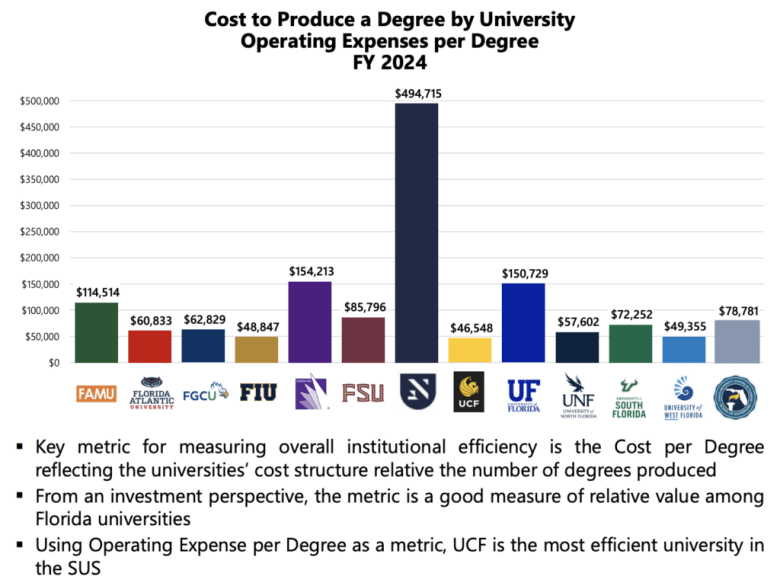 Credit: Cost to produce a degree throughout a student’s span at the institution. (Screenshot via Board of Governors report)
The report tracks the universities’ success in getting students into jobs. For purposes of the report, job placement is defined as those who within a year of graduating with a bachelor’s, earn more than $40,000 annually or are in graduate school.
It found that New College of Florida has the lowest placement rate at 65%, followed by Florida A&M University with 70%. Conversely, Florida Polytechnic University ranks highest in the report for job placement with 81%, followed by University of West Florida with 80% and University of Florida with 79%.
FAMU graduates had the lowest median starting salary in the SUS at $45,800. The next closest is New College at $46,100. Florida Polytechnic had the highest at $66,800, followed by University of Florida at $58,200, each school with emphasis on science and technology.
There were 657,000 applications to attend Florida universities in 2024, a 41% increase from 2018 when 466,000 students applied.
In 2023-2024, 27% of students took out student loans. That’s compared to 40% of students in 2017-2018. Tuition did not increase.
The University of Florida had by far the most research revenue generation during fiscal year 2024, with $2.03 billion. The next closest was the University of South Florida at $612 million.
“Really good insight and information, a lot for the universities to take in and consider and note that the BOG also is taking this quite seriously and we know there’s a chance to get better here,” Board of Governors chair Brian Lamb said during the meeting at University of South Florida.
The report is an attempt to bring transparency to the SUS given about two-thirds of the $5.8 billion SUS budget is paid by state dollars. Student tuition accounts for just $2 billion.
The report also stems in part from a dispute between BOG member Eric Silagy and New College of Florida President Richard Corcoran. Silagy claimed New College was spending more than $91,000 annually to educate each student while Corcoran said it was $68,000 annually.
The report’s findings weren’t lost on Silagy Thursday.
“Thank you for your team’s work on this, for pulling together the data, so there can be really no question anymore about what the numbers really are and that’s not an excuse anymore,” Silagy said, a reference to his prior math disagreements with Corcoran.
The report recommended that universities improve budget and financial reporting and suggested requiring universities to track and report on “key metrics.”
New College questions
In September 2024, Silagy questioned the financial future of New College.
Those questions rose again during the board’s January meeting this year.
During that meeting, Vice Chair Alan Levine acknowledged during his tenure on the board, balance sheets and other financial metrics were not actively reviewed. He suggested putting together “a more transparent scorecard of university finances and some of the metrics that we look at in terms of cash management and things like that.”
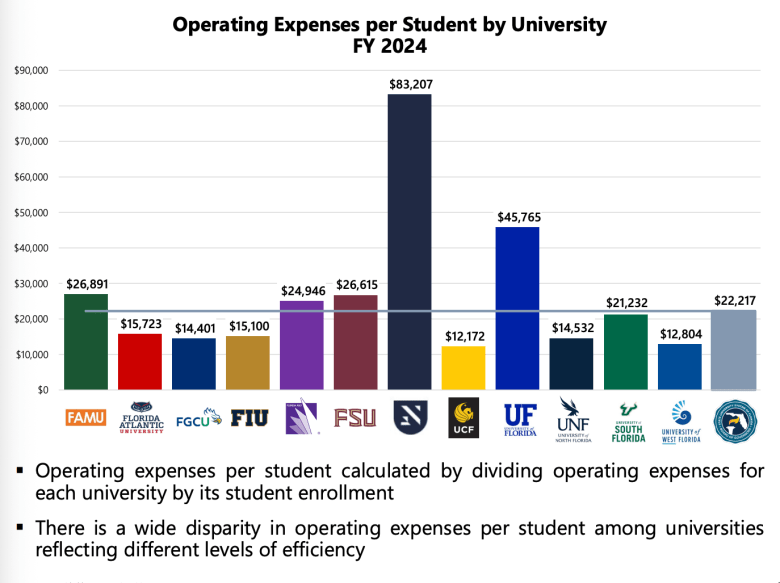 Credit: Operating expenses per student per university, the data point in question at previous BOG meetings. (Screenshot via Board of Governors report)
In February, Gov. Ron DeSantis called for a “deep dive” into state universities and looked to eliminate spending that decision makers deemed unnecessary.
“This is the DOGE-ing of our state university system,” DeSantis said in February during a news conference in Tampa announcing the audit. “And I think it’s going to be good for taxpayers and it’s ultimately going to be good for students, as well.”
The report Thursday did not include detailed information about particular programs.
In other business
Also during the BOG meeting, governors extended University of Central Florida President Alexander Cartwright’s contract for another year, through the end of 2026.
The BOG will vote on University of North Florida President Moez Limayem’s move to be president of University of South Florida during its next meeting.
SUS Chancellor Ray Rodrigues said he will provide an update on DeSantis’ call to “pull the plug” on H-1B visas in January.
Regarding the safety summit last month, following the shooting at Florida State University, stakeholders recommended universities identify doors without locks and plan to “address these vulnerabilities” and “address rooftop access to ensure these areas are secure.” That comes after Charlie Kirk was killed on a college campus in Utah. His alleged assassin was on a rooftop of an academic building.
The recommendations also focused heavily on communication protocol in times of emergency.
Lastly, Lamb did not seek another term as chair of the board. Levine was voted chair for 2026 and Tim Cerio voted vice chair.
Florida Phoenix is part of States Newsroom, a nonprofit news network supported by grants and a coalition of donors as a 501c(3) public charity. Contact Michael Moline for questions: info@floridaphoenix.com. Follow Florida Phoenix on Facebook and Twitter.
Subscribe to Orlando Weekly newsletters.
Follow us: Apple News | Google News | NewsBreak | Reddit | Instagram | Facebook | Bluesky | Or sign up for our RSS Feed
Related Stories
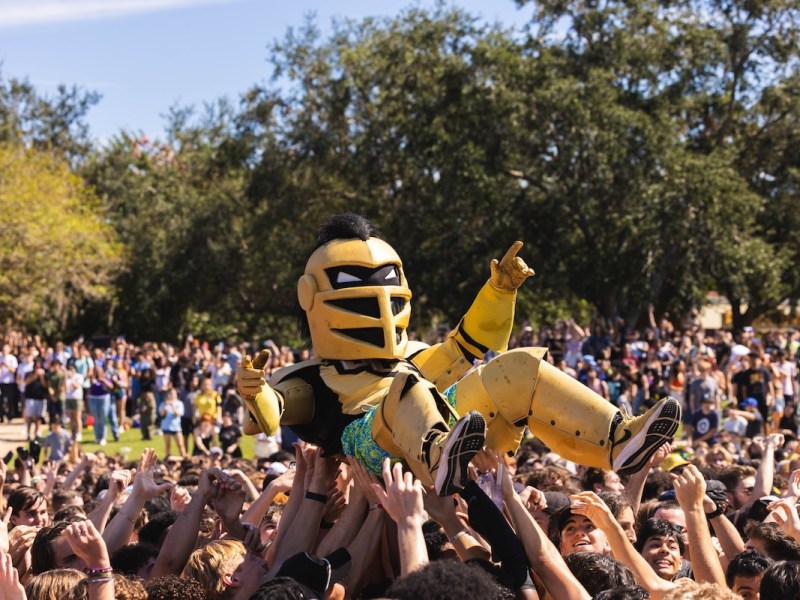
The report found that UCF, the school with the largest enrollment, had the lowest cost to produce a degree from start to finish.

Electric Daisy Carnival headbanged its way back into town

Catch this soul-soothing circus before it runs away without you
Related