
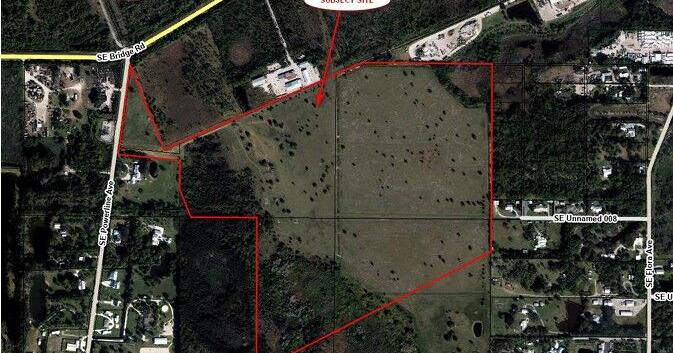
STUART – The Martin County Commission majority approved rezoning 108 acres near Powerline and Southeast Bridge roads to light industrial Sept. 15 despite protests by nearby residents worried about potential negative impacts on their mostly rural lifestyle.
District 3 Commissioner Blake Capps and Chairwoman Sarah Heard dissented on that vote after the former advised against that zoning for fears the developer or future property owner might one day propose a data center on the land.
Light Industrial zoning, however, had already been recommended by the Local Planning Agency on Sept. 3 instead of the applicant’s requested General Industrial Zoning.
Currently, data processing centers are a permitted use in most of Martin County’s industrially zoned lands, and commissioners directed staff on Aug. 25 to come back with a draft moratorium ordinance.
Before the Board even got to its agenda during the latest meeting, several public speakers vented their frustration against either the rezoning or data centers in general.
Only one person however, former Juno Beach Mayor Alexander Cooke, spoke against them both.
Cooke is currently running against Rep. Brian Mast for the 21st Congressional District as an independent candidate.
“I strongly believe in land conservation and I hope you take this zoning change later today very seriously,” he said. “Once you lose Ag land, it is gone forever, and 10 or 20 years from now we may need that land. So please protect this land. Ten years from now we won’t need these data centers – we’re already at excess capacity. We will have wasted land.”
When the Commission finally got to the agenda item that day, Chairwoman Heard noted that an intervenor had signed up to speak during that quasi-judicial hearing, a rarity in their formal hearings.
That prompted both her and District 5 Commissioner Ed Ciampi to ask County Attorney Elysse Elder to explain the role of intervenor for the public.
“Under our code, a surrounding property owner can be an intervenor if they receive notice under the zoning code,” Elder said. “In some circumstances, property owners within 500 feet will receive notice, and in others like this, it’s property owners within a thousand feet. The intervenor was one of those property owners. They can petition the Board to intervene as long as they provide notice seven business days before the hearing.”
Planner John Sinnott then began his presentation.
“This is a request for a proposed amendment to the Martin County Zoning Atlas to change the zoning classification for an approximately 108.1-acre property from the current A-1 Small Farms District and M-1 Industrial District to the General Industrial District,” he said. “The GI district is consistent with the site’s future land use designation of industrial. This site is located just south of Bridge Road and Powerline Avenue and currently consists of pasture and undeveloped land.”
Sinnott pointed out that the land actually consisted of two separate parcels, one of which was legally mandated for rezoning to the county’s updated zoning code.
“The western 3.7 acres of the property are within the A-1 District, and the eastern 104.4 acres of the property are within the M-1 District,” he continued. “Both the A-1 and the M-1 districts are Category C Zoning Districts. This application is being processed as a mandatory rezoning to a Category A District, which implements the policies of the Industrial Future Land Use Designation. The rezoning of the M-1 portion is not technically mandatory.”
After emphasizing that the LPA had gone against staff’s recommended for general industrial and recommended light industrial to the Commission, Sinnott recommended GI. The applicant’s contracted Land Use Attorney Bob Raynes then came to the podium to correct one of the comments expressed by Cooke, which he believed was a common misunderstanding among Hobe Sound residents.
“There’s misconception that this is an agricultural piece of property, and it is not,” he said. “It has a future land use designation of industrial. This is already an industrial piece of property pursuant to the comprehensive plan, so that ship sailed in 1982 when the comp plan was brought into effect. The majority property already has an industrial designation on it, M-1, but that is an old zoning district. We’re here today to bring this property up to-date and consistent with the comprehensive plan.”
Raynes also dropped the bomb that appeared to initially change the focus of the discussion.
“Our client is a Hobe Sound resident, and he recognizes the concerns of the neighbors,” he explained. “So, we are willing to accept the Light Industrial Zoning Designation to cooperate if that’s what the neighbors feel is more appropriate.”
After the applicant’s Contracted Landscape Architect Brian Nolan confirmed that offer, Karin Street resident Kevin Mackie – the intervenor – followed him to the podium and admitted his job was done.
“I came here prepared to persuade this Board to uphold the LPA’s recommendation of limited industrial,” he said. “After hearing the applicant today, I want to comment them for being willing to entertain LI. I’m here to respectfully ask this Board to follow the LPA’s recommendation.”
District Commissioner Capps, however, had other plans, supporting that zoning only for the smaller parcel while expressing fears about the Light Industrial zoning on the rest.
“Some of those uses are more intense and are not appropriate with the surrounding residential development,” he said. “I’m going to make a motion that the smaller piece be limited industrial and the larger piece remain as M-1 Zoning.”
That idea brought a wave of protest by the applicant’s representatives and some of Capp’s colleagues, particularly Commissioner Eileen Vargas. The latter peppered staff with questions until Deputy Growth Management Director Peter Walden admitted he preferred limited industrial on both parcels. Realizing he might not get a Board consensus on his motion, Commissioner Capps played the data center card and got staff to admit that such facilities were permitted uses in the LI Zoning Category. He promptly challenged his colleagues to defend that zoning in light of the county’s proposed moratorium on data centers. That led to a lengthy debate after which Chairwoman Heard passed the gavel to Ciampi to second Capp’s motion.
Both Ciampi and Commissioner Stacey Hetherington said they couldn’t agree with that and formed a block with Vargas to dissent on that motion, which failed 2-3. Commissioner Vargas then made a motion to rezone both parcels to light industrial, which was seconded by Hetherington and passed 3-2, with Capps and Heard dissenting.