
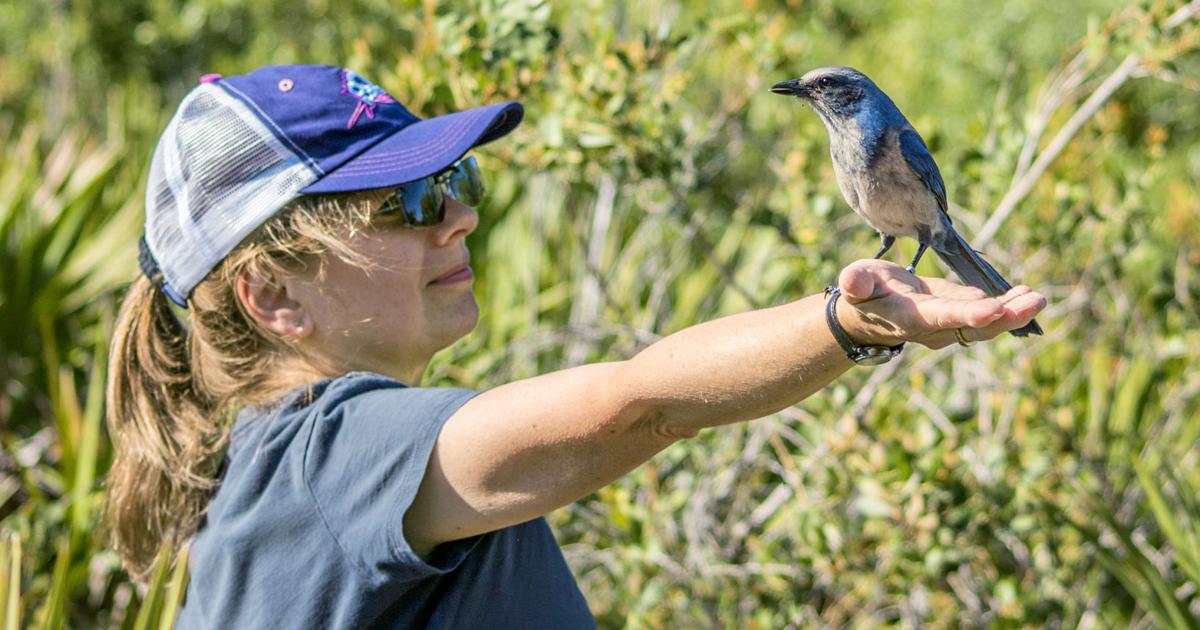

A wild Florida scrub jay perches on a birdwatcher’s arm in a Port Charlotte preserve. These birds are naturally curious and have little fear, and sometimes choose to interact with people who show up in their territories.
Sun file photo by Josh Olive
PORT CHARLOTTE — The Charlotte County scrub jays near one property in East Charlotte County are protected for now, following a court settlement.
But it appears a federal law that generated the dispute may no longer protect them.
With no discussion, the County Commission unanimously approved a $140,000 court settlement with Michael and Ryan Colosi.
The vote Tuesday essentially means the county is buying a 5-acre lot on Bending Willow Court.
The settlement includes a $10,000 payment to the nonprofit law firm that represented them.
After buying the land in 2024, Michael Colosi was facing a $120,000 permit to build a house on a small section of his lot.
The Pacific Law Foundation took on his case, which fit its longstanding efforts to prevent government overreach, including of property owners.
The county adopted the costly system as a compromise with the U.S. Fish and Wildlife Service’s regulations to protect the threatened Florida scrub jay, which has little habitat left in the state.
With the permit money, the county tries to buy more habitat for the birds, but it’s been tough finding or making habitat that suits their unique needs of fire-cleared pine scrub.
While noting unfairness to Colosi, the law firm was set to argue in federal court that the Endangered Species law should not apply to any species that lives in only one state.
Environmental groups jumped into action on the Charlotte County suit, because more than half of listed species exist in only one state.
Responding to The Daily Sun, several of those groups — including EarthJustice and Florida Wildlife Federation — expressed relief at the scrub jay settlement, because it eliminated one threat to the 1970s law.
Those groups did not comment on whether the changes to the act at the national level effectively nullify the costly federal regulations on scrub jay protections. Both groups are currently fighting the changes in court at the national level.
The protections have applied to developers in scrub jay territories throughout Florida for several decades, affecting rural areas primarily.
The national changes were introduced at the behest of President Donald Trump’s administration taking effect Sept. 14. According to the National Agricultural Law Center, the changes removed habitat destruction as part of the definition of harm to an endangered or threatened species.
The change also requires harm to a species to be intentional and excludes incidental harm.
Three environmental groups, along with a Native American tribe, have filed four suits in federal courts against the U.S. Fish and Wildlife Service as well as the National Marine Fisheries Services. The claim is that redefining the term “harm” was done illegally, with no explanation, and using laws that expressly forbid such changes.
There have been no court actions halting the implementation of the new rules, according to the center.
The Pacific Law Foundation did not respond to requests for comment.
Charlotte County officials responded in an email
“To satisfy its land acquisition obligations under the Habitat Conservation Plan, the County agreed to purchase the Property at its Appraised Value,” Charlotte County Communications Manager Elaine Jones stated in an email. “The county attorney has restricted the communications pursuant to the settlement agreement.”