

A LYNX bus picks up passengers at the UCF Transit Center on Wednesday. The proposed STAR Plan seeks to expand Orange County’s transit network, which could include using buses.
Bryan Gonzalez
A new transportation proposal could bring expanded public transit options to UCF and communities across Orange County.
The Sunshine Transit Advancement Resolution, nicknamed the STAR Plan, is an initiative proposed by Sunrise Movement Orlando that seeks to establish rapid transit corridors across Orange County, according to the organization’s website.
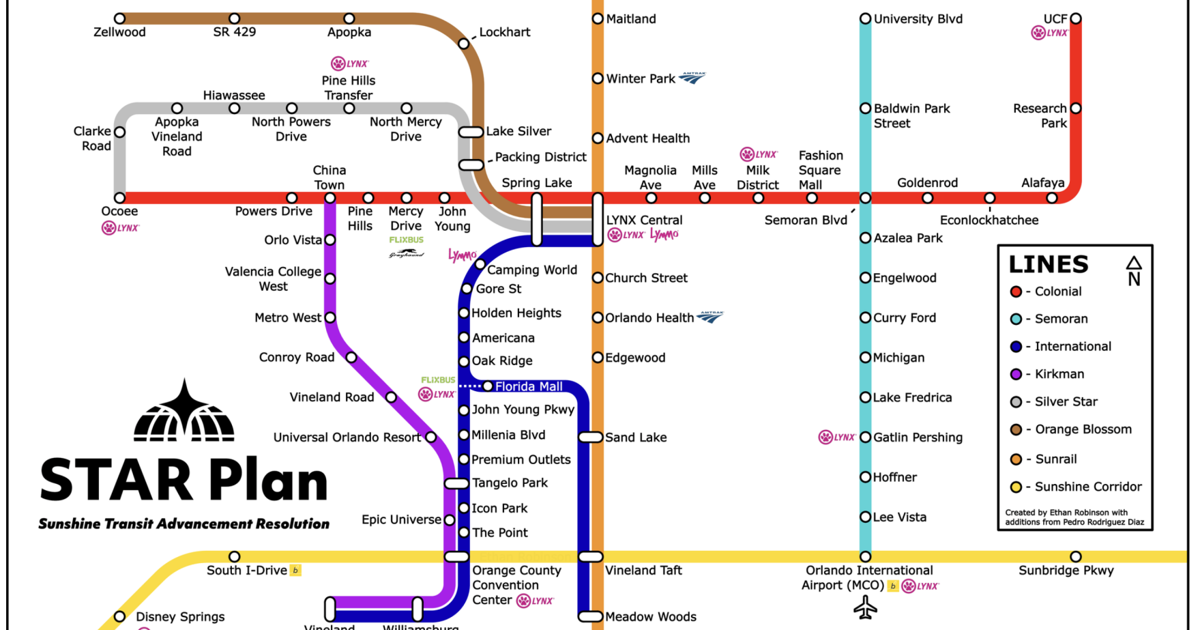
A map created by Sunrise Movement Orlando identifies eight proposed transit corridors connecting communities across the county, including a proposed route serving UCF. The corridors would provide rapid transit, which the organization defines as service operating at least every 15 minutes.
The project would be funded through tax increment financing, which allows local governments to use future increases in property-tax revenue within a designated area to help pay for improvements in that area.
Dom Berardi, senior communications major, supports the plan and has been influenced by his experience growing up in the suburbs.
“I support the STAR plan because growing up in the suburbs as a kid was really isolating and just awful,” Berardi said. “I don’t think anyone should live the way they were designed.”
Berardi, who creates social media content focused on urban transportation and car dependency, said he believes the STAR plan could strengthen connections between communities by making them less reliant on cars.
“The STAR plan can really help to bring back social cohesion and start that journey into a better future for everyone because it starts with transit,” Berardi said. “You can’t build bigger things, or build more parks, if you have to provide parking for all of that.”
Sen. Carlos Guillermo Smith, whose district includes UCF, has publicly supported the plan.
“Central Florida has no transportation infrastructure,” Smith said. “It’s nicknamed ‘Car-lando’ for a reason because really, if you need to get anywhere, you have to get in your car.”
The transportation system could include buses operating in dedicated lanes, light rail, commuter rail or other forms of rapid transit depending on the area, according to the plan.
Local elected officials and organizations have endorsed the plan, including U.S. Rep. Maxwell Frost, UCF alumna and Florida state Rep. Dr. Anna V. Eskamani and the UCF Urban Knights Association.
UCF Urban Knights Association Treasurer Michael Yara, senior sociology major, is a member of Sunrise Movement Orlando and said the plan is still in its early stages.
“Transportation planning — you can think about it in years, not weeks,” Yara said. “It would be gradual. So that could look like investing in one corridor first.”
Yara acknowledges that an obstacle to the current funding model is a ballot measure this November.
“One issue is that there’s a referendum on the ballot this November to heavily cut property taxes, and that matters for various aspects of government, including transportation,” Yara said.
Orange County Commissioner Dr. Kelly Martinez Semrad, whose District 5 includes UCF, has publicly supported the plan but said she is unsure whether it currently has the four commission votes needed for approval.
Semrad said if approved by the commissioners, the county would begin to conduct a feasibility study to determine what the project would look like.
“For everything, it will be a process,” Semrad said. “It will take time, because we are bound by policies and ordinances.”
The map showcases eight rapid transit corridors proposed as part of the STAR plan. The plan is pending approval at the Sept. 29 Board of Commissioners Meeting, according to Sunrise Movement Orlando.
Courtesy of Sunrise Movement Orlando
Semrad, an associate professor at UCF’s Rosen College of Hospitality Management, said Orlando’s limited public transportation options are already affecting the region’s tourism economy.
Semrad pointed to the National Association of Home Builders’ International Builders’ Show, which held its final Orlando event in February before moving permanently to Las Vegas.
“When you start to have trade shows not choosing to come here because of traffic, now we’re starting to talk about our lack of transit as impacting our economic function,” Semrad said.
Eskamani, a public supporter of the STAR Plan, said funding remains one of the biggest challenges to implementing the proposal. Eskamani said Orange County lacks a dedicated funding source for transportation and pointed to previous attempts to secure one, including a proposed penny sales tax that voters rejected in 2022.
“Instead of always manifesting what we can’t do, what we can’t afford,” Eskamani said. “The STAR Plan provides a vision that if we allocate dollars toward public transportation, we can really create something accessible, efficient, reliable that is going to save you money and reduce traffic long term.”
The Orange County Board of County Commissioners is scheduled to vote on the STAR Plan for the first time Tuesday, Sept. 29.