
ORLANDO, Fla. — Orange County commissioners are set to consider a feasibility study for the STAR plan, a public transportation proposal that identifies eight corridors where rapid transit could be used, and suggests a tax increment financing district to help fund early work on the projects.
The plan, started by Sunrise Movement Orlando, calls for creating a tax increment financing, or TIF, district within a half-mile of the proposed corridors. The money collected through increases in property values would not cover the full cost of transit projects, but supporters say it could help Orange County compete for state and federal matching funds.
“We were looking for a solution that the county commission where all they had to do was pass an ordinance,” said Giancarlo Rodriguez, hub coordinator for Sunrise Movement Orlando.
In the past, Orange County voters have rejected a transportation sales tax, and efforts to allow tourism development tax, or TDT, funds to be used for transportation have not been successful.
Orange County Commissioner Kelly Martinez Semrad said the TIF would be only one piece of a larger funding strategy.
“First, the TIF is not going to generate the complete pot of money and we all know that,” Martinez Semrad said. “But it does give a pot of money to be competitive to say to the state, ‘Hey, we have matching funds,’ or say to the federal government, ‘We have matching funds.’”
The STAR plan is based on Miami-Dade County’s SMART plan, a grassroots transportation initiative that has moved forward with bus rapid transit. Miami-Dade County completed its first bus rapid transit corridor in 2025.
Stacy Miller, director and CEO of the Miami-Dade County Department of Transportation and Public Works, said officials studied that corridor and determined bus rapid transit was the best fit based on potential ridership and cost.
“We analyzed this particular corridor and determined what could be the best approach given the volume of potential riders and costs,” Miller said. “We determined bus rapid transit was the ideal scenario right now.”
Miami-Dade County assistant director of construction Alejandro Barrios said bus rapid transit was a less expensive way to begin improving service quickly.
“It is a lot faster to implement — it is a lot less expensive and as you can see, we provide a train-like experience,” Barrios said.
The Miami-Dade project cost about $300 million to build. According to the county, $100 million came from federal funds, $100 million came from the state and the remaining $100 million came from a local half-cent surtax approved by voters.
“This was probably one of the least expensive of our SMART programs when it comes to cost, and it was over $300 million when you think about it,” Miller said.
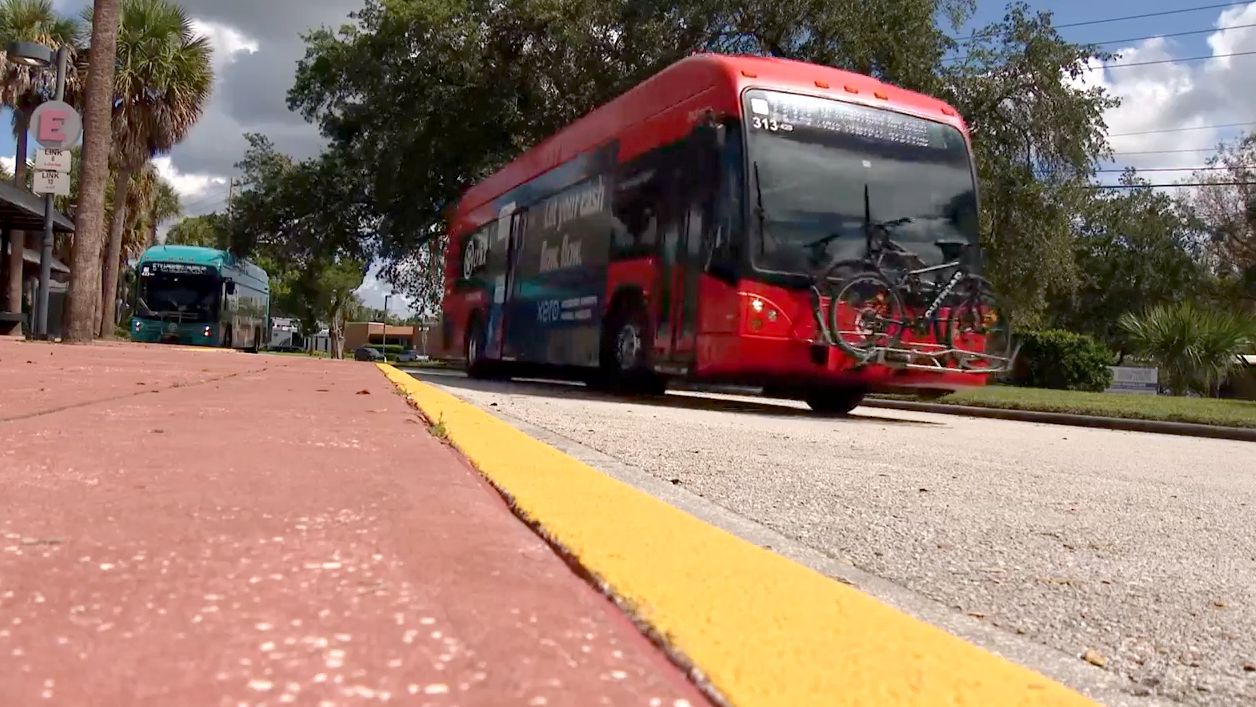
In Orange County, LYNX bus routes remain the only public transit option for many riders on the busy corridors. Supporters of the STAR plan say rapid transit could bring more efficient service to high-traffic corridors and help address congestion.
“I do think it is worth it for the long-term goal,” said Christina Bertrand, outreach coordinator for Sunrise Movement Orlando. “I think, as a community, having public transportation be the reliever for the traffic will save people money in the long term.”
Orange County commissioners are expected to vote on whether to begin the feasibility study. That study would provide more details on potential costs and funding options for the proposed rapid transit corridors.