David Brown | Staff Writer
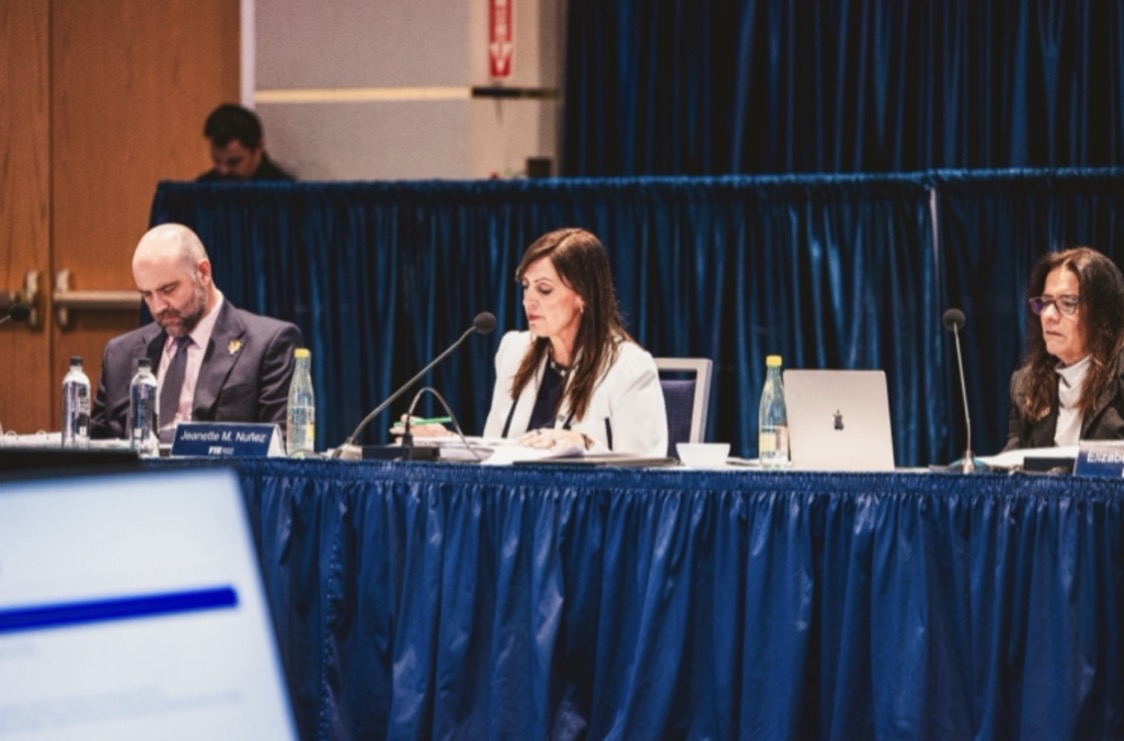
Last Thursday, Florida International University’s Board of Trustees reaffirmed its commitment to the State University System of Florida’s Statement on Free Expression following a tumultuous year of legal battles involving free speech, campus enforcement policies, and controversial appointments to leadership.
The reaffirmation to free speech comes after the ACLU of Florida’s lawsuit against the university of behalf of the on-campus student organization, ICEbreakers, arguing that FIU and its president, Jeanette Nuñez, violated their rights to protest following a silent demonstration against the university’s agreement with ICE.
The lawsuit comes from a protest on March 13, where student representatives of ICEbreakers wore “ICE OFF FIU” T‑shirts during a Fireside chat featuring President Nuñez and retired baseball player Alex Rodriguez, expressing their opposition to FIU’s arrangement allowing campus police to enforce federal immigration laws.
The demonstration specifically targeted FIU’s 287(g) agreement with ICE, adopted in April 2025, which authorizes FIU police to carry out functions typically reserved for federal immigration agents.
Afterwards, students were reprimanded and ordered to record two-minute videos, apologizing for their demonstration, under the threat that if students fail to submit the videos by September 4, 2026, academic and administrative holds would be placed.
U.S. District Judge Jacqueline Becerra later granted a preliminary injunction blocking FIU from enforcing disciplinary punishments to the student protesters.
Other controversies have added to FIU’s turbulent year. The university is additionally battling a separate First Amendment lawsuit from law student Abel Carvajal, who says FIU unlawfully investigated him for racist and antisemitic messages shared in a private WhatsApp group chat, following the College Republicans at FIU group chat leak.
FIU also faced backlash for appointing former Trump administration official Daniel Z. Epstein as interim law dean, to FIU’s College of Law, bypassing traditional university search procedures.
Most recently among the controversies is with President Nuñez’s contract, regarding a contract bonus of $400,000 amongst concerns with faculty raises and Miami’s rising cost of living.
A systemwide commitment with university-specific rules
The State University System’s Statement on Free Expression states that Florida’s public universities should support “full and open discourse and the robust exchange of ideas and perspectives” and describes higher education to be a place where divergent ideas, opinions, and philosophies can be debated and critically evaluated.
At the same time, the statement gives individual universities authority to establish regulations governing how expression takes place on their campuses.
“Each institution has adopted regulations” that must align with Florida’s Campus Free Expression Act, the U.S. and Florida constitutions and applicable legal decisions, according to the statement.
The distinction is quite significant. The State University System establishes a common free-expression framework, while individual universities remain with the authority to define campus-specific regulations governing how the expression of free speech can occur.
At the 12 public universities across the state, different meanings for how free speech should operate on their campuses can emerge.
The systemwide statement allows for reasonable restrictions on expression due to the time, place and manner of the expression; it also acknowledges that universities may restrict unlawful expression, such as true threats or defamation.
Institutions like Florida A&M University, a historically Black university in Tallahassee, may interpret and apply free-speech completely differently to Hispanic‑serving institutions in South Florida like FIU or FAU, reflecting differences in demographics, campus cultures, student views and political pressures.
At FIU, this distinction has become particularly relevant as the university’s own campus regulations face scrutiny in federal court, making this reaffirmation confusing and in aspects, untrustworthy to defend students’ free speech.
What the reaffirmation means moving forward
The Board’s reaffirmation does not create a new free-speech policy for FIU. Instead, it renews the university’s commitment to the State University System’s existing principles while FIU continues to operate under its own campus regulations.
For students, the distinction could either be a benefit in reinforcing the previous protections for students or leave the final decisions of how free speech should be expressed up to each University’s administrations.
About Post Author