
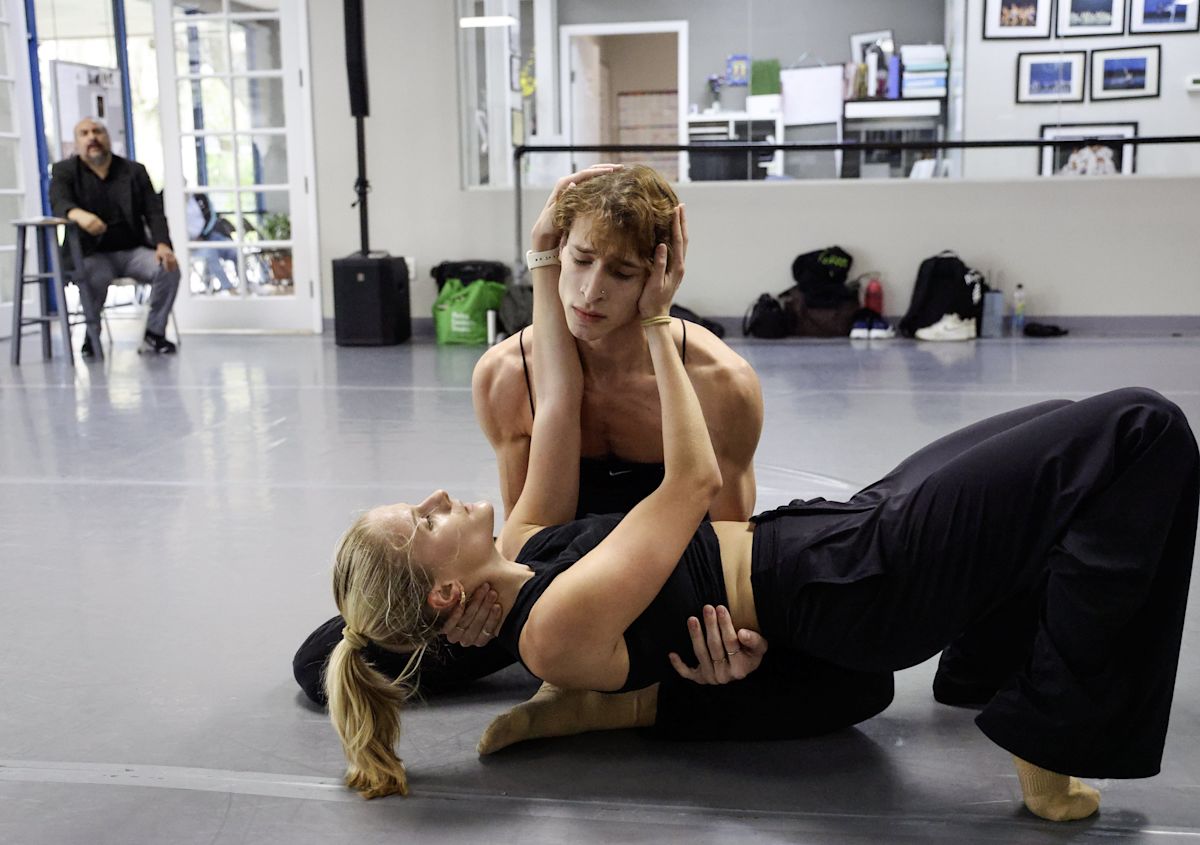
The dancers swept the suitcases over their heads and whisked them across the studio.
They each crossed the Tampa rehearsal space with one bag, which contained a different memento: a letter, a scarf, a set of children’s toys.
The narrator, played by Cornelio Aguilera, recited lines from a small chair in the back corner.
“They arrived to the factory, the tabacaleros, from distant lands,” he said. “Their faces weathered by the sun, hands roughened by the soil of another world.”
As the music slowed, the dancers unlatched the bags and cradled their belongings close. The Tampa City Ballet professionals had slipped into the role of immigrants arriving in Ybor City in the 1920s for “La Séptima,” an original production opening the company’s 2026-27 season.

Dancers with Tampa City Ballet perform a scene of the arrival of immigrants to the Port of Tampa during a rehearsal of La Séptima.
Paula Nuñez, the founder and artistic director, created and choreographed the project, a historical ballet which follows the immigrants who built Ybor, its social clubs and underground gambling scene of the early 1900s.
Over the last decade, Nuñez has produced a handful of performance pieces that dive into Ybor history, working without the funding that older professional companies can get.
Each piece has built on the last, and Nuñez calls “La Séptima” the closing of the trilogy.
This year’s project includes a traditional stage show, an immersive dance experience at the Cuban Club and a behind-the-scenes conversation at the University of South Florida with artists and historians.
Nuñez said it was important to tell Ybor’s history without romanticizing it or making it overly negative. As Floridians celebrate Ybor City’s 140th and America’s 250th anniversaries this year, the country is reckoning with heightened political tension. Nuñez and her dancers say they see similar themes in “La Séptima.”
“Rather than presenting American history only through national figures and major political events,” she said, “I think ‘La Séptima’ looks at America through one street: Seventh Avenue.”

Dancer Carissa Smith moves through a routine from a scene at a cigar factory.
Nuñez is an immigrant herself, from Venezuela, who came to Tampa in 2002.
She studied classical ballet, performed for international ballet companies and later started teaching at USF, where she researches how choreographers can deconstruct classical ballet to meet 21st-century dance.
She opened Tampa City Ballet as a nonprofit in 2018 after seeing talented graduates head to other cities to pursue professional careers. The company held one of its first performances at Hillsborough College’s Performing Arts building in Ybor, so Nuñez walked around SeventhAvenue and chatted with folks at the Cuban Club when she wasn’t leading rehearsals.
It felt like a film set, she said. She was hooked.
Nuñez’s first project about Ybor history was a short film she made in the aftermath of the COVID-19 pandemic called “102 Degrees,” about the 1918 Spanish flu hitting cigar factory workers. She developed another iteration, “Interstices,” which was an interactive performance at the Cuban Club in 2023.
“Interstices” and “La Septima” are both based on the 1897 book “Tampa: Impressions of an Emigrant”by Wenceslao Gálvez y Delmonte. It was translated in 2020 by Noel Smith, then the deputy director of USF’s Contemporary Art Museum. The story follows the author’s own experience as a Cuban immigrant who becomes a lector in a cigar factory.

Cornelio Aguilera, of Wesley Chapel, narrates as Wenceslao.
Nuñez read the translation and started to adapt its episodic chapters into scenes that mix contemporary, modern, jazz, classical ballet and Latin dance.
She studied how cigar makers move their hands and elbows to choreograph their motions. She picked up clothes from thrift stores to sew the costumes, while dancers pored over historical catalogs to research their characters.
Nunez also teamed up with Santiago Echeverry, a professor at the University of Tampa, who used artificial intelligence to produce animations of cigar factories and roaring ’20s social clubs in Ybor. The projections act as set design behind the dancers.
“We want to get the resources so we can actually shoot real video with real people and pay people to do this,” Echeverry said. “But until that moment, we have to use whatever we can.”
He said he could have used historical photos but chose not to because he wanted the projections to resemble a dream, not a documentary.

Dancer Joey Bell reads news of La Revolucion with singer Daniella Mass.
Keeping the project historically faithful was a responsibility everyone took seriously, Nuñez said, from the joyful and romantic scenes to more uncomfortable storylines.
The production explores the divide between the cigar factory workers who filled the social clubs at night playing dominoes and the rich socialites who indulged in lavish parties.
One dance dives into the emotional toll of Ybor’s segregated social clubs. Another handful of scenes highlight the illegal gambling culture and organized crime in the city. Charlie Wall, played by Bailey Lord, was a mobster who controlled Ybor’s underground lottery game, La Bolita, and had massive political influence.
“I think we’re still seeing that today,” Lord said. “The class divide is further than it’s ever been and the middle class is getting smaller and smaller. All of our dancers are working multiple jobs and actively trying to survive this time where financially it’s really difficult to live.”
Nuñez said her works tend to spark social and political discussions, especially as history tends to repeat itself. Many dancers said the rehearsal process taught them so much about the city they grew up in.
Aguilera, playing the narrator, stood among the dancers in the rehearsal’s final moments.
“Is this the city I imagined?” he asks a nonexistent audience.
“I do not know. But I gave it my words, my sweat, my heart. And it made me one of its own.”
Tampa City Ballet’s ‘La Séptima’
The stage performances of “La Séptima” are at 7:30 p.m. Friday and Saturday at the New Tampa Performing Arts Center, 8550 Hunters Village Road in Tampa.
The immersive experience runs at 7:30 p.m. Oct. 9, 4 and 7:30 p.m. Oct. 10 and 4 p.m. Oct. 11 at the Cuban Club, at 2010 N Avenida Republica de Cuba in Tampa.
The Salon, a behind-the-scenes conversation experience with Nuñez about the inspiration and process behind the production, is at 6 p.m. Oct. 17 at USF’s Theatre Center, 3837 USF Holly Drive in Tampa. It will also feature excerpts from “La Séptima.”
For tickets, visit tampacityballet.org.

Dancers perform the finale during a rehearsal of La Séptima.
The Tampa Bay Times Education Hub reports on Florida’s schools and universities and the students they serve. You can contribute to the hub through our journalism fund by clicking here.