
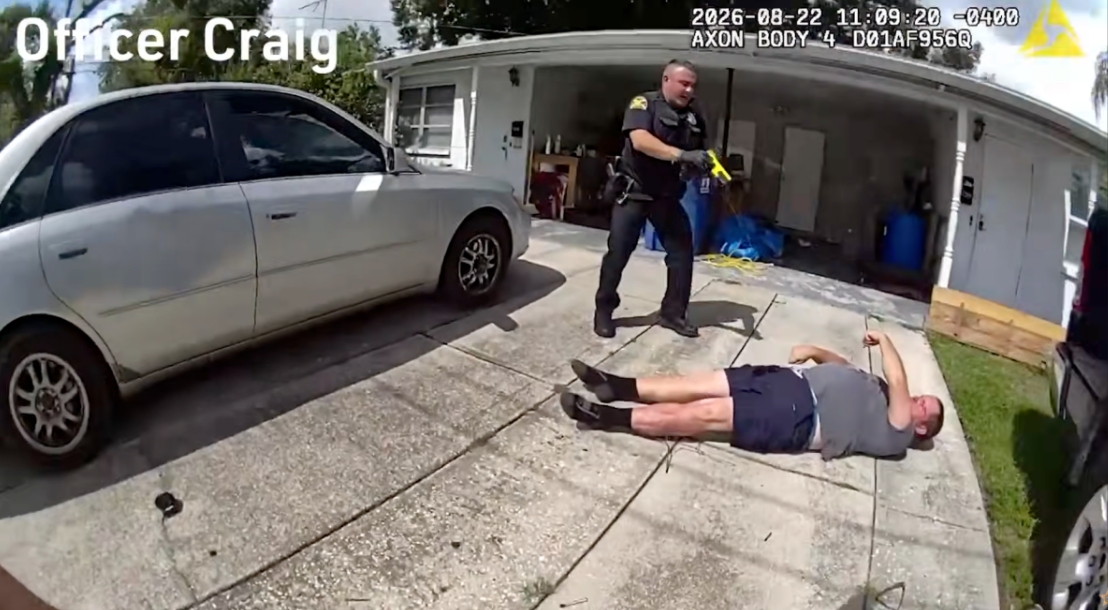
A still from bodycam footage showing St. Petersburg Police officer Daniel Poveda and Brian Pepal in St. Petersburg, Florida on Aug. 22, 2026.
Credit: Pinellas Sheriff / YouTube
Bodycam footage shows an unarmed man, who had already attacked police, appearing to comply with instructions when he was inadvertently killed by officers from the St. Petersburg Police Department.
At a press conference Monday (warning: graphic content), Pinellas County Sheriff Bob Gualtieri said the incident was an “excusable homicide.”
On Aug. 22, 2026, Brian Pepal’s stepmother flagged down a passing police car and asked for a welfare check on Pepal, who she said was experiencing a mental health crisis.
Pepal was diagnosed with schizophrenia and bipolar disorder, according to Gualtieri, and his family said his mental health began declining after he was hit by a vehicle in 2023.
Earlier that morning, a neighbor reported that Pepal had threatened to cut her head off, according to police.
Officers knocked on Pepal’s door, and he then began punching the officers. During the ensuing struggle, officers tased him repeatedly, even as he appeared to comply with instructions after falling to the ground. He died minutes later.
The Pinellas-Pasco medical examiner said that Pepal’s death was a homicide, caused by “traumatic asphyxiation with contributing conditions of restraint, coronary atherosclerosis, obesity, and schizophrenia,” according to Gualtieri. He also said marijuana was found in Pepal’s system.
Coronary atherosclerosis affects about half of people over the age of 45.
Body camera shows officers’ interaction with Pepal
Officers Tammy Craig and Daniel Poveda knocked on Pepal’s door, identifying themselves as police. Body camera footage shows that Pepal left his house unarmed, asking, “What is the police department?” before punching Poveda.
Pepal continued attacking the officers for 15 seconds until Craig successfully hit him with her taser and he fell on his back with his arms paralyzed in front of him.
Tasers work by launching sharp electrodes into skin, then sending electricity to those electrodes through wires still attached to the taser gun. After being hit, a person can be shocked repeatedly by reactivating the taser until the electrodes are removed.
This incapacitates an individual’s muscles and can result in muscle weakness even once the taser is deactivated. Axon (stylized in all-caps), who manufactures the tasers used by SPPD, recommends monitoring a subject for 20 minutes following taser use to ensure they are feeling well.
Pepal appeared to attempt to stand up once he was no longer paralyzed, at which point the taser was activated again, shocking him.
He then followed shouted instructions to roll over onto his stomach, and Poveda yelled at him to put his hands behind his back.
Pepal rolled onto his side, freeing his arm from underneath him, and began to place his arm behind his back when Poveda yelled at Craig to “keep popping him.” Craig activated the taser again, and Poveda handcuffed Pepal’s left wrist.
Pepal then appeared to shout: “People, help me.”
“No, no, you just keep popping him,” Poveda told Craig. “Keep popping him.” She activated the taser again, shocking both Pepal and Poveda.
“Bring the other one back,” Craig instructed. “No, I can’t do it,” Pepal appeared to respond. Labored breathing from Pepal can be heard in the video as he says, “Why? … Help, help.”
He said a few more indiscernible words before falling silent.
The officers successfully handcuffed Pepal, who began to move his legs, which they then crossed and folded up near his thighs. Poveda kneeled on Pepal’s shoulder.
“You shocked me like six times,” Poveda told Craig as they held Pepal down.
Other officers showed up and discovered that Pepal was unresponsive. They turned him on his back and saw that his face was turning purple.
“Take off those handcuffs,” one of the other officers appeared to say.
“No no no no, this guy’s fighting,” Poveda appeared to respond as other officers began compressions on Pepal’s limp body.
The next several minutes of footage show family members and neighbors standing, embracing and watching as resuscitation efforts are taken over by fire rescue.
Pinellas Sheriff Bob Gualtieri says no wrongdoing
In 2020, Pinellas established a task force that investigates use of deadly force among the county’s police agencies. The task force is made up of homicide detectives from several different departments, and is led by the Pinellas County Sheriff’s Office.
Announcing the results of the investigation, Gualtieri said at the press conference that the officers did everything correctly given the circumstances. A letter from State Attorney Bruce Bartlett said that the officers would have been justified in using deadly force.
There appear to be a few inconsistencies between a letter summarizing the sheriff’s findings and the body camera footage.
For instance, Pepal appears incapacitated before Poveda fires his taser, but the report said that he was incapacitated after. The report states that Poveda kneeled on Pepal’s shoulder during the handcuffing process, but video shows he didn’t kneel on Pepal’s shoulder until after he was handcuffed.
The report also said that Pepal “failed to comply” with instructions to place hands behind his back and instead “placed both hands under his torso.” In the video, Pepal appears to be placing one hand behind his back, only dropping his arms when Craig activates her taser again. His left hand does not appear to be underneath his torso in the video.
Under Florida law, that might not matter. Florida statute broadly allows the use of lethal force to defend against imminent threats and prevent forcible felonies from occurring.
Bartlett’s investigation concluded that the officers didn’t intend to kill Pepal in the first place.
“There was no intent in the actions of Officer Poveda and Officer Craig to cause of the death of Brian Pepal and the force used by Officer Poveda and Officer Craig was a reasonable response to the circumstances present by Brian Pepal’s own actions,” the letter reads. “Therefore, it is the conclusion of the State Attorney’s Office that the death of Brian Pepal was an excusable homicide, pursuant to F.S. §782.03 and F.S. §776.05(1).”
The St. Petersburg Police Department still has to review Craig and Poveda’s actions to ensure they followed department policy.