
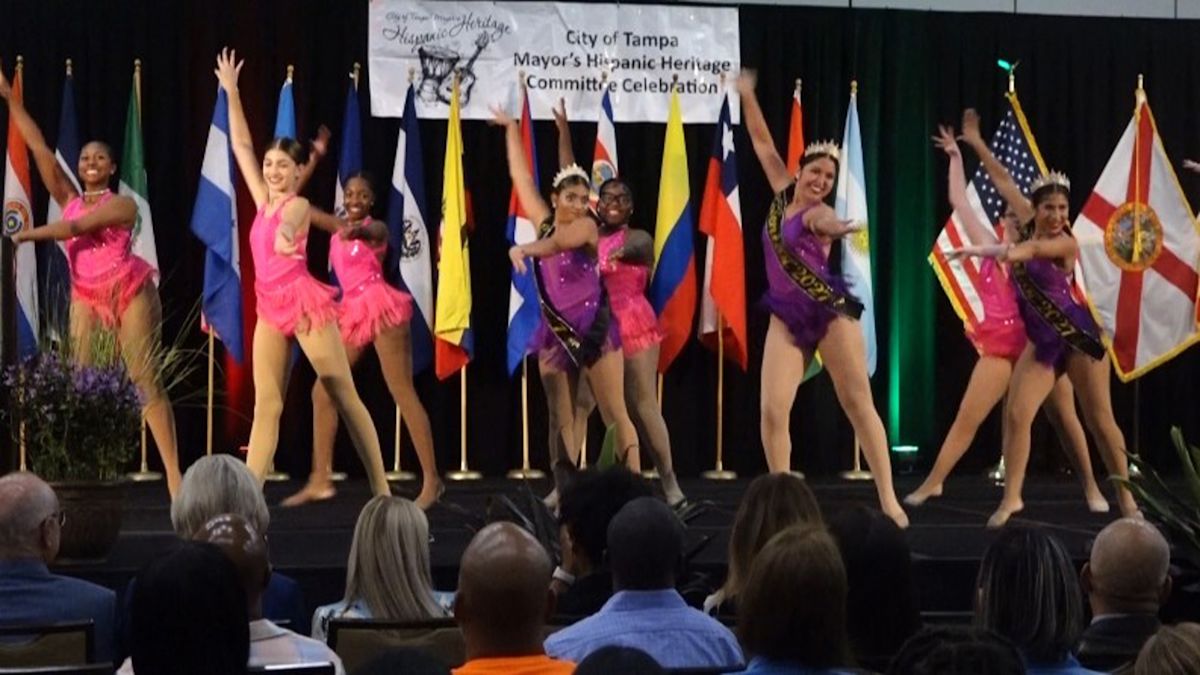
Tampa celebrated its Hispanic heritage Tuesday with music, dancing and a proclamation at the Tampa Convention Center, marking the city’s 38th annual Hispanic Heritage Celebration.
The celebration comes as Hispanic Heritage Month continues through Oct. 15, but organizers and speakers also acknowledged what some in the community describe as uncertain times, particularly for families concerned about immigration policies.
The event, organized through the mayor’s Hispanic Heritage Committee, focuses not only on Tampa’s Hispanic history but also on the future of the city’s Hispanic community through education, mentoring and scholarship opportunities at local community colleges and universities.
Mayor Jane Castor said Tampa’s Hispanic heritage is deeply connected to the immigrants who came to the city to work in the cigar industry and helped shape its identity.
“We have close to 30% of our population are Hispanic. And if you look back at the cigar industry, really, the community that built the City Of Tampa,” Castor said.
Castor said the immigrants who came to Tampa were pursuing opportunities for themselves and their families.
“If you look at the folks that came over for the cigar industry, the immigrants, they came over with a dream. The American dream. And they were able to realize that dream,” she said.
Castor said that history remains central to Tampa’s identity.
“This country is made by immigrants. And so, we are celebrating the Hispanic heritage, our community, and what it’s meant to the City Of Tampa over these centuries,” Castor said.
She also described Tampa as a welcoming community and said immigrants have contributed to the city’s culture, art and history.
Maribel Garrett, Tampa’s Hispanic liaison, said the city’s immigrant roots are a source of pride for the community.
“The City of Tampa was founded by immigrants. And that’s one of the things that makes us so proud, that makes us so proud of our roots. Of our background. And people should continue to feel that sense of pride. That sense of belonging here in the City of Tampa,” Garrett said.
But Garrett also acknowledged that some people are experiencing uncertainty.
“People have that sense of ‘What is going to happen?’ That uncertainty. And we just wanna make sure they understand that as a city we are welcoming,” she said.
Garrett said the city intends to keep its Hispanic heritage in mind as Tampa plans for the future.
“And we will continue to ensure that those roots, that background that makes us who we are as a city continues to be an important part of the decision-making process, of how we move forward as we continue to build our future,” she said.
She said that commitment extends beyond Hispanic Heritage Month.
“Ybor City was built by those groups, so it’s important that we not only recognize it but that we continue to celebrate it not just during Hispanic heritage. But year-round,” Garrett said.
“We understand that there are individuals out there that are part of that heritage, that culture and they’re just incorporated within our community. And then they’re not going anywhere,” she said.
Keynote speaker Alberto Delgado, a Tampa businessman and founder of Festival de Bomba y Plena en Tampa, also called for unity within the Hispanic community.
“Our community become stronger when we choose collaboration over division,” Delgado said.
He said the history and contributions of Hispanic and Latino communities in the United States cannot be separated from the nation’s broader story.
“Our roots are powerful. Our contribution has impacted this nation significantly. The history is clear. And no one, no one, can erase those facts,” Delgado said.
“And never underestimate the power our legacy has made and continues to make in this great nation,” he said.
The celebration also highlighted efforts extending beyond Tampa, including assistance for communities in Colombia affected by devastating earthquakes.
Javier Marin, director of Tampa’s Economic Opportunity Department, said the relief effort is evolving as officials determine where supplies and other assistance are now most needed.
“The needs have shifted, the locations. And so, we are working with the government of Columbia, we’re working with our sister cities and trying to figure out what the actual need is,” Marin said.
Marin said additional shipments from the Port of Tampa Bay could be necessary, although officials are still working through logistical and legal issues.
“It looks like we may have to ship more from Tampa Port Tampa Bay so that it can be delivered from there. We’re just not there yet. There are legalities that need to be addressed,” he said.
He said reconstruction materials and services could also become part of the relief effort.
“There is a need for reconstruction services or products. We are trying to figure out what that needs to look like, but we going to ask people to do is to stay tuned,” Marin said.
Marin said officials expect to make another appeal for public support in the coming weeks, including help covering the cost of shipping supplies from Tampa.
Medical assistance is also part of the effort.
“USF Health already has a very strong presence in Colombia today. There are a number of doctors that are working to bring medical products and medical equipment into those areas because the need is still very large,” Marin said.
He said Tampa’s relationship with Colombia is strengthened by the area’s Colombian community and its sister-city connection.
“Not only because we have a large diaspora from Colombia here in Tampa, but also because we have a sister city there, and so there is constant exchange of information and programs and cultural events. And even commerce,” Marin said.
While the precise needs are still being determined, Marin said the connection to communities affected by the earthquakes remains strong.
“They still need us,” he said.
The event was one of many Hispanic Heritage Month activities planned across Tampa Bay before the observance concludes Oct. 15. Upcoming events include the annual Taste of Latino Festival & Empanada Smackdown on Oct. 11, along with other cultural celebrations and performances.
For Tampa’s Hispanic leaders, however, the month is also an opportunity to keep attention on a history that stretches back generations — and on a community they say continues to shape the city’s future.