
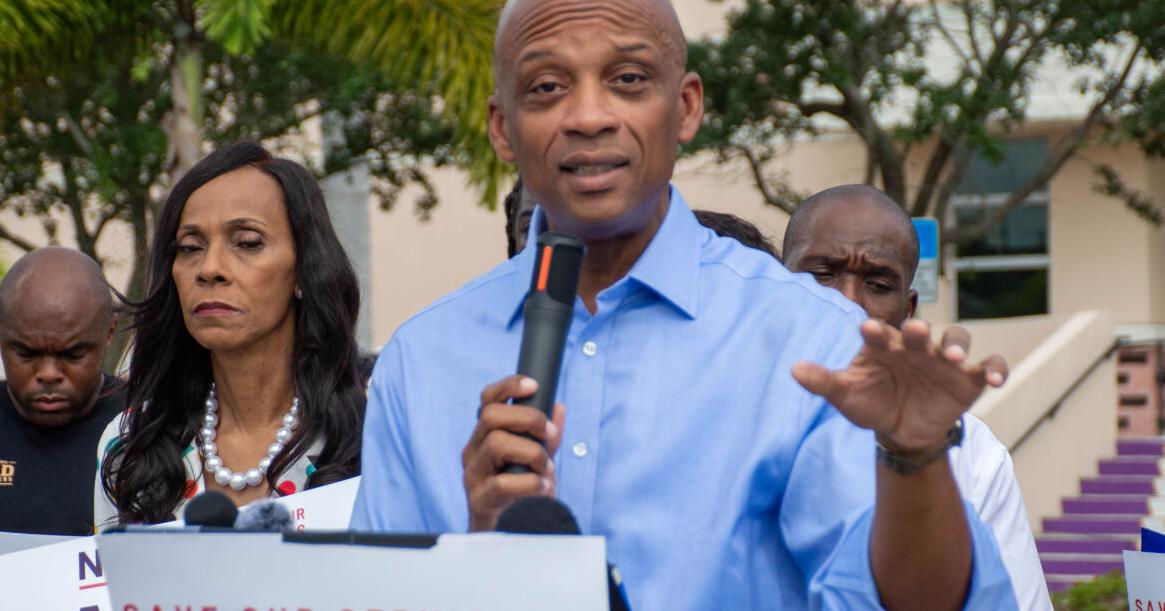
A retired teacher worried about senior centers. A firefighter asked what would happen when someone calls 911. Elected officials pointed to buses, parks and after-school programs.
Gathered Friday, Sept. 25, at Antioch Missionary Baptist Church in Miami Gardens, they joined Equal Ground and the Save Our Services – No on 3 coalition to urge Floridians to reject Amendment 3, a proposed property tax change on the Nov. 3 ballot. They argued that the savings offered to homeowners could leave local governments with less money for services used by homeowners and renters alike.
“I don’t want a tax break today if it means higher fees, higher costs or reduced services tomorrow,” said Merline Merle Malcom, a retired public school teacher and homeowner who spoke at the press conference.

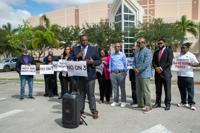
Genesis Robinson, executive director of Equal Ground, surrounded by Black elected officials and community members from the Save Our Services – No on 3 coalition at Antioch Missionary Baptist Church in Miami Gardens.
(Amelia Orjuela Da Silva for The Miami Times)
Amendment 3 would expand the homestead exemption on property taxes other than those levied by school districts. For qualifying residents who maintain a permanent Florida residence by Dec. 31, 2026, up to $150,000 of a home’s assessed value would be exempt in 2027 and up to $250,000 would be exempt in 2028.
Newer residents who establish homestead would initially receive a smaller exemption, with access to the larger amount beginning in the fifth year. The amendment also would reduce the cap on annual assessment increases for non-homestead properties from 10% to 5%.
The amendment needs approval from 60% of voters to take effect.

Community leaders hold signs from the No on 3 campaign.
(Amelia Orjuela Da Silva for The Miami Times)
’These are not luxuries’
Genesis Robinson, executive director of the Equal Ground Education Fund, said the organization would work with the statewide coalition to bring the debate directly to Black communities through roundtables, faith outreach, Black media and local partners.
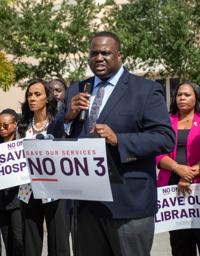
Genesis Robinson, executive director of Equal Ground.
(Amelia Orjuela Da Silva for The Miami Times)
“We know that families are looking for relief,” Robinson said. “But the reality is, Floridians deserve real relief — not a proposal that shifts the cost and puts the services that our communities rely on at risk.”
Robinson listed hospitals, firefighters, children’s programs, parks, libraries and roads among the services he fears could suffer.
“These are not luxuries,” he said. “These are basic services that help keep our community safe.”
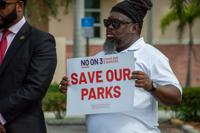
A community member holds a sign that reads “Save our parks.”
(Amelia Orjuela Da Silva for The Miami Times)
A Florida Policy Institute Amendment 3 Local Funding Cuts Calculatorlaunched Tuesday, Sept. 29, estimates $1.51 billion in Miami-Dade County funding would be at risk across fiscal years 2028 and 2029 — about $537 million in the first year and $970 million in the second. Its county operations category accounts for an estimated $656.5 million of the two-year total.

“We know that families are looking for relief, but the reality is, Floridians deserve real relief — not a proposal that shifts the cost and puts the services that our communities rely on at risk.” -Genesis Robinson, Equal Ground
(Equal Ground)
District 1 Miami-Dade County Commissioner Oliver Gilbert III pointed to transit, parks, roads, after-school programs and meals for seniors as services residents rely on every day. He said roughly 300 people spoke at a recent county budget hearing, and “not one person came and said, ‘We want fewer services.’”
Instead, he said, the county could face a choice that affects residents who would not even stand to benefit from the homestead exemption:
“Either cutting the service or increasing the amount that they pay for it. Right now, if you take the bus, you only pay 11% of the actual cost of taking the bus,” Gilbert said. “Could you really afford to go to that job on the beach, from where you live, if you had to pay the whole amount every time?”
What happens if it passes
Bernard Taylor, a firefighter paramedic in Palm Beach County, said lower property taxes would appeal to families facing higher costs for housing, groceries and insurance. But he asked voters to consider whether local governments could maintain emergency coverage with less revenue.
“When you call 911, you should never have to wonder whether your municipality has an ambulance,” Taylor said. “When your house catches fire, you shouldn’t have to wonder whether you’re near a fire station with enough firefighters to respond.”
Taylor cited an analysis by Palm Beach Gardens that modeled the impacts of Amendment 3 on the city, highlighting the possible elimination of 64 firefighter positions over two years. In Miami-Dade, FPI’s figures estimate $243.1 million over two years for fire rescue and emergency medical services at risk.
“When emergency happens, every second matters,” Taylor said.

Miami-Dade homeowner Merline Merle Malcom speaks at the press conference.
(Amelia Orjuela Da Silva for The Miami Times)
Malcom raised a different set of questions. As someone who uses such programs, she wondered whether senior centers would still offer exercise, health and safety classes if budgets tightened. She also wondered about basic services such as garbage collection and emergency response.
“What would happen if I had an emergency? Well, how long would it take for them to get there?” she said. “What about my garbage pickup? Now it’s twice a week. Would it still be twice a week? Or would they reduce it to once a week?”
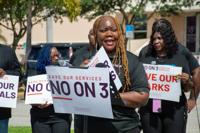
Daniella Pierre, president of the NAACP Miami-Dade Branch.
(Amelia Orjuela Da Silva for The Miami Times)
Daniella Pierre, president of the NAACP Miami-Dade Branch, described children who receive free books through community programs and parents who rely on aftercare and summer activities. FPI estimates that The Children’s Trust of Miami could see about $60.4 million less in property tax revenue and $32.5 million less for libraries over fiscal years 2028 and 2029. FPI notes that the impact will likely be greater as funding for some services falls within multiple categories.
From a civil rights perspective, Pierre said Black and brown communities stand to lose the most.
“We must ask who would really benefit from Amendment 3, and who will actually bear the burden? Our communities have historically seen the least investment. We simply cannot afford to lose any more grounds or any more opportunity. Equal access to opportunity and essential services should never depend on our zip code,” Pierre said.

Community leaders hold signs opposing Amendment 3.
(Amelia Orjuela Da Silva for The Miami Times)
.Engage Miami Executive Director Katherine Leiva similarly tied local services to whether young adults can remain in South Florida.
“If you don’t have a car, a transit cut can mean you can’t get to the class, to your job, or get to that internship that you’re hoping becomes a full-time job by the end of the semester. If parks and recreation programs are cut, young people lose places to gather, play and build community,” Leiva said.
She cited an FPI reportestimating Jackson Health System losing about $63.9 million in county support. Jackson is not itself a special hospital taxing district; its funding depends in part on decisions Miami-Dade makes about county revenue.
The question for renters
Renters would not receive the homestead exemption under Amendment 3. Coalition members argue they could face thus face higher costs if governments increase taxes on rental property and landlords pass those increases along.
A separate analysis by Jared Walczak, a national property tax expert with Walczak Policy Consulting, examines how Amendment 3 could affect property taxes on rental homes across Florida. If local governments raised property tax rates enough to replace lost revenue, the analysis estimates an additional $268 a year in property taxes per Miami-Dade apartment unit and an additional $1,069 a year per single-family rental.
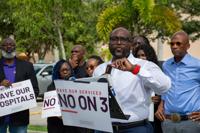
State Sen. Shevrin Jones.
(Amelia Orjuela Da Silva for The Miami Times)
State Sen. Shevrin Jones said the state should debate property tax relief, but he argued that this proposal would move costs rather than resolve them.
“This is not a tax relief,” he said. “This is a tax shift. You might not pay it on this. But you’re going to pay it on that.”
Ultimately, Jones said the debate should not depend on party affiliation.
“This has nothing to do with Democrats and Republicans, because when you look at your bank account, there’s no D or no R next to it…”