
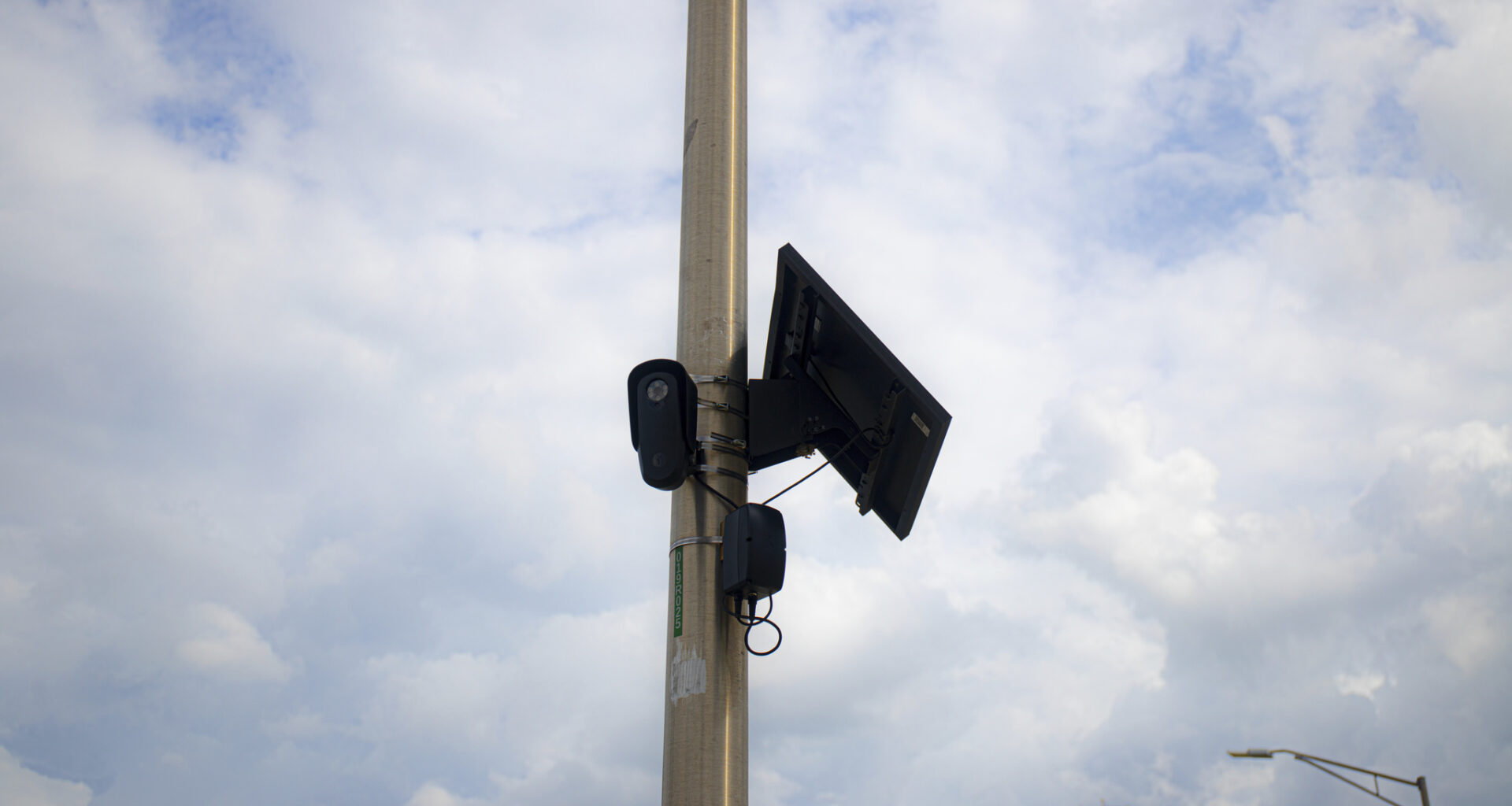
 USF police confirmed the department uses Flock Safety’s automatic license plate readers, and shares their data with regional law enforcement agencies. ORACLE PHOTO/THOMAS MARRS
The University of South Florida Police Department (USFPD) has confirmed it uses Flock Safety’s automated license plate readers across campus.
Flock Safety cameras are solar-powered, internet-connected automated license plate recognition cameras designed to capture vehicle details and cross-reference them against law enforcement hotlists in real time, according to Flock Safety.
The technology was created in 2017. While it started in Georgia, it quickly spread to help police departments all across the country, according to the Savannah Morning News.
USFPD’s Public Information Officer Larry McKinnon confirmed the department’s deployment of the units as part of its daily policing operations.
“This technology can assist with locating stolen vehicles, missing persons’ investigations, and developing investigative leads,” McKinnon said.
McKinnon said the data collected by the cameras is also shared as part of regional data-sharing agreements typical of law enforcement agencies in the area.
“[This allows] us to coordinate more effectively with neighboring jurisdictions on public safety matters affecting the USF community,” McKinnon said.
McKinnon said that direct access to the surveillance feed remains restricted.
“Access is limited to trained law enforcement personnel, and its use is governed by departmental policy,” McKinnon said.
Related: USF St. Pete researchers finalizing flood monitoring camera project across Pinellas County
Some USF students say mass vehicle surveillance invades on their privacy.
Peyton Lord, a sophomore health science major, said he first noticed the cameras around campus and the surrounding Tampa area in late August.
“I have a car, and I just don’t like the idea of that every single time I go somewhere, it’s being seen and logged somewhere,” Lord said. “I like the idea of increased security, but it just goes about it in a lot of the wrong ways.”
According to the Flock Safety team, Flock markets its technology primarily as an objective deterrent against violent crime and auto theft.
Lord said she feels doubt about its long-term impact on campus culture.
“I just want to think that they’re there for a good reason, to actually keep students safe,” Lord said. “I think the idea of better surveillance is a good idea, but the people who have access to it and the people who are creating it are just not the right people for it.”
Michelle McAveety, a senior computer engineering major, said the presence of the cameras creates an inescapable atmosphere across campus.
“While I understand and am used to cameras placed in spaces like classrooms or public areas, the usage of cameras at the entrance of the university makes surveillance feel unavoidable and suffocating,” McAveety said.
McAveety, who first became aware of the units through cybersecurity channels in spring 2026 before spotting them during the summer, voiced frustration over the lack of official transparency from administration.
“It bothers me that there was no communication from the university regarding this measure,” McAveety said. “It is hardly a secret, yet they intentionally have not notified students or justified their decision to increase surveillance.”
Related: UPD to enforce body cams by August
The skepticism on campus echoes a broader backlash playing out across the Tampa Bay area, like the pushback in town hall meetings, according to the Tampa Bay Times.
In Temple Terrace, city officials opted out of renewing a license plate reader contract with Flock competitor Vigilant, redirecting those funds toward internal administrative tools and an anonymous tips mobile app, according to the Tampa Bay Times.
Otherwise, nationally, organizations and independent watchdog groups have intensified pressure on ALPR companies.
Across the Tampa campus alone, activist-maintained tracking maps estimate about 20 Flock cameras, according to DeFlock Maps.
Watchdog databases like HaveIBeenFlocked have published leaked audit records revealing widespread data access.
USFPD Chief Chris Daniel said that the department continually balances its technological capabilities with legal compliance.
“The privacy of our community is something we take seriously,” Daniel said. “Our use of ALPR technology is subject to internal policy, oversight, and applicable Florida law, and we continually evaluate our practices to ensure appropriate use.”