
The Broward School District repeatedly mismanaged a competitive bidding process to exclude one technology vendor and later steer business toward another, the county’s top watchdog has concluded.
A report from the county’s Office of Inspector General also alleges that one of those vendors committed possible felonies by submitting false information to get business with the school district.
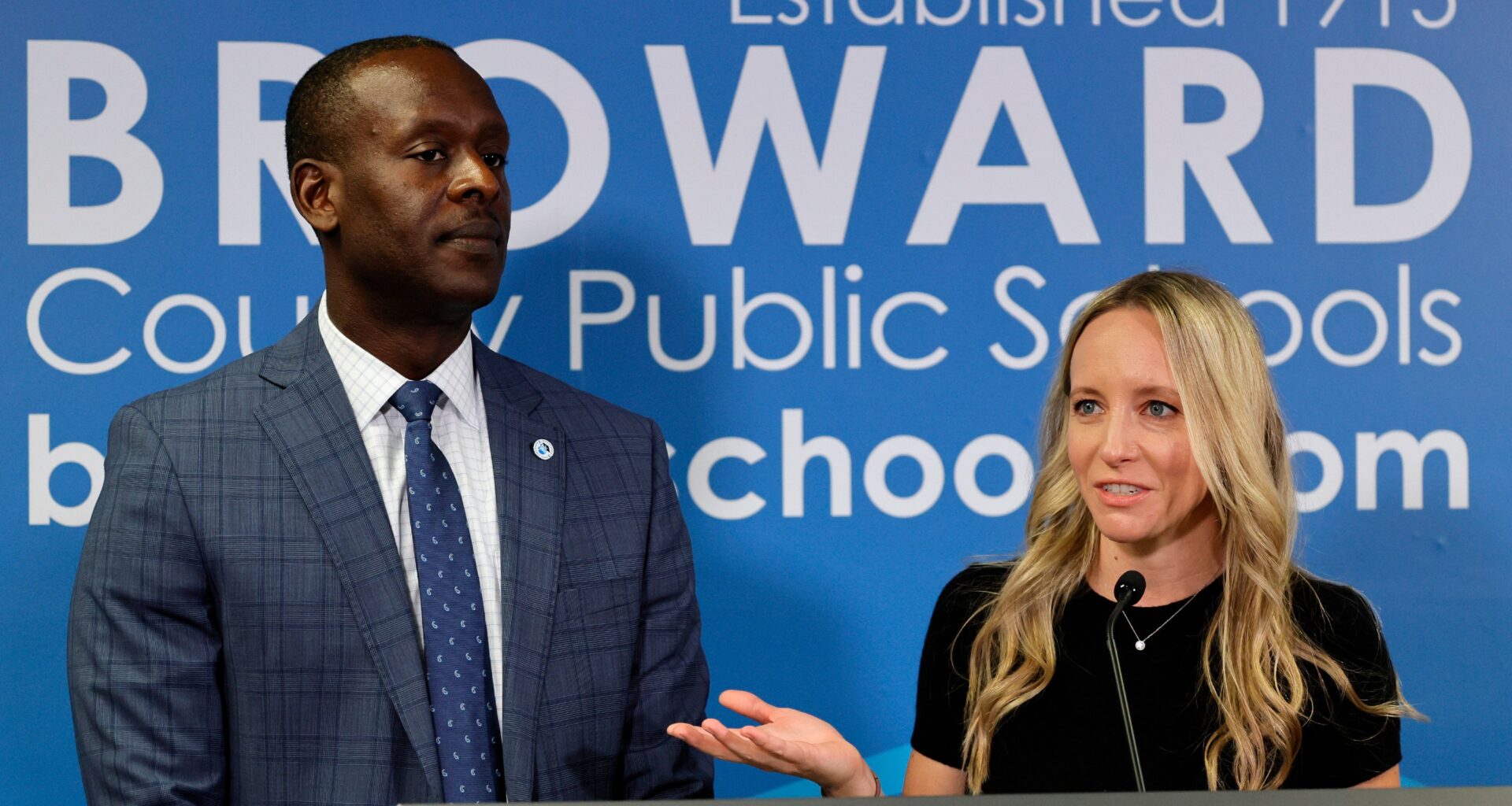
Superintendent Howard Hepburn told the South Florida Sun Sentinel he is taking steps to terminate the contract of the vendor identified and will pursue discipline, up to potential termination, for district employees named in the report.
“We can’t tolerate any violation of our procurement policies or procurement laws. It increases the fissure of mistrust between myself and staff, and between the (School Board) and staff as well,” Hepburn said.
He said “we’ll take care of these issues swiftly” and vowed to “root this out immediately.”
The 623-page report from Inspector General Carol “Jodie” Breece is the first investigation of the school district released since Breece entered into a contract with the school district in January 2025 to review allegations of waste, fraud and mismanagement. The inspector general’s office has been reviewing county and city governments since 2010, and voters authorized the expansion to the School Board through a ballot measure in November 2024.
The report concluded that the actions by some district administrators, which included accusations of misleading the School Board, were problematic but didn’t rise to the level of criminal wrongdoing, nor did they lead to a significant waste of taxpayer dollars.
Two current district employees are named in the report: Economic Development Opportunities Compliance Officer Jennifer Andreu and Matthew Bradford, an executive director of technology operations.
Bradford had been appointed to serve as the interim technology chief for the district in July, but Hepburn removed him from that role in August after the district received a preliminary copy of the findings.
Neither Bradford nor Andreu could be reached by the Sun Sentinel, but both denied any wrongdoing in responses included in the inspector general’s report.
“Over nearly 30 years in technology leadership, including more than eight years serving Broward County Public Schools, I have consistently acted with integrity, professionalism, transparency, and dedication to the best interests of students, staff, taxpayers, and the School Board,” Bradford wrote in a rebuttal to the report. “Any suggestion that I intentionally provided inaccurate or misleading information is inconsistent with my professional record and my conduct in this matter.”
Jeremy Kroll, a lawyer for Andreu, wrote that investigators failed to thoroughly interview his client. He said the inspector general’s office presented a “gross misrepresentation of what it purports to investigate” by “jumping to conclusions based only on inference, and omitting clear and convincing objective evidence.”
“Ms. Andreu has always been an advocate of open and fair competition throughout her entire career and is more than willing to submit to a polygraph examination to settle this issue,” Kroll wrote.
Andreu, who also serves on the Plantation City Council, has also been under a district-related personnel investigation since January related to a botched effort to solicit a company to oversee district construction programs, district officials have said.
That personnel investigation is still pending, district spokesman John Sullivan said.
A district vendor is accused in the inspector general’s report of potential criminal behavior.
Brian Farrell, who is CEO of the Fort Lauderdale-based Phone and Pad Warehouse, secured a $540,625 contract with the district “by submitting a forged document as part of his winning proposal and by misrepresenting his eligibility,” the report said. The report alleges that Farrell changed an executed lease by doubling the square feet of a warehouse he was renting to meet eligibility requirements.
The inspector general’s office referred the matter to the Broward State Attorney’s Office on Wednesday.
“Prosecutors will thoroughly review the investigators’ findings and all relevant information available before making any decisions,” Paula McMahon, a spokeswoman for the State Attorney’s Office, told the Sun Sentinel.
Farrell referred a Sun Sentinel reporter to a response in the inspector general’s report prepared by his lawyer, Sidney Calloway.
Calloway asked that the inspector general’s use of the word “forged” be changed to “altered.” Calloway’s letter noted its “limited purpose and scope” in responding.
“The narrow scope of this response, and the absence of any point-by-point factual rebuttal, are not, and shall not be deemed or offered as, an admission of any fact, finding, or characterization set forth in the Preliminary Report, nor a waiver of any right,” Calloway wrote.
In his five-page response, Calloway questioned whether certain allegations were applicable and why Farrell was being treated differently than district employees named in the report.
“The Report describes senior District staff who steered procurement outcomes, advanced a pretextual justification for rejecting a solicitation, and made statements to the School Board that the Report finds were contradicted by contemporaneous emails – yet none of those individuals has been referred for prosecution,” Calloway wrote.
Breece told the Sun Sentinel that the district employees’ actions didn’t meet state requirements for a crime.
“For bid tampering by a public servant, the government would have to prove that the public servant influenced or tried to influence a solicitation through disclosure of material information when it was not public or that they tried to or did change a submitted solicitation response, documents, or results,” Breece said. “We did not find probable cause for that.”
The report focused on three solicitation efforts from September 2023 to October 2024 to buy and deploy more than $40 million worth of computers and tablets. That effort included distributing about 80,000 laptops to students a year ago to take home.
The district had used Lenovo as its primary computer vendor from 2013 to 2023, and the district had the option to extend that contract another year at the same prices Lenovo offered in 2019, the report said. A district procurement agent recommended this option, estimating it would cost the district $11.3 million less than soliciting new bids at post-COVID prices.
However, some former employees told the inspector general that some district leaders wanted to stop using Lenovo.
When the district first contracted with Lenovo in 2013, it bought low-end models that triggered numerous complaints about screen size, durability and performance.
When the district renewed the contract with Lenovo in 2019, it started purchasing more durable models, and the complaints subsided.
Still, the district’s technology department opted in 2023 to seek new bids for a technology contract.
On Oct. 30, 2023, the district announced that HP had the lowest bids for both laptop and desktop computers and would be recommended as the primary vendor. Lenovo came in a close second and would be recommended as an alternate.
However, Lenovo announced on Nov. 2, 2023, that it intended to file a bid protest, or a formal challenge to the outcome of the solicitation. The company alleged that HP’s proposal didn’t meet certain required specifications and should be disqualified, the report said.
Lenovo had “a viable basis to protest the planned award to HP, a basis that potentially could have directed the award to Lenovo, disfavored by some BCPS users,” the inspector general report states.
Instead of awarding the contract to Lenovo or defending against the bid protest, the district decided to reject all bids and start over.
An executive summary asking the School Board to reject all bids in January 2024 stated the reason was that the solicitation had been limited to Windows devices, inadvertently omitting Chromebooks and Android-based tablets. But that was a “pretext,” the report stated.
School district employees “recommended the rejection of all bids upon their realization that HP’s disqualification would make Lenovo the next lowest responsive and responsible bidder. As the former procurement director put it, staff did not want to award Lenovo the contract. But they could not write that on the Executive Summary.”
The district readvertised for bids on Feb. 8, 2024, and opened them on April 24, 2024. This time, the lowest prices came from a vendor that had not previously bid, Figgers Communications Inc. The company is owned by Fort Lauderdale businessman Freddie Figgers, a politically connected technology entrepreneur who has previously served as an appointee of Gov. Ron DeSantis on the State Ethics Commission.
Figgers Communications had already identified a subcontractor to deploy the devices.
But Farrell, Andreu and one of her employees tried to persuade Figgers Communications to subcontract instead with Farrell’s company, Pad and Phone Warehouse, the report said.
District employees frequently called and texted Freddie Figgers and even showed up at his office building, which was captured by a surveillance camera. Figgers told the inspector general’s office that Farrell also called him multiple times, with one conversation that “was along the lines of ‘if you want this, you need to hire me,” the report said.
Figgers said that Farrell knew Figgers Communications was the low bidder even though the results had never been released publicly. As a result, the inspector general’s office concluded that someone in the district had improperly shared price information with Farrell, violating a cone-of-silence policy that restricts district contact with vendors while a solicitation is still active.
Figgers refused the request to add Farrell’s company as a subcontractor, the report said. On July 23, 2024, Andreu persuaded the School Board to reject all bids, citing “errors and missteps.” She cited the district’s omission of a form mandated by state law but not included in the solicitation. She also said she wanted to switch to a solicitation where vendors are chosen not by price but by a variety of qualifications.
Some School Board members were suspicious, with then-Board member Daniel Foganholi questioning whether there was bid rigging.
“It feels like we’re trying to funnel a specific vendor and that’s why we keep going out to get things right,” Foganholi said at the July 2024 meeting.
The School Board agreed to reject all bids, with Foganholi and two other board members voting no.
“School Board members’ concerns about the timing of the recommendation to reject all bids and overall questions on access to bid results were well-placed,” the report states.
Kroll, Andreu’s lawyer, disputed the allegation that his client tried to steer business toward Farrell’s company. The report said that Andreu and Farrell had worked together in Miami-Dade and Palm Beach County, which is not accurate, Kroll wrote in a response.
“Ms. Andreu worked for Miami-Dade County Public Schools for 27 years and has never worked in Palm Beach. Mr. Farrell, to Ms. Andreu’s knowledge and belief, has never worked for Miami-Dade County Public Schools,” Kroll wrote. “Therefore, they have never ‘worked together.’ The report appears to imply some sort of preexisting, insidious relationship between Ms. Andreu and Mr. Farrell where none exists.”
In the third effort to hire vendors, Andreu issued two requests for proposals, one for the devices and a separate for deployment.
This time, Figgers did not bid. HP was recommended for a contract to issue the devices while Farrell’s company, Pad and Phone Warehouse, was recommended for the contract for deployment. But the report said Farrell submitted false information to receive this bid.
The solicitation required that each proposer submit proof that it had maintained a warehouse of at least 10,000 square feet for at least a year.
“While Mr. Farrell did have a lease agreement for a 4,800 square foot warehouse, he submitted to BCPS a lease agreement that showed he had a 10,800 square foot warehouse, when he in fact did not,” the report said.
According to the inspector general’s report, Farrell may have committed two third-degree felonies and one second-degree misdemeanor by submitting false information.
The report makes a number of recommendations, including setting strict restrictions on sharing vendor bids and information with others, updating discipline rules to exclude people in an employee’s chain of command from investigating policy violations, ensuring procurement staff receive annual training, updating district policy to prohibit district employees from knowingly making misrepresentations at School Board meetings and ensuring district staff verify that vendors meet all requirements.
The inspector general’s office asked the district for progress on addressing these recommendations by Dec. 29.
The issues with the computer solicitations resulted in delays in implementing a program to issue laptops to students. The school district planned to award the technology contracts to HP and Phone and Pad Warehouse at a meeting on May 13, 2025. But Hepburn removed the requests from the meeting that day, saying he had received complaints and needed to conduct a review. The next month, the school district confirmed that the Office of Inspector General was reviewing the matter.
Hepburn told the Sun Sentinel on July 24, 2025, that while the inspector general’s investigation was ongoing, his office had conducted its own review of the technology procurement and didn’t see any problems. The School Board agreed in September 2025 to approve the technology contracts.
“We’ve reviewed everything with a fine-tooth comb from the start of the process to the end of the process, and we haven’t found anything of concern,” Hepburn said during the 2025 interview.
Asked on Thursday how the district’s conclusions could be so different from what the inspector general found, Hepburn said he didn’t have the same tools.
“We looked at the procurement documents from solicitation to proposal, to scoring and ranking, and we didn’t see any red flags,” Hepburn said. “Of course, that’s why we depend on the inspector general. They have subpoena power and more investigative processes that can strengthen the detail of a review.”
Board Chairwoman Sarah Leonardi told the Sun Sentinel the district takes the issues raised by the inspector seriously.
“I have confidence and look forward to the superintendent taking swift action to ensure we maintain public trust,” she said. “We will work quickly to respond to the concerns raised and reinforce existing policies and processes. We strongly believe in swift accountability and support the superintendent’s authority to respond appropriately.”