
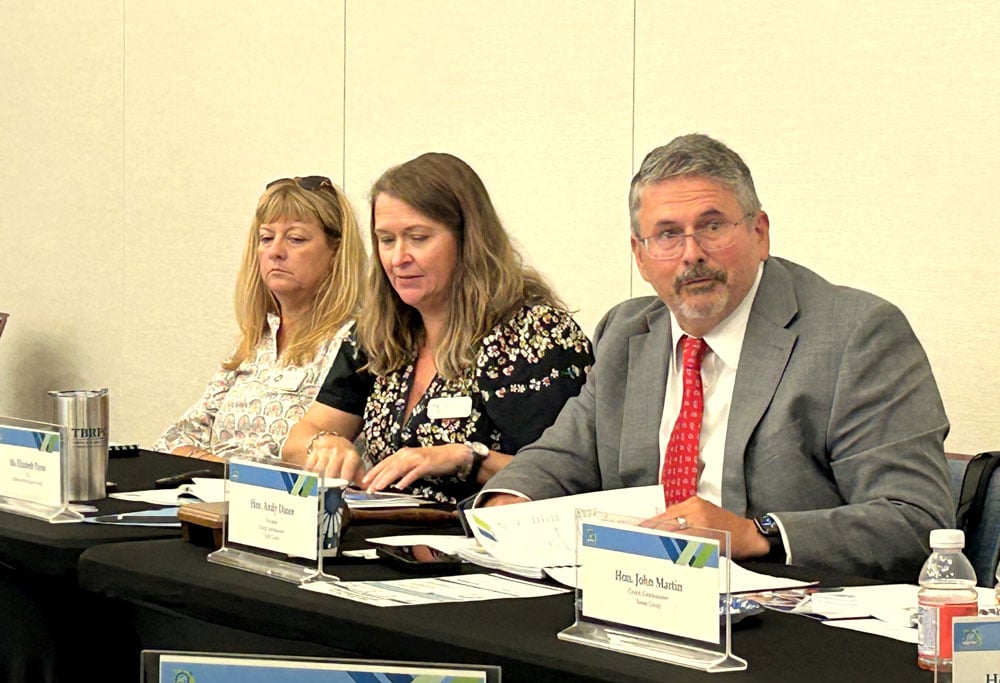
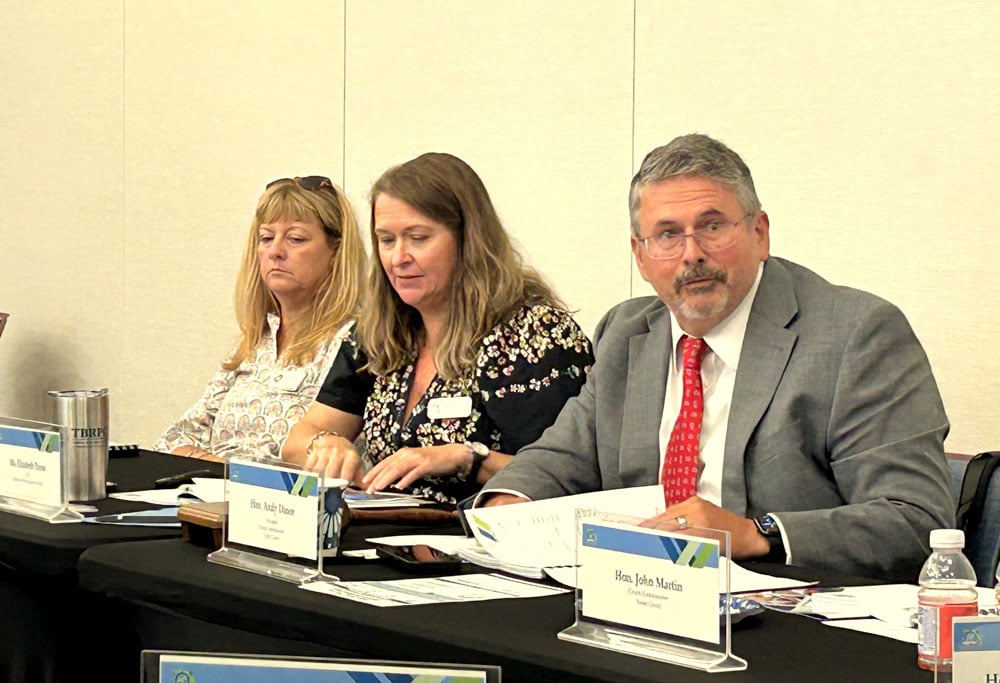
Flagler County Commissioner Andy Dance, right, was newly installed as the Northeast Florida Regional Council’s President during the organization’s board of directors meeting on Thursday, Oct. 1 at the Nexus Center in Bunnell. Far left is NEFRC Secretary/Treasurer and Clay County Commissioner Betsy Condon, and at center is Beth Payne, NEFRC’s Chief Executive Officer. (© FlaglerLive)
Flagler County Commissioner Andy Dance made what might seem to be a mundane observation during a public meeting Thursday at Flagler County’s Nexus Center in Bunnell.
“Here in Flagler County, most people leave the county to work,” Dance said.
Dance wasn’t speaking at a county commission meeting. He was addressing the board of directors of the Northeast Florida Regional Council–his first meeting with the organization as its president. He’d been first vice president over the past 12 months. The council held its monthly meeting in Bunnell in his honor. It normally meets in Jacksonville.
Flagler workers “don’t stay in the county,” Dance said. “That presents a lot of challenges regionally: infrastructure, impacts on roads, utilities, energy, the public services here.”
Enter the Northeast Florida Regional Council, established in 1977 and representing Baker, Clay, Duval, Flagler, Putnam, Nassau and St. Johns counties, as well as 25 cities, among them Palm Coast. The council is composed of a 35-member Board of Directors consisting of two-thirds locally elected county and municipal officials, and one-third gubernatorial appointees. The Council also has four non-voting ex-officio governor’s appointees representing state and regional agencies.
Among NEFRC’s chief concerns are economic and community development, emergency preparedness, resilience to climate-related hazards such as rising sea levels, and building a stronger regional healthcare system.
Thursday’s meeting, attended by 12 NEFRC board members, two ex-officio members and Flagler-area officials and administrators, included discussion of county-imposed data center moratoriums, NEFRC’s newly awarded U.S. Environmental Protection Agency Brownfields Assessment Coalition grant (an early step in helping communities revive and reuse contaminated “brownfield” areas), an update on the emergency and disaster preparedness of the Healthcare Coalition program, which NEFRC manages for 18 counties in North Florida, a military installation readiness review, and discussion of the NEFRC itself, which Northeast Florida Regional Council Chief Executive Officer Beth Payne characterized as “the ‘case for NEFRC’ isn’t widely understood.”
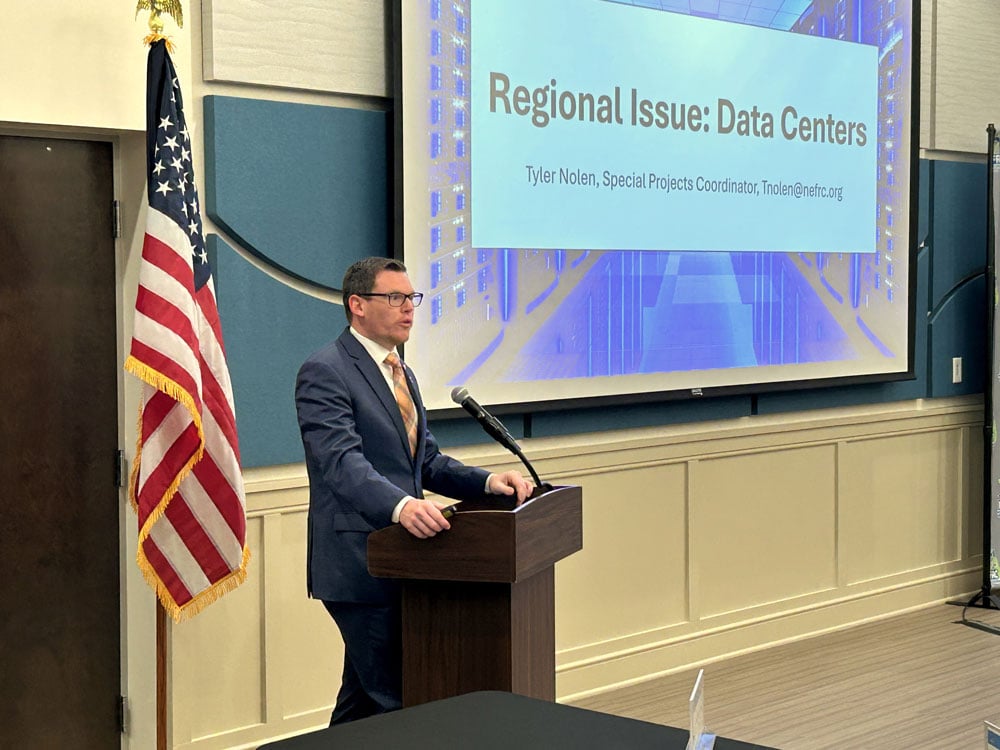
Tyler Nolen, NEFRC’s Special Projects Coordinator, presented an update on data centers to the board during the Oct. 1 meeting at the Nexus Center in Bunnell. (© FlaglerLive)
Dance made that case during his first presentation as NEFRC President. Though he said he was speaking from a Flagler perspective as the county transitions “from a small county to a medium county” in terms of population growth, he said Flagler’s position is mirrored in the other NEFRC localities.
As Dance’s PowerPoint noted that Flagler County’s population was 49,832 in 2000, then 95,696 in 2010, an estimated 140,360 in 2025, and a projected 158,009 in 2030, he added: “Growth changes more than population. It changes the scale and complexity of local government. Growth creates challenges beyond our (county) borders.
“Water obviously doesn’t know boundaries. It goes where it wants to go. We have to look at some of these issues from that scale – watersheds, aquifers, drainage patterns, flooding. All those things cross boundaries.”
Growth creates “interconnected demands” on roads, utilities, energy and public services, he added. “Storms, flooding and beach erosion cross boundaries, even when solutions are implemented locally.” Development and increases in commuters affect regional travel patterns.
Dance, a Palm Coast landscape architect, noted “My roots are in the environmental side,” and added that “Development patterns affect neighboring communities, natural resources and wildlife corridors.
“So, in the center of all this is the Regional Council. Growth compounds demands. Regional cooperation helps us respond smarter. We can’t do our job in a vacuum.”
The council’s methods, according to its website, include “strategic communication, stakeholder collaboration, and comprehensive analysis to develop effective solutions” for communities in its region.
Tyler Nolen, NEFRC’s Special Projects Coordinator and Local Emergency Planning Committee Coordinator, presented an update on data centers, an issue the board has been discussing for months. The discussions inspired Dance to initiate what turned into a year-long moratorium on data-center applications in Flagler County. There were and are no such applications in the pipeline.
“In Northeast Florida, pretty much every one of you in the room has passed a moratorium on data centers in some shape or form,” Nolen said. “Flagler County is a little bit different – its moratorium only applies to unincorporated areas.” That’s true, though Palm Coast is on the cusp of approving strict new language in its Land Development Code, or LDC, that would place very high hurdles in the way of data center applications. In a sense, Palm Coast would be ahead of the counties, which imposed their moratoriums to give their staffs time to develop land development code amendments. So Palm Coast is almost there already.
Large-scale data centers have drawn concerns due to their heavy water use, noise pollution and strain on the power grid.
“The purpose of the moratorium is to temporarily pause all new data centers, regardless of size, while we determine what the regulations are that are appropriate,” Dance said during an August Flagler County Commission meeting.
At Thursday’s NEFRC meeting, Dance said Flagler’s moratorium “was really passed as a planning exercise because under our current LDCs the options weren’t great on where they could apply. So, we needed time to analyze and plan the LDCs for appropriate locations. The last thing we need is Tallahassee giving us narrow regulations.”
Palm Coast City Council member Charles Gambaro was attending his last NEFRC meeting as a board member. He is stepping down from the council at the end of his appointed term in November after an unsuccessful bid for the U.S. House (he lost to Randy Fine in the August Republican primary).
A U.S. Army Reserve Brigadier General, Gambaro said of data centers, “If you scan out on a national scale, it is a national security issue, if we look at our peer adversaries.”
Gambaro added that “There are plenty of places where you can put them where they’re not going to affect communities. Big companies that want to come in and put in data centers, they have options. They don’t have to necessarily put them smack dab in the middle of large populous areas. But for other projects that help global interconnectivity, those are things that have to be carefully considered. That’s why we’ve taken the approach that it can’t affect water, it cannot affect power, it can’t affect noise levels. It’s right to study this. It’s coming whether we like it or not.”
NEFRC board member John Martin, a Nassau County Commissioner, said, “People ask all the time, ‘Why don’t you just ban them?’ There are several counties across the state that have done that, but that’s an exercise in futility.”
Bans on data centers will face legal challenges eventually, “and we will lose the legal battle,” Martin said.
Nolen told the board that “It has been very interesting to hear about the size and scope of these facilities. When you say that phrase ‘data center,’ I think the first thing that comes to mind is this ginormous facility that has hundreds of thousands of square feet. What we have learned through this process is that there are places known as data centers that may occupy a closet space. Computers have become so efficient that we’ve watched them grow from massive pallet-based items to a closet rack.
“How do we define data centers? What size are we talking about? That’s the bigger discussion.”
–Rick de Yampert for FlaglerLive
