
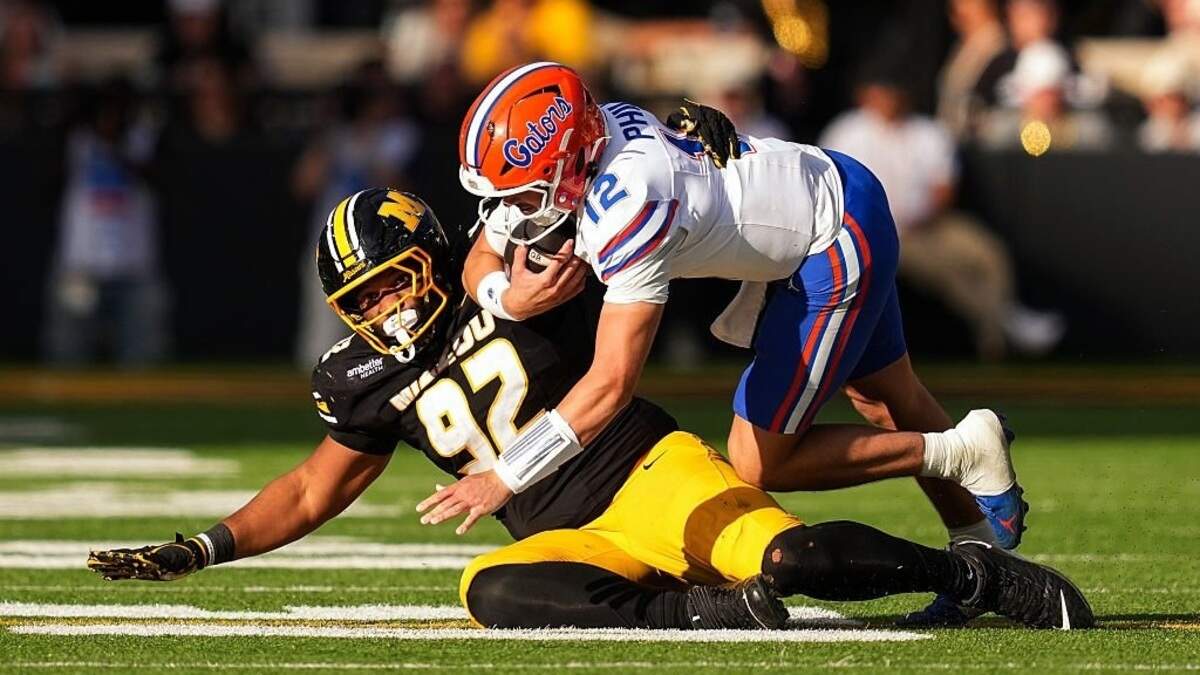
Late in the third quarter of an already rough afternoon, Missouri running back Jamal Roberts, filling in for All-American Ahmad Hardy, disappeared on his 18th carry of the day. When he reappeared, this time at Florida’s 2-yard line, some 77 yards later, Florida coach Jon Sumrall looked confused.
That Missouri man entered into a scrum at the line of scrimmage. Then, unlike anything that happened in a mystical first month for No. 8 Florida, Roberts kept running, all the way to 211 yards.
After a September of inspiration, the Gators (4-1, 2-1 Southeastern Conference) swallowed (or maybe choked on) a dose of reality via No. 25 Missouri (4-1, 1-1 Southeastern Conference), ultimately in the form of 45-17. Everything the Gators had assembled and rebuilt in Sumrall’s first days proved weak against an SEC foe of true depth, especially one with a coach, Eli Drinkwitz, who was within the pool of rumored candidates for Florida’s job, only to be met with public outcry.
Given this was such a deluge, a few of the most notable points of concern might be an appropriate rain gauge.
Florida’s Heisman-contending running back, Jadan Baugh, spent the second half on the sideline. No, he wasn’t hurt. Worse, he tallied 13 yards on 12 carries and wasn’t worth the injury risk of continuing to play. While leading the country with 11 touchdowns and holding at second with 600 yards, he averaged a gaudy 7.2 yards per carry. Saturday he averaged 1.1 yards per carry.
On the opposite sideline, Missouri’s Roberts and quarterback Austin Simmons also didn’t play most of the fourth quarter. Roberts wound up with three second-half touchdowns. This was a 10-10 game before the final two and a half minutes of the first half. Simmons was no slack, either — 23 for 30, 340 yards, two touchdowns cementing him among the SEC’s finest new starters. Their first three-and-out came with seven minutes in the fourth quarter.
“You marry up the identity that Drink’s created over time there with how they play … they’ve had an identity of running the football,” Sumrall said. “Then [on] the other side and I think they got really good players, too. … I think they play the game the way it’s meant to be played. A lot of respect for how they play the game.”
Florida’s Aaron Philo, who had largely hid behind a country-leading running game this season, found himself consistently behind the sticks. Without said run, this served as an eye-opener. He still might need some time to find his feet, finishing with 197 yards.
Which also seems an apt analysis for Florida as a whole. The defense, which entered this week giving up 398.3 yards per game, 83rd in the country, allowed 560. The offense, totaling 325 of its own, lacked the juice that’d made offensive coordinator Buster Faulkner the talk of the sport. This had, quite simply, a frying pan-like feel — Florida hit over the head with some mortality. In the Show Me State, the Gators were shown.
What happened against No. 4 Ole Miss, Sumrall preached before the game, was only last week. As Florida continues its ascent back into the image of CFP contention, its ability to focus on the next test was the new challenge. In their fnext exam, the Gators looked anything but prepared.
“I’m not celebrating anything. Nobody in our building should be celebrating anything,” Sumrall said during the week. “We’re in for a rude awakening. We’ve got to get ready to play a really good football team on the road.”
They weren’t. Set against the backdrop that no 9-3 at-large team has ever made the Playoff, Florida’s next exam will be one of response. A year ago, under Florida’s previous staff, the Gators shuttered when staring down a midseason stretch of ranked opponents.
This year: South Carolina, next Saturday. No. 1 Texas, the one after. No. 2 Georgia, two weeks later.
For Sumrall, there’s little confusion about that.