
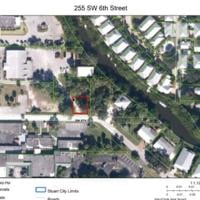
STUART – A former city commissioner’s intent to hamstring a hotelier’s plans to build a Fairfield Inn downtown between Federal Highway and 6th Street backfired a year and a half later when a circuit court judge granted him a new hearing because the Commission majority failed to comply with its own city code in its decision for denial.
Judge Marsha Ewing’s decision had its genesis on Feb. 10. 2025 when the then Commissioner majority led by Christopher Collins balked at rezoning a 0.33-acre parcel from urban waterfront to urban highway. That parcel and two others were already combined under a unity of title requested by city staff, and hotelier Nimesh Patel needed matching zoning to avoid conflicting developmental regulations. After a motion for approval of the rezoning by Commissioner Eula Clarke died for lack of a second, then Vice-Mayor Collins tried to convince Patel to pursue a conditional use, which he refused. Collins then made a motion for denial, which was seconded by Commissioner Sean Reed. When City Attorney Lee Baggett advised them to rephrase the motion to approval and then deny it to make it easier for Patel to reapply, Collins refused. That motion passed 3-2, with Commissioners Clarke and Campbell Rich dissenting.
Collins resigned from the Commission at the end of April 2026 to make a successful bid for the County Commission. His replacement Merritt Matheson has shifted the Board majority to a more pro-business stance since the August election. Fast-forward to Sept. 28 of this year and Baggett’s explanation as to why the Commission was having to repeat the 2025 quasi-judicial hearing.
“The applicant filed a lawsuit in Martin County challenging the Commission’s denial of the owner’s rezoning application, [so] we hired an outside lawyer,” he said. “It was in the appellate division of this local circuit court, so it’s actually like doing an appeal. Circuit Court Judge Ewing issued an opinion on Dec. 19, 2025. Her opinion found the City Commission parted from essential requirements of law and remanded the cause back to the Commission for another hearing.”
Baggett then read from the applicable section of the city’s land development regulations to emphasize which part the former Board majority had failed to comply with.
“In the event of a determination of not in compliance, the application shall be rejected, and the specific reasons for such determination with reference to the requirements of this code shall be stated in the resolution,” he read. “So, we failed to put the specific reasons for the denial in our resolution. This is going to be basically a redo of the second reading. Again, we need to make sure we are in compliance.”
Stuart Development Director Jodi Kugler subsequently provided a brief recap of the request, which revealed that the former Commission majority had ignored the recommendations of both the city’s Local Planning Agency and Community Redevelopment Board.
“I’m presenting an amendment to the official zoning atlas to change the Urban Waterfront to Urban Highway Zoning Designation at 255 S.W. 6th St.,” she said. “The parcel is currently vacant [and] within the Urban Overlay Zoning District and Community Redevelopment Area. This petition did go to the LPA on Jan. 16, 2025 and to the CRB on Feb. 4, 2025, [which] forwarded a unanimous recommendation of approval to the City Commission. At this time, staff is still recommending the Commission approve rezoning the subject parcel to Urban Highway.”
A representative of Patel, Jarod Gaylord, also provided a presentation, emphasizing that one of Collins’ primary reasons for denial – the loss of Urban Waterfront-zoned land – didn’t even apply.
“The entire site is about 1.58 acres, but we’re requesting 0.33 acres to be rezoned,” he said. “Urban Waterfront does have a requirement for a vista. This would not accomplish this goal because it is not along Frazier Creek. You would have to be looking to the properties to the east to see it. So, keeping this as Urban Waterfront to create a vista is absurd. In April of 2026, this Commission decided to have a second reading [again], which brings us here today.”
Commissioner Sean Reed was the first Board member to pose a question afterward and the only member of the former Board majority present due to Commissioner Laura Giobbi’s absence.
“I’ve got a question Jodi on the building height,” he said. “It mentions 45 foot, but is there anything that stops this applicant from doing administrative variances to exceed this height?”
“This really doesn’t pertain to this particular application,” Kugler replied. “We’re only asking for the rezoning. They would be bringing in a development plan that would meet the requirements. To answer the question, an administrative variance does not allow higher height without City Commission approval.”
“Is there any building in the City of Stuart that exceeds 45 foot besides the hospital?” Reed prodded.
After Kugler informed him that the Atlantic Point Marina had come in at 60 feet through a conditional use approved by the Board, City Manager Michael Mortell – whom Reed had voted to fire last October as part of the old majority – added more details. The new Commission majority had rehired him two weeks prior.
“Sterling Tower is more than 45 feet,” he said. “The code is 45 feet of habitable [space]. The code allows for up to 59 feet of air-conditioning ducts or whatever the attic space is, but it can’t be habitable.”
After further discussion between the Board, staff and the applicant, the City Commission voted to approve the rezoning 3-1, with Commissioner Reed dissenting.