

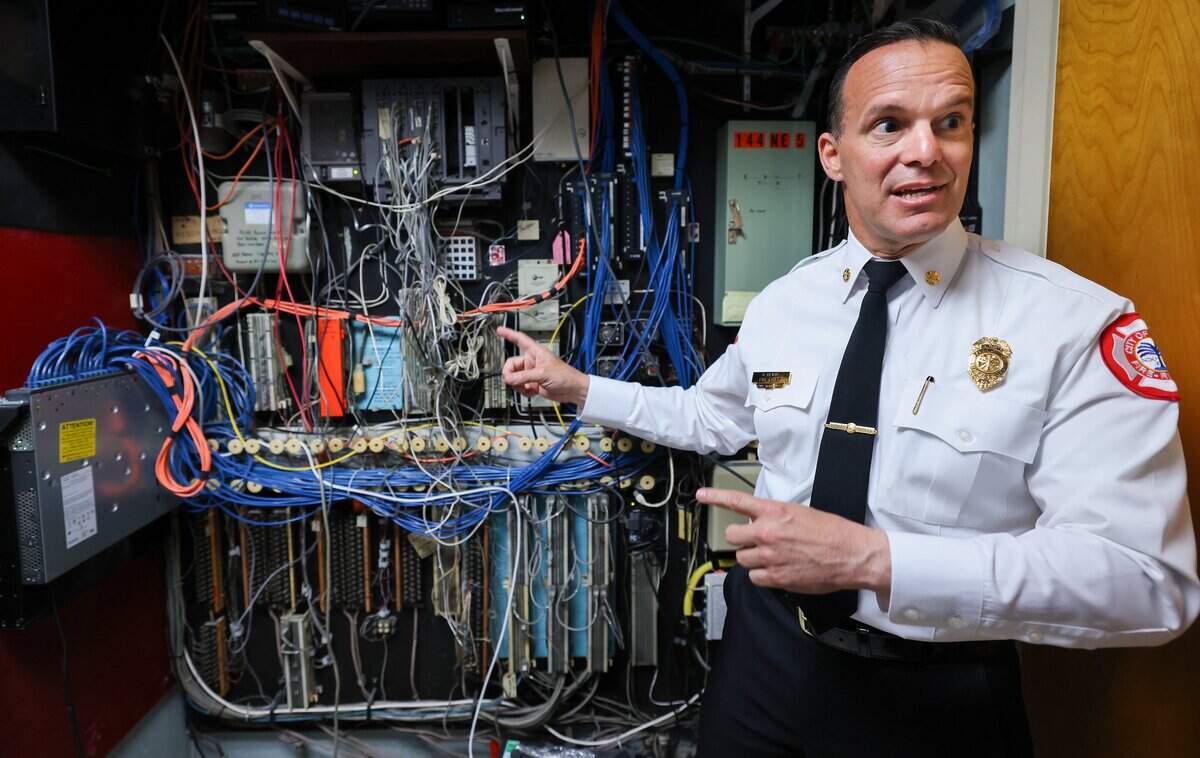
 Miami Fire Chief Robert Hevia points to an outdated electric closet that contains important communication and other devices essential for public safety at Fire Station 1, built in 1964, where mold, water intrusion and outdated equipment are hampering effective emergency response. Carl Juste cjuste@miamiherald.com
As Miami residents review the proposed $450 million “Safe and Ready” general obligation bond on the November ballot, they should know the full cost of signing a blank check for a plan that needs a lot more work.
What’s on the ballot promises to fix our city’s public safety infrastructure without raising the debt millage rate. Mayor Eileen Higgins assures us that this massive borrowing package fits neatly within our existing bonding capacity.
But there’s a real cost to future taxpayers paying a huge tab that should be managed through disciplined, day-to-day budgeting. We agree with the mayor about upgrading public safety facilities. But we firmly disagree about this half-baked plan. On Nov. 3, vote “no” on Referendums 1 and 2.
Referendum 1’s headline figure of $450 million is inherently misleading because, when accounting for interest payments and issuance costs over the life of the bond, the true financial burden approaches $800 million.
The city administration’s assurance that the bond will cause “no increase to the current capital projects debt millage rate” is a classic municipal shell game. Even if the millage rate remains flat, approving this bond means locking in hundreds of millions in ad valorem property tax revenue that could otherwise be used to lower the tax burden on middle class families, fund pressing operational needs, or invest in other infrastructure like flood control.
Rather than auditing current expenditures or reallocating existing revenues to prioritize police and fire facilities as promised, the administration has chosen the path of least resistance — kicking the financial can down the road. More than two-thirds of the proposed borrowing, $305 million, is allocated to a public safety headquarters that remains at the conceptual stage. Voters are being asked to approve funding before anyone knows the real cost.
At the same time Miami is considering decades of new debt, Amendment 3 could substantially reduce the city’s property tax base. If passed by Florida voters, Amendment 3 will radically reshape property taxes by aggressively expanding the homestead exemption to $150,000 in 2027 and $250,000 in 2028, while cutting the annual assessment cap on non-homestead properties (like rentals and commercial spaces) from 10% down to 5%.
City officials estimate potential annual revenue losses of over $45 million in 2027 and 2028. For Miami’s property owners, particularly condominium residents already reeling from skyrocketing insurance premiums and mandatory state-mandated structural reserve requirements, this bond represents yet another layer of fiscal liability.
Miami’s own Finance and Audit Advisory Committee is charged with reviewing proposed debt financing. Yet, the $450 million proposal reached the ballot without review. As well, voters won’t know the additional long-term costs to staff and maintain these new facilities when they are being asked to decide.
Referendum 2 offers comfort, not true oversight. Its proposed advisory board would be appointed by the officials who run the projects and would start work only after the borrowing is approved. It could never ask whether the bond is necessary, properly sized or affordable. Our Miami Forever Bond board shows the limits of that model: it tracks spending but has no power to investigate waste.
While the city claims individual tax bills will not see an immediate rate hike specifically for this bond, any increase in a property’s assessed value will automatically compound the dollar amount dedicated to servicing this massive debt. Relying on continuous property appreciation to cover long-term debt liabilities is a precarious strategy that shifts the burden of municipal mismanagement directly on the backs of local homeowners.
True civic leadership requires making difficult choices within the confines of a standard operating budget. Funding core public safety infrastructure through long-term debt, rather than operational efficiency, is the hallmark of a government unwilling to trim bureaucratic waste first.
Our firefighters and police officers deserve buildings that work. Our residents deserve a plan that has been vetted before they agree to put themselves and their children in debt. Vote no on 1 and 2, and demand City Hall come back with one.
Christine King and Damian Pardo represent Districts 5 and 2, respectively, on the Miami City Commission.