
ORANGE COUNTY, Fla. – Artificial intelligence is already finding a place in Orange County classrooms, but new Florida requirements are poised to change how schools decide which tools students can use — and whether parents allow their children to use them at all.
Orange County Public Schools is working to update its policies after the State Board of Education adopted Florida’s AI rule on Sept. 16. The rule now contains 18 requirements, expanded from 15, and gives school boards until July 1, 2027, to adopt and implement policy changes.
Among the most significant changes is a requirement for parental consent when students directly use certain AI instructional tools.
“If the student will be directly using the tool,” parents must be given the option to opt their child when AI instructional tool is used in class, according to materials OCPS presented during an Oct. 6 School Board work session. Families that do not opt in must be offered a non-AI instructional tool that is “substantively comparable” in instructional quality and access.
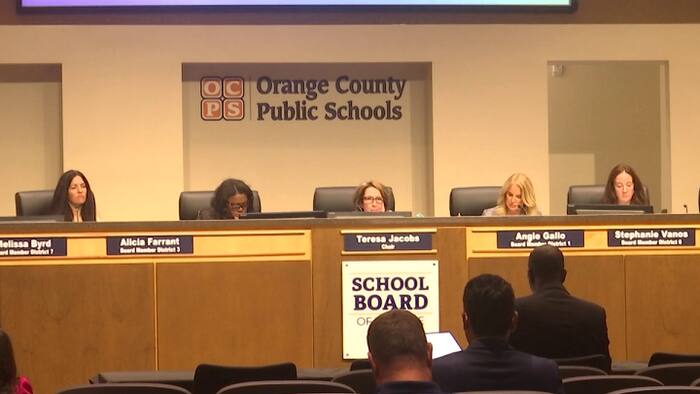
“Now we have to figure out how to make this happen in the deadline,” Gallo, an OCPS board member, said during the discussion.
Some parents said the consent process itself could become burdensome.
“I can’t keep up with the amount of messages and opt ins,” one parent said.
She also questioned how schools would balance AI use with limited classroom time.
“Adding that into the mix is like, ‘Oh great, let’s investigate that’ … but if it requires five more minutes out of instruction time, then what are we sacrificing?” she said.
The rules also establish new safeguards around how artificial intelligence can interact with students. AI designed or configured to meet students’ social or emotional needs is prohibited, as are systems that simulate friendship or companionship or use relationship-building features intended to encourage continued interaction. Instructional tools also cannot conduct undisclosed behavior monitoring, social scoring or psychological profiling.
One parent whose child will be attending OCPS in a few years said schools should teach students how to use AI while continuing to develop independent judgment and critical-thinking skills.
“I want my daughter to be able to critically think and [know] when is a good time to use AI and understand if this is an actual beneficial resource,” she said.
That concern is reflected in other portions of the rule. District materials say policies must address academic integrity and authorship verification and, when appropriate, require students to demonstrate mastery without AI. The requirements also call for training for teachers and administrators and human review when AI contributes to decisions involving areas such as grading, evaluations, promotion, discipline, threat assessments, counseling and referrals for exceptional student education. “AI may assist. A person must decide,” the district’s presentation says.
OCPS officials said much of the district’s existing AI policy already addresses issues including approved tools, protected data, academic integrity and human review. But the district identified areas that must be clarified or expanded, including mandatory training, additional decision-making safeguards and restrictions involving commercial AI models.
The changes leave district leaders with practical questions about implementation — including how schools will manage different experiences for students whose parents opt in and those whose parents do not.
For families, the debate is increasingly moving beyond whether artificial intelligence belongs in schools. The question now is under what conditions students should be allowed to use it — and how schools can embrace emerging technology without allowing it to replace the human judgment, instruction and critical thinking at the center of education.
Copyright 2026 by WKMG ClickOrlando – All rights reserved.