
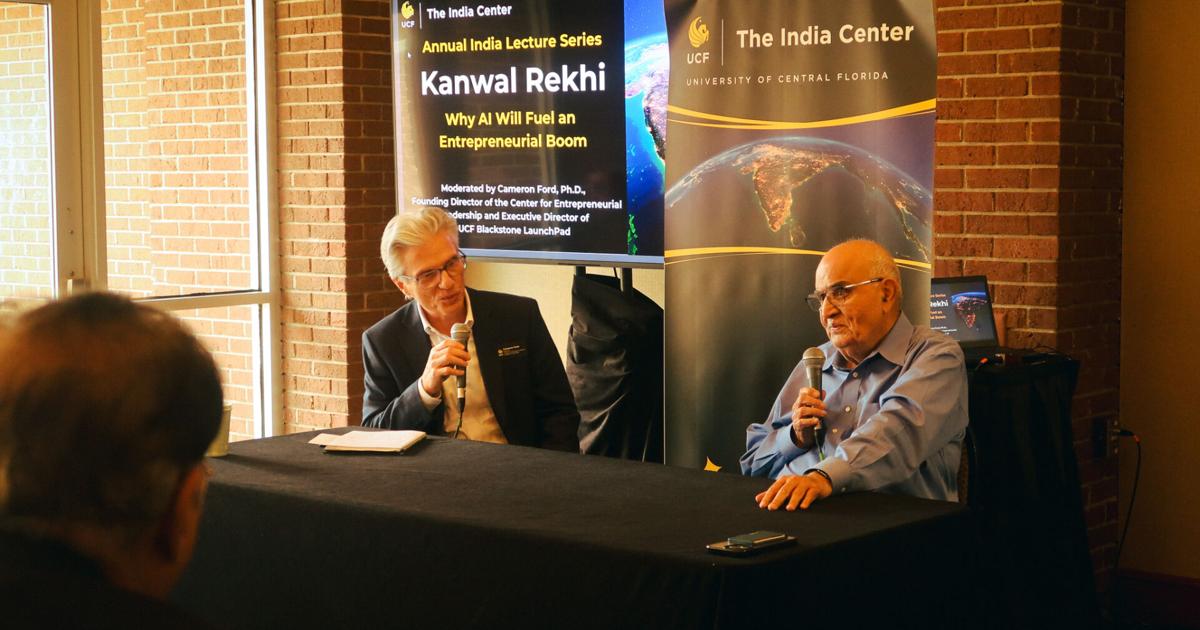

(Left to right) Dr. Cameron Ford and entrepreneur Kanwal Rekhi address attendees about artificial intelligence during a panel discussion on Wednesday at the Live Oak Event Center. The India Center invited Kanwal to share how automation can spark historic startup growth by making company creation more affordable.
Courtesy of Fabian Arcila
A crowded Live Oak Event Center audience gathered Wednesday to hear Silicon Valley entrepreneur Kanwal Rekhi discuss artificial intelligence and the future of startup creation at The India Center’s Annual India Lecture Series.
“Tools don’t make the business,” Rekhi said. “Tools are a means to an end. In the end, it is a customer problem that you’re solving.”
Rekhi said the key for emerging entrepreneurs was recognizing that generative software and algorithms could not substitute for human instinct and strategic positioning.
Sachin Budda, junior finance major, said he learned about the talk through his coursework and felt drawn to attend.
“I saw it posted on my class page, and you know, I’m Indian, so I saw some gravitation towards it,” Budda said. “I was like, ‘You know what? Why not?’ I just rushed over here.”
Budda said hearing about Rekhi’s career gave him a clearer perspective on career resilience and using new technologies deliberately.
“Although AI is super impressive when it comes to academics and studying, learning for your tests right now in college, it’s super helpful, but it’s interesting to see how it will play off in real life, especially in the work environment and in entrepreneurship,” Budda said.
The India Center hosted Rekhi, cofounder of Excelan and seasoned venture capitalist, to examine how modern tools lowered the operational costs of launching companies while expanding access to entrepreneurship. Dr. Cameron Ford, founding director of the Center for Entrepreneurial Leadership and executive director of the UCF Blackstone LaunchPad, moderated the discussion.
During the conversation, Ford noted that technical disruptions had consistently lowered the minimum team sizes required to launch viable companies over the past three decades. Ford asked Rekhi if modern artificial intelligence served as a uniquely high leverage tool for startups compared to past eras.
Rekhi agreed, explaining that while large legacy corporations moved slowly due to bureaucratic inertia, small startups could use automated software to quickly test prototypes and execute concepts with fewer resources.
“Oh, absolutely, AI is a good mile stock, you know, Rekhi said. “AI is a way to execute your vision.”
However, Rekhi warned students not to let technical software become their venture’s sole value proposition.
“Do not let technology be the only differentiation in your mind, because everybody has that,” Rekhi said. “Your advantage is you.”
Andy Pham, senior health sciences major and federal work-study student at The India Center, helped organize and coordinate the event setup.
“This is probably the most amount of people I have ever seen at an India Center event,” Pham said. “We got a very common speaker to come in from California, so I think it went very, very successful, and it seems like a lot of people were engaged.”
Ed Barreto, senior international relations major and research assistant at The India Center, said the lecture drew an engaged group of attendees who participated actively during the audience discussion.
“The turnout was, as Andy said, probably one of the highest that we had for the India Center,” Barreto said. “We had a good discussion between the speaker and the students, which isn’t always the case. Today, they actually engaged with the topic at hand.”
Pham said student engagement regarding resource use and societal impact was one of the lecture’s most striking moments.
“The most interesting and surprising thing I heard today was when students questioned the environmental impact of AI,” Pham said.
Barreto said he hoped the turnout would encourage students to continue attending international and cross-cultural programming across campus.
“The more the students show up, the better it is for us and it is for them,” Barreto said. “So it’s a win; the better the event goes, hopefully more students come back for more.”